|
|
|
|
|

|
|
Rotor Germany Tree
Enigma cipher machines
The Enigma cipher machine is arguably the most famous
cipher machine in the world,
not least because of the important role it played
during World War II (WWII), while at the same time
it was broken at an uprecedented scale.
Based on the principle of the rotor machine,
the text is scrambled by electrically wired rotors.
This page provides an index to the various models,
accessories, simulators, manufacturers,
patents and related subjects.
Please note that there is no such thing as the Enigma.
Enigma is the brand name of a series of cipher machines,
developed before and during WWII,
some of which are compatible with each other,
and some of which are not.
If your are interested in the history of Enigma,
you might want to check
the Enigma Family Tree,
the Enigma Timeline, or
the Enigma Glossary.
Before and during WWII, Enigma was the inspiration for many
other designs of rotor cipher machines, such as the British
Typex and
the American SIGABA.
And even after the war, some cipher machines were based on the
same principle, such as the American KL-7,
the Russian Fialka and
the Swiss Nema.
We are always interested in acquiring new equipment, documents
and other artefacts for the museum.
If you have something to offer, please contact us.
➤ Enigma history
➤ Enigma family tree
|
|
|
|
Enigma is arguably the most well-known implementation of
the rotor-based cipher machine. As its patents were registered in various
countries,
many designs of similar machines were based on it.
Many of the later machines, including the machines that were used
by the Allied Forces during and after WWII,
were largely based on the design of the Enigma.
Here are some examples:
|
|
Many attempts have been made to describe the working principle of
the Enigma machine on the internet. Some of these are correct, and
some are not. This is yet another attempt.
|
Several years ago, when creating the Enigma-E,
an electronic replica of the Enigma,
we had trouble understanding the precise
operating principle of the Enigma machine;
something that is vital for a reliable simulation.
At the time, most websites only gave a rough description
of the machine and important details were omitted.
We then created out own description and made it publicly available.
➤ More information
➤ Wheel wiring
If you are interested in building your own electronic Enigma machine,
you might want to learn more about the Enigma-E
self-build kit.
It is compatible with a real Enigma machine.
|
|
|
A great animation on how the Enigma works is available below.
It was created in December 2021 by Jared Owen, and features Enigma I —
the most common Enigma model that was used by the German Army during
WWII. For more great
animations, visit Jared Owen's YouTube channel [3].
|
|
|
The story of cracking the Enigma code in 2 hours
|
|
|
|
Below is a two hour documentary that explains the full story of how the
Enigma cipher machine was broken at Bletchley Park during WWII.
This is a fully remastered 16:9 version of the 4-episode documentary
Station X, aired in 1999 by Channel 4 in the UK in 4:3 format.
It features interviews with former codebreakers, and with
Tony Sale, the original curator of the Bletchley Park Museum.
|
Source: Timeline - World History Documentaries (YouTube) - 1:53 hours
One puculiarity about the above video should be noted.
The Enigma machine used in the video uses rotors with letters rather than
numbers. The reason for this is that the machine used in the video is
a Naval Enigma M1, rather than the more common Enigma I
used by the Army (Heer) and Air Force (Luftwaffe).
Luckily, the two machines are fully compatible.
➤ Original Channel 4 version in 4:3 format
|
|
|
Enigma models on this website
|
|
|
|
Before and during WWII, many different Enigma machines were
developed and built. Some of these machines are compatible with
each other, but others are not. Below is a list of some of these
machines that we've seen over the years. Please note that
this list is by no means complete and will be subject to future
changes, as and when we find 'new' machines.
Each machine is described briefly below.
Click the image for a full description with many photographs.
|
In 1923, the first machine under the Enigma brand appeared on
the market. It was known as Die Handelsmaschine,
and was large and bulky.
The machine resembled an electric typewriter and printed its output
directly on paper.
Although we've never actually seen the machine, and therefore
have no good photographs of it, we did find an
accurate description of the machine by inventor Arthur Scherbius himself.
➤ More information
|
|
|
|
|
Die schreibende Enigma
1926
|
|
|
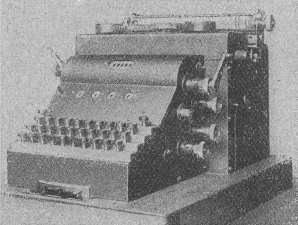
Die schreibende Enigma was developed between 1924 and 1926,
as the successor to the Handelsmaschine.
The rotating print head of the earlier machine
was replaced by a series of type-bars, like the ones commonly
found on typewriters.
The machine looks very similar to a standard typewriter and is very well
finished. Nevertheless, there were many production problems and
it appeared very difficult to operate it reliably at higher printing
speeds.
Eventually, in 1929, it was replaced by the Enigma H
(see below) which was far more bulky.
➤ More information
|
|
|
The Enigma H was the last model in the range of Schreibende Enigma
(printing Enigma) machines. It was developed and introduced in 1929, as
the successor to the Die schreibende Enigma.
The official model number for this machines was H29 and the internal
designator was Ch. 14, whilst it was called
Enigma II by the Reichswehr (the predecessor of the Wehrmacht).
This machine was sometimes used as a printer for
a modified Enigma I
or Enigma G.
➤ More information
|
|
|
Enigma A was the first Enigma cipher machine that used light bulbs for its
output. It is therefore also known as the Glühlampenchiffriermaschine
(glow lamp cipher machine). It had a rather uncommon layout and required
a special key to be pressed in order to set the rotors in motion.
The machine was introduced in 1924 was soon succeeded
by its successor, Enigma B.
As far as we know, there are no surviving
examples of the Enigma A.
➤ More information
|
|
|
The Enigma B was the second machine that used light bulbs (Glühlampen)
for its output. It was introduced in 1924/1925 as the successor to the
Enigma A. Different versions of the Enigma B have existed,
including a Swedish one.
The letters on the keyboard and on the lamp panel are organised in the
order of the alphabet. It is the first Enigma with removable wheels.
➤ More information
|
|
|
Enigma C was the successor to the Enigma B. It is the first machine
has a power switch at the top, plus two terminals for connecting an
external power supply. It has an improved keyboard and contains two
spare light bulbs.
A special variant of the Enigma C — known as
Funkschlüssel C — was
used by the German Reichsmarine from 1926 onwards. It has 28
contact points and 29 keys on its keyboard.
➤ More information
|
|
|
The Enigma D was developed in 1926 as the successor to the
Enigma C. It is often referred to as the
Commercial Enigma.
The official model number was A26
and it was given the internal designator Ch. 8.
The image on the right shows a rare sample of the Commercial Enigma
that was found in 2024.
➤ More information
|
|
|
The Enigma K can be regarded as a series of 'special' machines
based on the design of the Enigma D. The official
model number is A27 and the first internal designator for this
machine is Ch. 11b. The machine was introduced in 1927, but it
wasn't before 1936 that the letter K was used in the serial number.
Other machines, such as the
Tirpitz (T),
the KD and
the Swiss K, belong to this family.
➤ More information
|
|
|
|
|
Zählwerk Enigma (A28)
1928
|
|
|
At some point in the Enigma family tree, a machine was developed
with an improved wheel-turnover mechanism and a counter. It was
called the Zählwerk Enigma and was used by
various intarnational commercial and military customers.
The later Enigma G (model G31) is also known as Zählwerk Enigma
and is based on this machine.
➤ More information
|
|
|
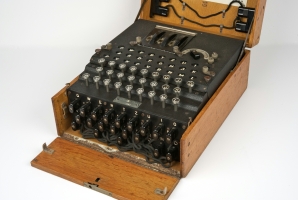
The Enigma I is the most well-known Enigma.
It was developed especially for the German Reichswehr
(later: Wehrmacht). All military Enigma machines are based on this model.
Is has three cipher rotors, a fixed reflector (Umkehrwalze, UKW)
and a plug board (Steckerbrett).
The initial Naval Enigma (M1, M2 and M3) is functionally identical
to this machine, but has letters on the rotors rather than numbers.
➤ More information
|
|
|
The Enigma Z is a rather strange variant of the light bulb machine
(Glühlampenmaschine) as it only has 10 keys and 10 lamps, containing
the numbers 0 thru 9.
Not much is known about this machine, although it is likely that there
were two different versions of it; one based on the Enigma D
and the other based on the Zählwerk Enigma (G).
➤ More information
|
|
|
The Enigma G (model G31) was a slighly smaller variant of
Zählwerk Enigma A28 (see above). The machine was sold to
various international customers and was also used during WWII
by the German intelligence service, the Abwehr.
Because the Abwehr was the biggest customer of
the machine, it is often referred to as the Abwehr Enigma,
but this is a misnomer. It was not the only cipher system used
by the Abwehr, and the Abwehr was not the only user of the
machine.
➤ More information
|
|
|
|
|
Swiss Enigma K (A27)
1939
|
|
|
The most famous version of the Enigma-K
is the one that was supplied to the Swiss Army on the eve of WWII.
For this reason it is often called the Swiss Enigma K or just Swiss K.
It was modified by the Swiss Army and was supplied with an external
lamp panel and a power supply.
As the Swiss knew that the Germans were capable of breaking Swiss Enigma traffic,
they developed NEMA as a replacement.
➤ More information
|
|
|
During WWII, the Germans used a special Enigma machine for
the German Railway (Reichsbahn).
It was basically a standard Enigma K with rewired wheels
and a rewired UKW.
Enigma traffic from the German Reichsbahn was first encountered
by the codebreakers at BP in July 1940 and
later in February 1941.
➤ More information
|
|
|
The Enigma T, codenamed Tirpitz, was developed during WWII by the Germans
especially for use by the Japanese Army. It was based on the
commercial Enigma K, but had differently wired wheels and multiple
turnovers on each wheel. Furthermore, it had an Eintrittswalze (ETW)
that was wired differently than all other Enigma machines.
➤ More information
|
|
|
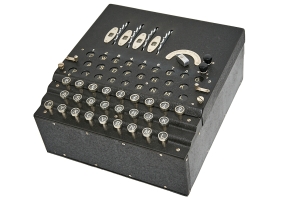
On 2 February 1942, the Kriegsmarine (German Navy) unexpectedly
introduced this new version of the Enigma machine. The M4 had
4 rotors rather than the usual 3, and was initially unbreakable by
the Allied codebreakers. It is backwards compatible
Enigma I and M3
The exta 4th rotor was used exclusively by the U-boat division of the
German Navy. The rest of the Navy used it in M3-compatible
mode.
➤ More information
|
|
|
The Enigma KD was a rare variant of the Enigma K,
that was used by Mil Amt, the successor of the Abwehr.
It is based on the Enigma K but has wheels with 9 notches
each, plus a rewirable reflector (UKW-D).
➤ More information
|
|
|
|
|
Polish Enigma double
1933
|
|
|
During WWII, several attempts were made to improve the security of the
Enigma. In January 1944, the Luftwaffe (Air Force)
introduced a field-rewirable reflector, called UKW-D.
It is little known that there was a separate version of UKW-D
for the Kriegsmarine (Navy).
The UKW-D shown here is such a rare naval variant.
➤ More information
|
|
|
In another attempt to improve the security of the Enigma, the Luftwaffe
introduced the Enigma Uhr in July 1944; a small wooden box that could be
connected to the machine's Steckerbrett by means of
20 cables.
On top of the Uhr is a large wooden knob that allows the operator
to select any of 40 alternative wirings, preferably one for each new message
on a given day.
➤ More information
|
|
|
|
|
Lückenfüllerwalze
wanted item
|
|
|
Another measure to make the Enigma safer, was the so-called
Lückenfüllerwalze (gap-fill wheel)
that featured 26 user-configurable notches. This way, the
number and position of the notches of each wheel could be
changed frequently.
The Lückenfüllerwalze was planned to be used in combination
with UKW-D, but like UKW-D and the
Uhr it came too late.
➤ More information
|
|
|
In Switzerland, each Enigma machine
that was used by the Army and the Foreign Office
— commonly known as a Swiss-K — was
supplied with a mains power supply unit (PSU).
It allows the Enigma to be powered from any mains voltage, in addition
to the internal battery.
Up to four Enigma machines can be connected simultaneously to a single
PSU.
➤ More information
|
|
|
For convenience a small printer was developed for Naval Enigma machines.
They could be fitted on top of an M3 or M4, and had an external
power supply unit.
When typing, the enciphered text was printed on a 9mm paper strip.
It is likely that this printer was only used in the shore stations,
as it has to be powered from the 75-220V AC mains.
➤ More information
|
|
|
In 1918, the first Enigma-related patent was registered by
Arthur Scherbius in Germany. Since then, numerous other inventions
have been patented by Scherbius and his collegues, in Germany
as well as in many other countries.
We've collected the most important Enigma-related patents on
a single page, which are also available for download.
➤ More information
|
|
|
Of all the different Enigma models, only the military machines – used by
the German Army before and during WWII – have a Steckerbrett (plugboard) at
the front of the machine.
This plugboard is suitable for double-ended 2-pin plugs, each with a thick
and in thin pin. It was not the first design of a Steckbrett however.
➤ More information
|
|
|
In recent years, some real Enigma messages have been recovered
from the archives and from sunken U-boats and attempts have been
undertaken to break these messages again.
This section of the website deals with some real Enigma messages,
complete with the required settings of the machine, so that they
can be decoded on a simulator.
➤ More information
|
|
|
An Enigma machine uses small - rather unusual - lamps for its output.
These lamps have a common E10 fitting, but have a somewhat
flattened glass bulb. It is important to find these lamps, as ordinary
bulbs are too high and will penetrate the celluloid lamp film.
There are two variants: clear and half-opaque.
➤ More information
|
|
|
Many Enigma machines found today, are not in very good condition
and may require some work in order to get them going again.
In the past few years, various people have made an effort to produce
good and accurate reproduction parts in order to restore Enigma
machines. Some of these parts are available through the Crypto Museum.
➤ More information
|
|
|
Based on many years of research by Frode Weierud, we've been able
to put together the most accurate family tree of Enigma machines to date.
It shows the relationship between the various models and variants,
and provides a lot of additional information.
Please note that the tree is based on ongoing research and is therefore
subject to changes in the future.
➤ More information
|
|
|
It is sometimes thought that the Enigma was broken by
Colossus, the first electronic digital computer.
This was not the case, however.
The Enigma was broken manually (using hand methods) and with help of
an electro-mechanical device, called the
Bomba (Polish),
and Bombe (British).
The latter has been rebuilt and is now on public display at
Bletchley Park (UK).
➤ More information
|
|
|
ID Internal manufacturer designator Year Year of introduction Keys Number of keys on the keyboard Contact Number of contacts on each rotor Rotors Number of rotors in the machine (3/5 = three from a set of five) ZW Zusatzwalze (extra rotor, 4th rotor) UKW Possible number of reflector settings Driven UKW is driven by the rotor to its right Military Used by the German Army Steckerbrett Plugboard present
|
|
Initially, all Enigma machines were manufactured by the original company
Chiffriermaschinen AG — abbreviated
ChiMaAG — in Berlin (Germany).
After the German Army acquired the Enigma patents,
ChiMaAG was taken over in 1935
by Heimsoeth und Rinke (H&R).
During World War II (WWII),
additional companies were appointed to manufacture
Enigma machines under license.
Below is the list of all Enigma manufacturers
and their manufacturer code (when applicable) [1].
|
From 1935 onwards, Heimsoeth und Rinke (H&R) was the
main contractor, which succeeded the original manufacturer
Chiffriermaschinen AG (ChiMaAG). However, H&R
did not manufacture any machines itself. Instead, the machines were made
by Konski & Krüger (K&K) elsewhere in Berlin.
From 1941 onwards, these machines were marked with jla — the
manufacturer code assigned to H&R.
In 1944, K&K outsourced the production of 300 Enigma M4 machines
to a another firm by the name of Geyer.
These machines carried the manufacturer code gvx
that was assigned to K&K.
All early naval machines (M1, M2 and M3) were made by K&K
on behalf of H&R [4].
Between 1942 and 1945, Ertel Werk in München — code bac
— produced 3360 Enigma I machines on a separate serial number range
suffixed with the letter 'E' (e.g. A01262/bac/44E).
In addition, typewriter manufacturer Olympia in Erfurt made
3450 Enigma M4 machines from 1943 to 1945.
Olympia (code aye) used its own number range from M15001 to M18450 (e.g. M18340/aye/45).
Atlas Werke (code) jmz did not make any Enigma machines,
but is thought have made sub-parts.
|
There appears to be a recurring debate about the number of steckered (military)
Enigma machines that have been manufactured. In publications, the production
figures vary between 20,000 and 100,000. In reality the answer lies somewhere
in between. In 2021, historian Frode Weierud made an
accurate estimation
based on orders and production reports from the German archives [4].
The tables below show the production quantities of the various models, as far
as they are known. As there are no production figures of most of the commercial
machines and the early printing Enigma machines, we have made an educated guess
based on the serial numbers of surviving machines.
Note that the 3-letter manufacturer codes were introduced between 1940
and 1941.
|
|
Below are digital copies of the original Enigma logo.
This logo has been recreated from scratch and is presented here
as a PDF file, in order to preserve the resolution.
The copyright of this logo belongs to us.
You may download and use these logo's for personal non-commercial use.
For commercial use of the logo, please ask permission first.
|

|
|
|
|
|
Enigma logo (black & white) (3KB PDF file)
|
|
This file contains the Enigma shield that was present inside the top lid
of the wooden case, in partular with commercial machines that were produced
before WWII. The distance between the two mounting holes should be 65 mm.
|
|
|
|
|
Enigma stamp (2KB PDF file)
|
|
This file contains the stamp with the Enigma logo as it was sometimes
present inside the hinged flag (Klappe) at the front of the wooden case.
It is fully scalable, but is currently not scaled to the actual size.
|
|
|
Every once in a while, someone decides to built a replica of an Enigma.
Although the basic operating principle of the machine is pretty straightforward,
making a reproduction is not simple at all. Bear in mind that a single coding
wheel consists of over 300 individual parts.
Below are some links to people who have successfully built a replica
or a machine with similar functionality.
|
|
|
Enigma Simulator for Windows
|
|
|
Version 7.0.1 - 7 December 2011
In 2004, Dirk Rijmenants in Belgium released the first version of his
graphical Enigma simulator for Windows. With this program he won the
Superior Coding Award in the 2004 Planet Source Code Contest (PSC).
Since then, the program has been enhanced several times and is
considered one of the best Enigma Simulators for Windows.
The program simulates all known Enigma variants in great detail,
including appropriate skins and sound. Operation of the simulator
is very intuitive and online help is available at a click of the
mouse.
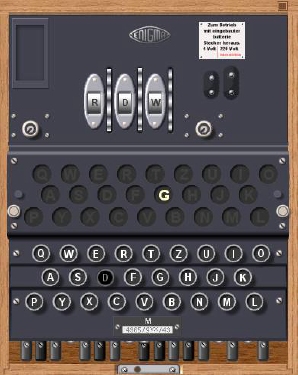
The image on the right shows a screen-shot of the M3 simulator.
➤ Download simulator (off-site)
|
|
|
|
|
Enigma Simulator for RISC OS
|
|
|
Version 1.70 - 3 November 2016
In 2001, Paul Reuvers developed a fully featured Enigma Simulator
for RISC OS, the first operating system to run natively on ARM-based
hardware. The software is maintained to the present day, and runs on
modern hardware, including iMX6, Beagle Board, Raspberry Pi
and Virtual Acorn.
The program simulates all known variants of the glowlamp-based
Enigma machine in great
detail, including selectable skins and full sound effects.
Setting up the machine is intuitive
and online help is available at the click of a mouse.
Simulations are provided for the Enigma I, M3,
M4, Abwehr G and
variants of the commercial Enigma D and K.
Also included are Enigma T (Tirpitz), the
Polish Enigma Clone and Enigma E.
➤ More information
|
|
|
|
|
Other software simulators
|
|
|
|
A number of Enigma computer simulations have been developed
by various people, for a variety of platforms. Below is a list
of popular Enigma simulations.
|
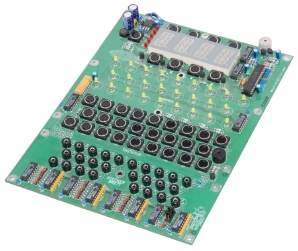
This Crypto Myseum do-it-yourself kit allows you to build your own Enigma
compatible with 3 and 4 rotor military Enigma.
The package includes a printed circuit board, all electronic parts,
a metal enclosure and a 60+ page manual with building instructions,
historical backgrounds and a few original Enigma messages.
Introduced in 2003, the Enigma-E is still going strong in 2026.
For those of you who want a more complete setup,
there is even a separate kit for building your own Enigma Uhr.
➤ More information
|
|
|
|
For those of you who don't want to build your own device, the
Enigma Touch might be right up your alley. Compatible with all known
Enigma models, the device has a clear and intuitive user interface,
complete with realistic sound.
The Enigma Touch is available in two form factors: (1) as the tablet-style
device shown in the image on the right, and (2) in a wooden case.
➤ More information (off-site)
|
|
|
If you want an Enigma machine that you can take everywhere and keep
in your pocket, the Arduino Enigma might be something for you.
Based on a miniature Arduino platform with touch display,
and housed in a laser-cut wooden enclosure.
➤ More information (off-site)
|
|
|
Enigma RDE is a fully functional open-source 3D-printed replica
of the Enigma I cipher machine. It was developed by students
at the Media University (HdM) in Stuttgart (Germany).
If you have a 3D printer, you should be able to print your own Enigma
for approx. EUR 300 in parts.
The abbreviation R.D.E. stands for
Runterladen-Drucken-Einschalten
(download-print-switch on).
It was developed under supervision of Prof. Dr. Simon Wiest.
➤ Further information
|
|
|
|
An Enigma machine appears in the folloing movies:
|
1981 Movie Das Boot 2000 Movie U-571 2001 Movie Enigma 2001 Movie All the Queen's Men 2014 Movie The Imitation Game 2018 Netflix Das Boot (series 2018-2023)
|
|
If you come across any other movies in which the Enigma is visible,
please let us know.
|
| |
|
|
Printing Enigma
|
|
|
|
|
| Type | Model | Designator | Year | Description |
|
|
|
-
|
-
|
-
|
1923
|
Die Handelsmaschine (print wheel)
|
|
-
|
-
|
-
|
1926
|
Die schreibende Enigma (type bars)
|
|
H
|
H29
|
Ch.14
|
1929
|
Enigma II (push bars)
|
| |
|
|
Glowlamp Enigma
|
|
|
|
|
| Type | Model | Designator | Year | Description |
|
|
|
A
|
-
|
-
|
1924
|
First glowlamp machine
|
|
A'
|
-
|
-
|
1924
|
Kleine militärmaschine
|
|
B
|
-
|
-
|
1924
|
Removable rotors, Ringstellung
|
|
B'
|
-
|
-
|
1925
|
Swedish variant, fixed UKW, extra rotor
|
|
C
|
-
|
-
|
1925
| Fixed UKW with 2 positions
|
|
C'
|
-
|
-
|
1926
| Funkschlüssel C, UKW with 4 positions
|
|
D
|
A26
|
Ch.8
|
1926
|
Settable UKW, notch attached to rotor body
|
|
K
|
A27
|
Ch.11b
|
1927
|
Notch attached to letter ring
|
|
-
|
A28
|
Ch.15
|
1928
|
Counter machine, cogwheel mechanism
|
|
Z
|
Z30
|
Ch.16
|
1930
|
Mark 1: Numbers-only version
|
|
Z
|
Z30
|
Ch.16
|
1930
|
Mark 2: Cogwheel stepping mechanism
|
|
G
|
G31
|
Ch.15a
|
1931
|
Counter machine, Abwehr Enigma
|
|
G
|
G31
|
Ch.15b
|
1931
|
Connector for printing device
|
|
G
|
G31
|
Ch.15c
|
1931
|
Version with plugboard
|
| |
|
|
Specials
|
|
|
|
|
|
K
|
A27
|
Ch.11b
|
1938
|
Swiss-K variant with external lamp panel
|
|
T
|
A27
|
Ch.11b
|
1942
|
Tirpitz, version for Japan
|
|
KD
|
A27
|
Ch.11b
|
1944
|
Enigma K with UKW-D
|
| |
|
|
WWII military machines
|
|
|
|
|
|
D
|
-
|
Ch.11a
|
1927
|
Reichswehr, prototype Steckerbrett
|
|
I
|
-
|
Ch.11f
|
1929
|
Enigma I (Reichswehr, Wehrmacht)
|
|
M1
|
-
|
Ch.11g
|
1934
|
Kriegsmarine version, 3 rotors
|
|
M2
|
-
|
Ch.11g
|
1938
|
Similar to M1
|
|
M3
|
-
|
Ch.11g
|
1940
|
Similar to M2
|
|
M4
|
-
|
Ch.11g4
|
1941
|
Kriegsmarine version, 4 rotors
|
|
- David Hamer, Geoff Sullivan and Frode Weierud,
Enigma Variations: An Extended Family of Machines
Cryptologia, July 1998, Volume XXII, Number 3, pp. 211-229.
- Frode Weierud, Enigma Production at Konski & Krüger
Crypto Cellar Research, March 2021.
Obtained from www.cryptocellar.org
- Frode Weierud, Enigma D versus Zähwerk Enigma
CryptoCellar Research. 15 September 2024. 6 pages.
Personal correspondence September 2022, February 2024.
|
1. Document kindly supplied by Arthur Bauer [2].
|
- Oberkommando des Heeres,
Liste der Fertigungskennzeichen für Waffen, Munition und Gerät
Reichsdrückerei Berlin 1944, reprinted by Pawlas, Nürnberg, 1977.
ISBN 3-88088-214-2
- Arthur Bauer, Foundation for German Technology
Historical Enigma documents kindly supplied for reproduction.
- Jared Owen Animations, How did the Enigma Machine work?
YouTube channel Jared Owen, 11 December 2021
- Frode Weierud, Enigma Production at Konski & Krüger
Crypto Cellar Research, March 2021.
Obtained from www.cryptocellar.org
|
|
|
|
Any links shown in red are currently unavailable.
If you like the information on this website, why not make a donation?
© Crypto Museum. Created: Tuesday 07 July 2009. Last changed: Thursday, 02 July 2026 - 07:10 CET.
|
 |

|
|
|
|
|
| | |