|
|
|
|
|

|
|
Rotor Enigma Steckern UKW-D M4 → ← Enigma I
3-rotor Naval Enigma M1, M2 and M3
- wanted item
M1, M2 and M3 were 3-rotor
electromechanical cipher machines,
generally known as M3, used during WWII by the German Navy (Kriegsmarine).
The machine was compatible with the Enigma I
used by the Army (Heer) and Air Force (Luftwaffe). After the
Wehrmacht
had introduced the Enigma I in 1932,
the Kriegsmarine followed in 1934 with the introduction of
the M1.
Although the machine is compatible with the Enigma I,
it has some manufacturing differences
that are unique to the German Navy.
The M1, M2 and M3 are also known by their designator: Ch.11g.
|
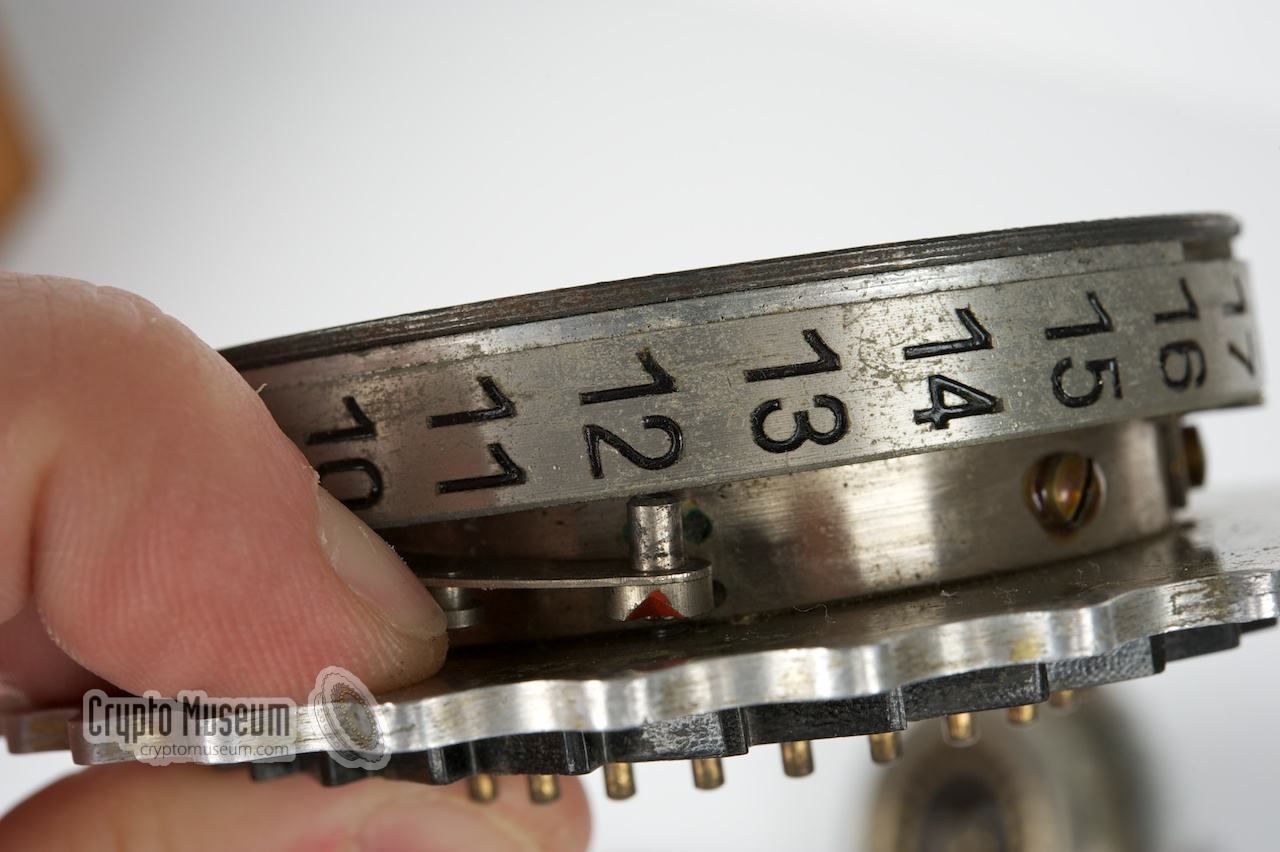
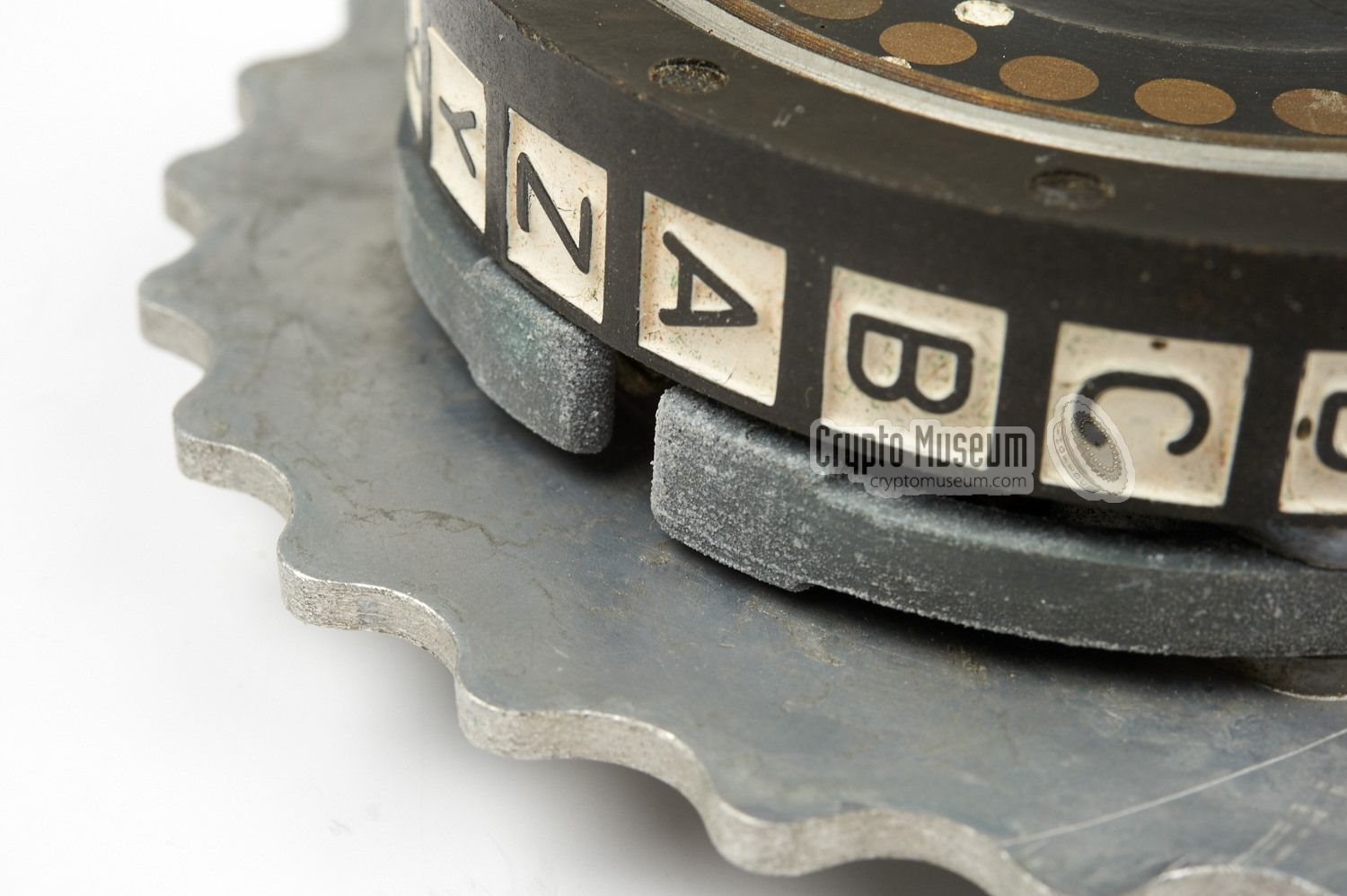
As an example: the cipher rotors have letters (A-Z) around the rim, rather than
numbers (01-26) and the machine has a 4V or 6V socket,
so that it could be powered from a ship's network.
In total, 611 M1 units were built.
The M1 was followed in 1938 by the M2,
of which 890 units were delevered. Finally, in 1940, it was replaced
by the M3,
of which approx. 800 units were built [2].
All three machines – M1, M2 and M3 – had the same internal designator:
Ch. 11g. We will therefore use the name M3 (which refers to the
procedure) to identify all three machine variants.
|
|
|
The image above shows an Enigma M3 aboard German U-boat U-124.
The machine is located in a recessed bay at the bottom left of the image.
In the enlargement, a power cable
is visible in the corner of the bay. It was used to
supply 4V directly to the machine.
The photograph was taken in March 1941, nearly a year before it was replaced
by the M4.
Also visible in the picture is a
printed coding table 1
to the left of the Enigma
and – at the far right – a message form (Funkspruch).
Initially, the M3 was supplied with five cipher rotors that were
wired identically
to the five rotors of the Wehrmacht's Enigma I.
This way, they were able to exchange messages with the
Heer and Luftwaffe.
In 1939 however, three more rotors were added — VI, VII and VIII —
which were used exclusively by the Kriegsmarine. They were not
supplied to the rest of the German Army. Furthermore,
on 2 February 1942, the Kriegsmarine unexpectedly started using the
4-rotor Enigma M4
on its U-Boat and battleship networks. The rest of the Kriegsmarine
kept using the Enigma M3.
|
 |
|
|
Differences with Enigma I
|
|
|
|
As discussed above, the M3 is functionally identical to the
compatible Enigma I
that was used by the Heer and Luftwaffe.
Nevertheless there are several manufacturing differences
that are unique to the Kriegsmarine machines.
So far, the following differences have been observed:
|
- Three additional rotors (VI, VII and VIII)
- Rotors with letters instead of numbers
- Different ring setting mechanism (double spring-loaded latch))
- Separate lamp panel (hinged on the M2)
- Lockable rotor cover with two locks
- Removable top lid (of the wooden case)
- Lock in top lid of wooden case rather than in the flap at the front
- Plugs with longer pins
- Two metal grips at the sides (for lifting the machine from a bay)
- 6V circular power socket (M1, M2), or two sockets for 4V and 220V (M3)
|
Whilst the Enigma machines of the German Wehrmacht
(Heer and Luftwaffe) were supplied with 5 cipher rotors, all Naval
machines had 8 rotors to choose from. The first five rotors
(I-V) were identical to the five rotors supplied to the rest of the
German Forces, allowing some level of compatibility,
but the additional three rotors (VI-VIII) were used
exclusively by the Kriegsmarine.
Of the 8 rotors supplied with the Enigma M3, three would be placed
in the machine at any time, subject to the current key settings.
Although 3-of-8 rotors theoretically gives a total number of 336 rotor
orders (8 x 7 x 6), this was limited in practice by the operational
procedures. There were instruction that one of the 3 rotors in the
machine had to be a Naval rotor (VI-VIII) and that that particular
naval rotor could not be used in the same position on two successive days.
|
The remaining 5 (unused) rotors were stored in a special
wooden box. The image on the right shows such a box with the
unused rotors in it.
The box has space for seven rotors but only five positions were used.
The remaining positions were probably meant for a future
extra rotors or for storing additional gadgets, such as UKW-D.
More pictures of this box below.
Click any of the images to enlarge. Note that the serial number
of the rotors is present on the box' ID-plate and is also engraved
in the lock of the wooden box.
|
|
|
Rotors I to V each have one turnover notch, but the three extra
Naval rotors (VI-VIII) each have two notches.
This was done to generate more frequent rotor turnovers and, hence,
make rotor stepping less predictable. The problem however,
is that the cipher period is reduced, as 26 (letters) is dividable
by 2 (notches).
As you can see in the images below, these
two notches are positioned
opposite each other. Details of the rotor wiring can be found
in the table below.
The construction of the Naval rotors is different from regular
Enigma rotors. Rather than using a
spring-loaded pin to set the
Ringstellung (common on all other rotors), the user has to press
two pawls simultaneously.
Furthermore, for unknown reasons,
the M4 rotors are marked with the 26 letters of the
alphabet (A-Z) rather than numbers (01-26).
The overall dimensions of the rotors are identical however and
the rotors of a naval Enigma fit and work perfectly inside an
Enigma I.
|
|
One weakness of the rotor turnover mechanism is that the rotors
move regularly. Only after the rightmost rotor has completed a
full revolution, does it cause the next rotor to make a single step.
As a result, the 2nd rotor (from the right) will only make one step
every 26 characters and the 3rd rotor will hardly ever move.
This makes the machine predictable and easier to break.
The only machine that did not suffer from regular stepping was
the Enigma G (Zählwerkmaschine).
|
The three Naval rotors (VI, VII and VIII) have two notches each,
which causes a more frequent rotor turnover and less regular stepping.
This was done as the 3rd rotor (from the right) hardly ever moved
during the ciphering process.
Note however, that the rotors have 2 notches which is not a
relative prime of 26 (26 can be divided by 2) and that the notches
are positioned opposite each other
(see the image on the right).
The result is that the cipher period is effectively halved,
which was yet another weakness of the system and a bonus
for the codebreakers.
|
|
|
Furthermore, operational procedures instructed the use of at least one
of the extra 3 Naval rotors (VI-VIII) every day, and that such a
rotor could not be used in the same position on two successive days.
This was known by the code breakers at
Bletchley Park
and reduced the number of possible combinations,
making it easier to guess to order in which the rotors were placed.
|
|
During WWII, several attempts were mounted to make Enigma traffic more
secure. In January 1944, a field-rewirable reflector,
called UKW-D,
was introduced by the Luftwaffe (German Air Force).
It is little known that a special UKW-D was also developed for the Kriegsmarine
(Navy).
|
The image on the right shows an extremely rare UKW-D with a serial number
starting with the letter M, indicating naval-use (Marine).
It was developed especially for the M3 and M4 and replaces the
existing reflector (B or C).
When in use, the wiring of the UKW-D was changed approx. every 10 days.
It provided strong additional security but was disliked by most operators
as it was difficult to set up.
➤ More information
|
|
|
|
The Enigma M3 has two locks in the top cover that can be used to prevent the
internal rotor settings from being changed.
This was probably done to allow only an officer to change the rotor settings.
The Enigma M4 only has one such lock.
As far as we know, locks were only present on the Enigma machines used by
the Kriegsmarine (Navy).
It is likely however that the lock was not used very often,
as only a limited number of keys have been found with surviving machines.
|
That said, the two locks of the M3 with serial number
M 522 (see below)
were locked when the machine was recovered from the Danish waters
by a fisherman in 1992,
indicating that, at least early in the war, the two locks were in use.
The image on the right shows an extremely rare key of an Enigma M4.
Note that the machine's serial number is engraved in the key. The locks,
and hence the keys, of the M3 were of the same make and model.
As each machine was supplied with its own set of locks, the key of one
M3/M4 generally does not fit another machine's lock.
|
|
|
If no original key is present, it is possible to have a replica key made
from a so-called blank, even whithout removing and disassembling the
lock. For this, one would need to call the help of a skilled lock-picker,
such as Barry Wels of the
Dutch lockpickers organisation Toool
who, in 2008, created a smoothly operating key
for our M4 in just under 10 minutes, using impressioning.
|
|
It is sometimes thought that the name Enigma M3 refers to a 3-rotor
machine and that for the same reason M4 was used for the 4-rotor
model. However, this is not correct. It was just the name of the key
procedure that was in use when the machine was issued.
The range started with M1 and ended with M4, the special U-Boat key.
Nevertheless, the key names correspond to small manufacturing differences.
The following variants of 3-rotor naval Enigma machines are known:
|
The internal designator used by the manufacturer was Ch.11g for
all three versions, whilst the later
4-rotor machine (M4) was
designated Ch.11g4.
The table below was compiled by Frode Weierud in 2009 and shows how many
of each version and variant were made between 1934 and 1941 [3].
At the bottom is the first production run of the later 4-rotor
Enigma M4 machine.
|
| Year | Quantity | Serial numbers | Version | Designator |
|
|
| 1934 | 401 | M 501 - M 901 | M1 | Ch.11g |
| 1935 | 60 | M 902 - M 961 | M1a | Ch.11g |
| 1937 | 150 | M 962 - M 1111 | M1a | Ch.11g |
| 1938 | 310 | M 1112 - M 1421 | M2 | Ch.11g |
| 1939 | 580 | M 1422 - M 2001 | M2a, M3 | Ch.11g |
| 1940 | 800 | M 2002 - M 2801 | M3 | Ch.11g |
|
|
| 1941 | 1011 | M 2802 - M 3812 | M4 | Ch.11g4 |
|
|
The first 3-rotor naval Enigma machines were introduced with the Kriegsmarine
in 1934, along with the first operating procedure: M1, which is why
these machines are known as Enigma M1.
Only 611 of these machines were built (M 501 - M 1111) before
it was succeeded by the M2.
|
The image on the right shows a good example of an Enigma M1 with serial
number M 897 that is on public display as part of the Enigma Gallery
at the Bletchley Park Museum (taken in 2014) [4].
This machine was found complete with the original maintenance booklet.
Unfortunately, the lamp panel is missing, but all other features are clearly
visible. To the right of the cipher rotors is a large circular 2-pin socket
that allows the machine to be powered from a 6V source. The lid
that covers the rotors has two locks, which is a typical feature of
the 3-rotor naval Enigma.
|
|
|
Note that the lamp panel of all naval machines can be removed separately
from the rotor cover. This was done to allow the connection of additional
devices to the lamp panel, such as an external lamp panel (Lesegerät)
and an electric typewriter. In both cases the lamps have to be removed
in order to accomodate the large connector that takes over the lamp
socket contacts.
The top lid of the wooden box contains two spare Steckerbrett cables
with the old style holders. It also carries an oval shield with the Enigma
logo and a rectangular one with the manufacturer's name (Heimsoeth und Rinke),
both of which were omitted later. The machine shown here was produced in 1934.
A typical feature of the M1-variant is the arrangement of the contacts on the
Steckerbrett, which carry both letters and numbers and is ordered
like the keyboard (QWERTZ).
On later machines, the Steckerbrett was arranged in the order of the
alphabet (ABCDE...), but it is currently unknown when this transisition
took place. Some manufacturing changes were applied in 1935,
resulting in the M1a-variant, but the differences with the M1 are
currently unknown.
|
|
In 1938, the M1 and M1a versions were succeeded by the M2.
Although the exact manufacturing differences with its predecessor are
currently unknown, the machine with serial number M 1322 gives us a good
impression of the production changes that had meanwhile been implemented.
|
The image on the right shows the machine with serial number M 1322,
which is part of the Enigma Gallery at the Bletchley Park Museum
(photograph taken in 2014) [4]. Initially this machine was available for
the public to touch in the early day of the museum, but given its rareness
it has since been placed behind glass.
The machine has the same circular power socket as its predecessor, but
a rectangular metal frame has been added to the left of the rotors.
This was intended for holding the station call sign.
The keyboard now carries the serial number.
|
|
|
The holders for the spare patch cables in the top lid of the wooden box
are of the new Bakelite type and the shields with the Enigma logo and
the manufacturer's name have disappeared. One of the most significant features
of this variant is the presence of a hinge above the lamp panel. It allows
the lamp panel to be raised without removing it completely, but was
dropped again later.
On this version the earlier QWERTZ-order of the sockets on the Steckerbrett
has been given up, in favour of the alphabet sequence (ABCDE...).
The plugboard still has letters and numbers, but these are now placed
together above each socket, rather than around the middle as before.
Two additional sockets were added, each marked with a red dot. These were
used for testing the patch cables in combination with an extra lamp on
the lamp panel (visible after raising the lamp panel).
|
|
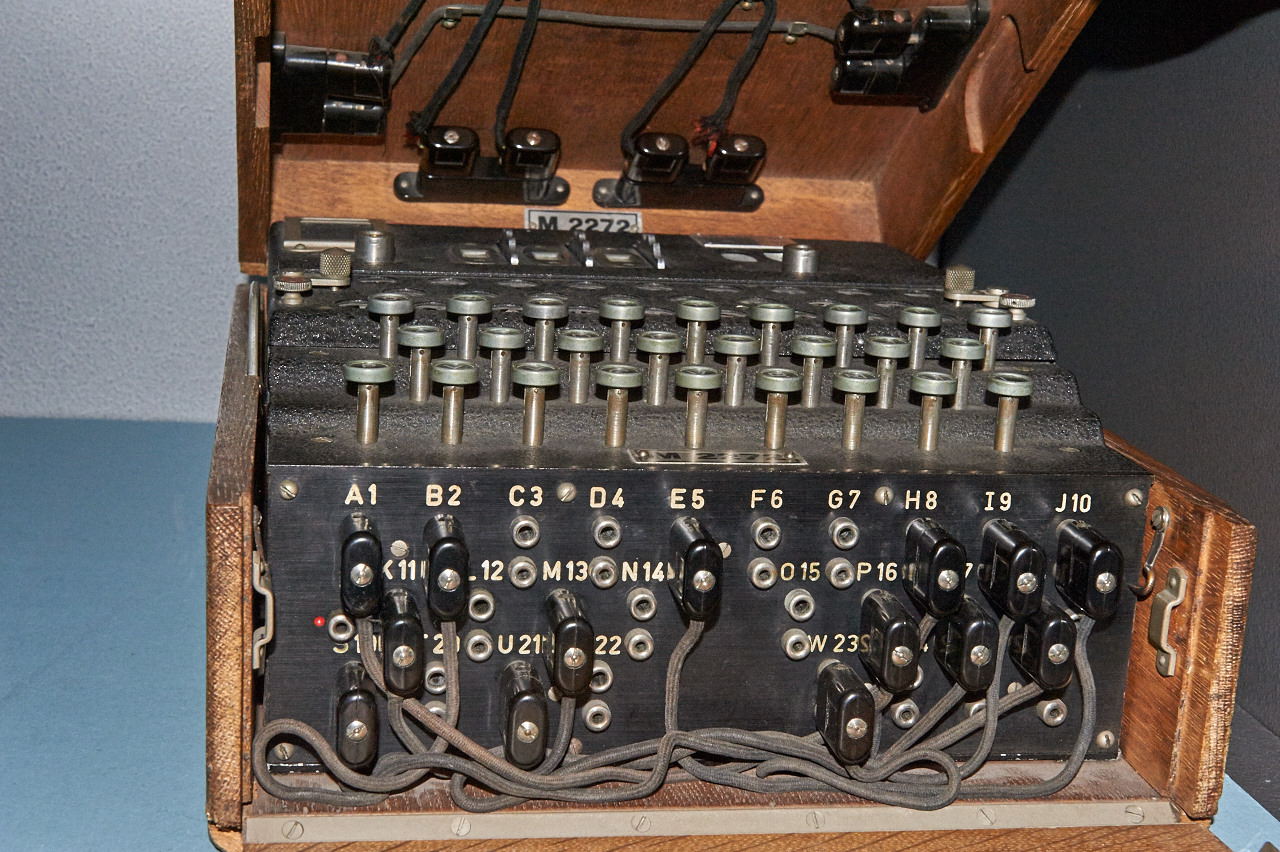
The M2 and M2a variants were followed in 1939/1940 by the M3, which was
the last series of 3-rotor naval Enigma machines. Like with the other
versions, the exact differences between the M3 and the earlier ones
are not known, but the M3 with serial number M 2272 gives us some idea.
|
The machine shown here has serial number M 2272 and is
from the collection of the Museum for Communication in Frankfurt (Germany).
This machine is largely identical to the M2 shown above, except for the
fact that the hinge between the lamp panel and the rotor cover has been
removed again. The lamp panel is separate though, just like on the later
4-rotor Enigma. This photograph also shows the rather strange arrangment
of the sockets on the plugboard, with a gap at the bottom center.
This typical arrangement was also used on the earlier M2.
|
|
|
The most interesting change to this model however, is the fact that the
circular 6V power socket has been replaced by two oval ones: a smaller
one that accepts 4V and a slightly larger one for connection to 220V.
This means that this version has a built-in 220V/4V mains transformer.
The same 4V socket was present on the later M4 machines, but the 220V
socket was not seen again.
|
|
|
Recovery of an M1 in Denmark
1992 - 2015
|
|
|
|
In 1992, a Danish fisherman found a strange device in the waters of a
small fjord (firth) named 'Vemmingbund', not too far from the historically
important Flensburg Fjord, right on the border between Germany and Denmark.
According to the reports at the time, there was no wreckage involved.
Instead, it was reported, the device mysteriously popped up from the water
one day...
|
The mysterious machine turned out to be an Enigma machine and was given
to the Danish Post and Tele Museum in Copenhagen [6]
where it has been stored ever since.
In 2015 it was decided to do some further research in the hope
to determine the exact model and age, and, if possible,
preserve it in its present condition.
The image on the right shows the machine in 2015. Although at first sight
it may seem to be in bad condition, it is actually not too bad for a machine
that has been in the sea for about 50 years and then in storage for
another 23 years.
|
|
|
Looking a bit closer, we see that the machine is largely undamaged
and that it was fully intact when it was lost to the waters of Denmark.
The patch cables on the Steckerbrett (plugboard) are still present in
their sockets and the three cipher rotors are still installed
inside the machine.
One of the goals of the 2015 investigation was to determine the exact
model and age of the machine. From studying the remains it had already
become clear that it could be an Enigma M3, as the rotors
have letters on the rim.
As it was impossible to open the case due to heavy corrosion,
the National Museum of Denmark [5] arranged for the machine to be
X-rayed.
Despite the fact that the machine is now over 80 years old and that it
has been in the water for some 50 years, followed by 23 years of
unpreserved storage, the x-ray photograph
is still amazingly detailed.
|
It reveals that the machine is largely undamaged and that most
of the internal wiring is still intact after all these years.
It also shows that the cipher rotors and the UKW are still in place
and that both locks on the rotor cover are indeed locked.
After carefully studying an extreme enlargement of the the
x-ray photograph
below, we found the machine's serial number imprinted in the rightmost
lock.
After flipping the image and applying contrast enhancement to it,
we were finally able to determine the serial number of this machine:
M 522, as shown in the image on the right.
|
|
|
According to Frode Weierud's research [3] this means that the
machine was built in 1934 and that it is probably from the first batch
delivered to the Kriegsmarine, as the range started with M 501.
Other features that confirm that this is indeed an M1, are the
presence of the 6V power socket at the top right and, more importantly,
the typical arrangement of the
sockets on the Steckerbrett.
We are grateful to the National Museum of Denmark [5] and the
Danish Post and Tele Museum [6] for allowing us to reproduce the
X-ray photograph here.
Click the image below for a close-up.
We should also like to thank Frode Weierud for providing details of
his forthcoming publication about research on naval Enigma machines [3],
and Niels Faurhold for his help and valuable insights [4].
The image above shows an X-ray photograph of the Enigma M1 with serial
number M 522 that was found by a fisherman in the Danish Vemmingbund Fjord
in 1992. The machine is now part of the collection of the Danish Post
and Tele Museum [6] and is currently being preserved (2015).
|
|
The wiring of the M3 is given in the table below. Rotors I thru V
are identical to those of the Enigma I. The same is true for
UKW B and C. The three additional rotors (VI, VII and VIII) were
used exclusively by the Navy.
The rightmost column gives the number of turnover notches.
|
| Rotor | ABCDEFGHIJKLMNOPQRSTUVWXYZ | Notch | Turnover | # |
|
|
| ETW | ABCDEFGHIJKLMNOPQRSTUVWXYZ | |
|
|
| I | EKMFLGDQVZNTOWYHXUSPAIBRCJ | Y | Q | 1 |
| II | AJDKSIRUXBLHWTMCQGZNPYFVOE | M | E | 1 |
| III | BDFHJLCPRTXVZNYEIWGAKMUSQO | D | V | 1 |
| IV | ESOVPZJAYQUIRHXLNFTGKDCMWB | R | J | 1 |
| V | VZBRGITYUPSDNHLXAWMJQOFECK | H | Z | 1 |
| VI | JPGVOUMFYQBENHZRDKASXLICTW | HU | ZM | 2 |
| VII | NZJHGRCXMYSWBOUFAIVLPEKQDT | HU | ZM | 2 |
| VIII | FKQHTLXOCBJSPDZRAMEWNIUYGV | HU | ZM | 2 |
| UKW-B | YRUHQSLDPXNGOKMIEBFZCWVJAT | |
|
|
| UKW-C | FVPJIAOYEDRZXWGCTKUQSBNMHL | |
|
|
|
Device Rotor cipher machine Purpose Secure naval communication Brand Enigma Model M1, M2, M3 Designator Ch.11g Years 1934-1940 Contractor ChiMaAG, H&R Manufacturer K&K (H&R) Country Germany User German Navy (Kriegsmarine) Compatibility Enigma I Successor Enigma M4 Rotors 3 from a set of 8 1 Turnovers 1 or 2 per rotor 2 Reflector Fixed (type B or C) Wiring see above Stepping Regular (Enigma stepping) Plugboard yes ➤ More Extras Green contrast filter Quantity 2301
|
-
The first five rotors (I to V) are compatible with the five rotors of
the Enigma I of the German Army and Air Force. The additional three rotors
(VI, VII and VIII) are used exclusively by the German Navy.
-
The first five rotors (I-V) each have 1 turnover notch.
The three naval rotors (VI-VIII) each have 2 notches.
|
|
The Enigma M3 is known by the following designators.
Note that 'M3' is actually the name of the operational procedure
used by the German Navy, but is commonly used as the model number.
The procedures started with M1 and continued until M4.
M1, M2 and M3 are basically the same machine with some manufacturing
differences.
The M4 procedure coincided with the introduction of a
4-rotor machine,
which is therefore named M4. All machines produced after 1940
are M4.
|
- Enigma M1, M2 or M3
- Ch.11g
- Naval Enigma M1, M2 or M3
- Naval Enigma
- Schlüssel M
|
|
Below is an overview of the serial numbers of the M1, M2 and M3 machines.
These machines were all manufactured by
Konski & Krüger in Berlin (Germany),
but carried the manufacturing code (jla) of the main contractor
Heimsoeth und Rinke (H&R). Note that the machines manufactured in 1934
and part of 1935, were made by ChiMaAG — the predecessor of H&R.
|
| Serial number | Model | Quantity | Year | Remark |
|
|
| M501-M901 | M1 | 401 | 1934 | |
| M902-M961 | M1a | 60 | 1935 | ChiMaAG taken over by H&R |
| - | | 0 | 1936 | No production in this year |
| M962-M1111 | M1a | 150 | 1937 | |
| M1112-M1421 | M2 | 310 | 1938 | |
| M1422-M2001 | M2a, M3 | 580 | 1939 | |
| M2002-M2801 | M3 | 800 | 1940 | After this, only M4 model manufactured |
|
|
| | Total | 2301 | |
|
|
|
| |
Enigma M1, M2 and M3 machines delivered by H&R (manufactured at K&K)
|
|
|
|
Surviving M1, M2 and M3 machines
|
|
|
M522 M1 relic Post Museum, Copenhagen, DK M755 M1 Australian War Memorial M864 M1 ASD, AU M879 M1 Bletchley Park, UK M1146 M2 Foreign Office, UK M1227 M2 Military Museum, Belgrade, RS M1322 M2 Bletchley Park, UK M2272 M3 Museum für Kommunikation, Frankfurt, DE
|
|
|
Surviving machines and parts
|
|
|
- Der Schlüssel M, Verfahren M Allgemein 3
Operating procedure for Naval Enigma (older version with ammendments).
Oberkommando der Kriegsmarine, Berlin 1940.
M. Dv. Nr. 32/1. S/N 476.
- Der Schlüssel M, Verfahren M Allgemein 1
Operating procedure for Naval Enigma (later version with manual changes).
Oberkommando der Kriegsmarine, Berlin 1940.
M. Dv. Nr. 32/1. S/N 4508.
- Der Schlüssel M, Allgemeine Bestimmungen 3
Oberkommando der Kriegsmarine, Berlin 1940.
M. Dv. Nr. 32/3. S/N 62.
- Kenngruppenbuch (K. Buch) 3
Oberkommando der Kriegsmarine, Berlin 1941.
M. Dv. Nr. 98. S/N 992.
- ➤ Doppelbuchstabentauschtafeln für Kenngruppen
Bigram substitution tables for Message Indicators.
- Signalschlüssel für den Funksignaldienst
Oberkommando der Kriegsmarine, October 1939.
- Geheime Marinefunknamenliste (GFL)
Oberkommando der Kriegsmarine, October 1943.
- GFL U.Boote (Geheime Funknamenliste)
Oberkommando der Kriegsmarine, August 1944.
|
-
Document kindly provided by Arthur Bauer [7].
-
Document kindly provided by Niels Faurholt.
-
Document kindly provided by Glen Miranker and scanned by Crypto Museum.
|
- Deutsches Bundesarchiv (German Federal Archive), Bild 101II-MW-4222-02A
Dietrich, Lorient (France), U-Boat U-124, 9 March 1441.
Retrieved from Wikimedia Commons.
- Frode Weierud, Enigma History
Personal correspondence, June 2009 (not yet published).
- Frode Weierud, Naval Enigma Models
Personal correspondence, 2009, 2015 (not yet published).
- Niels Faurholt, Images of Enigma M1 at Bletchley Park
Personal correspondence, May 2015.
- National Museum of Denmark, X-Ray photograph of Enigma M1
X-Ray of the M1 from the collection of the Danish Post & Tele Museum [6].
Retrieved May 2015. Reproduced here by kind permission.
- Danish Post & Tele Museum, M1 recovered from Vemmingbund in 1992
Retrieved May 2015. Reproduced here by kind permission.
- Arthur Bauer, Personal correspondence
Foundation for German Communication and related technologies.
March 2003 — October 2022.
- Frode Weierud, Enigma Production at Konski & Krüger
Crypto Cellar Research, March 2021.
Obtained from www.cryptocellar.org
|
|
|
|
Any links shown in red are currently unavailable.
If you like the information on this website, why not make a donation?
© Crypto Museum. Created: Monday 14 September 2009. Last changed: Saturday, 30 May 2026 - 08:22 CET.
|
|

|
|
|
| | |



![Enigma M3 in U-boat U-124. Photograph courtesy German Federal Archive [1]. Click to enlarge.](../m4/img/enigma_u124.jpg)






![Enigma M1 with serial number M897. Copyright Niels Faurholt [4].](img/m1_m897_000_large.jpg)

![Enigma M2 with serial number M 1322. Copyright Niels Faurholt [4].](img/m2_m1322_000_large.jpg)

![The mysterious Enigma that was found in Danish waters in 1992 [6]](img/m1_000_large.jpg)

![X-ray image of an Enigma M1 [5][6]. Click to zoom in.](img/m1_xray_large.jpg)