|
|
|
|
|

|
|
← Enigma I ← Enigma KD ← Enigma
Rewirable Enigma reflector
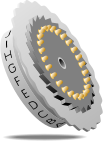
Umkehrwalze D, abbreviated UKW-D, was a field-rewirable reflector for the
Enigma 1 cipher machine,
invented in de mid-1920s by Chiffriermaschinen Aktiengesellschaft (ChiMaAG) [7]
and introduced in January 1944 by the German Air Force (Luftwaffe) as an
alternative to the existing reflectors UKW-B and UKW-C,
in an attempt to improve Enigma's cipher security.
A variant was available for use with Naval Enigma
M3 and M4.
It is also known as UKW Dora and Uncle D. 2
|
UKW-D was introduced by the Luftwaffe as part of a series of
improvements that were intended to improve the cipher security
of its Enigma I. Another safety measure was the
Enigma Uhr, which
was sometimes even used in combination with UKW-D
(e.g. on the Luftwaffe Red key).
The new rewirable reflector was mounted in place of the existing
UKW-B, and was rather cumbersome as it required part of the
machine to be disassembled. The operators didn't like it and as
a result, the wiring was changed only once every 10 days,
as per updated key sheet.
|
|
|
Had UKW-D been used with all
Enigma-I machines in the field,
it would have posed a serious – and possibly fatal – threat to the
codebreakers at Bletchley Park.
Luckily however, UKW-D wasn't distributed widely and
was therefore only used for specific – important – traffic.
Like with the Uhr,
the Germans had to be able to exchange
messages with both UKW-D and non-UKW-D users,
so they mixed messages with and without the devices,
using the same daily key.
This provided long cribs
and made breaking both Uhr
and UKW-D
very easy once the daily key had been broken.
UKW-D was also used in the Enigma KD,
a variant of the (commercial) Enigma K
that was used by the Mil Amt
(Militärisches Amt, the successor of the Abwehr)
from December 1944 onwards.
It is little known that a special version of UKW-D
was developed for the Kriegsmarine (Navy).
The version of UKW-D shown above is such a rare Naval variant.
It was developed for use with the four-wheel Enigma M4
and was supplied to units that had to communicate with the Air Force.
|
 |
After UKW-D was introduced, the key sheets of the Luftwaffe
were modified to include the wire pairs to be connected on the UKW.
Below is an example of such a key sheet.
Is has number 2744 which can be dated to August or September 1944.
It contains the Enigma settings for a full month starting at the bottom.
All key sheets were made for 31 days regardsless the length of the month.
Unused days were simply ignored or used for emergency messages.
The UKW-D settings are given in the 4th column, with the heading:
an der Umkehrwalze (at the reflector).
The settings are printed sideways, as they
were used for approx. 10 days.
The sheet below was found in the Bletchley Park archives
and was kindly supplied by Tony Sale
[6]. It is also shown
in Phil Marks's articles on UKW-D [1].
Click the image below to take a closer look.
These key sheets were used both by users of UKW-D
and users of UKW-B. Many mistakes were made when exchanging messages
between UKW-D and non-UKW-D users.
Furthermore, the table above shows the bad key-making habits of the Luftwaffe.
It features the non-crashing wheel order (i.e. a wheel was never used in the
same position on two successive days) and the non-consecutive Stecker rule
(never pair two consecutive letters together, e.g. CD or KL).
Such mistakes were a great help to the codebreakers as they reduced the
total number of possibilities.
The rightmost four columns of the table are used for the Kenngruppen
(discriminants). Each discriminant consists of three letters (trigram)
that were send as clear text in the preamble of the message
to identify the key in use.
The first two columns were used with UKW-B, while the last two indicated
that UKW-D was used. Again this was a cause of numerous mistakes
and confusion and occasionally British intercept stations overheared
arguments between German operators. Needles to say that such conversations
were often very helpful to the code breakers as well.
|
|
Opening an UKW-D can be a bit tricky. The inner core is held in place
by two spring-loaded balls, one at either side of the device,
that protrude a small hole in the outer shell.
Some people seem to think that you have to press both balls inwards,
e.g. with a screwdriver, in order to removed the inner
core. Over time, we've seen many UKW-D units with scratches around this area.
|
Removing the core is, in fact, very easy and should not cause physical
damage to the UKW. Simply use the rear end of a non-metal object,
such a paint brush or ballpoint, to push the inner core out of the outer
shell. That's all there is to it.
The inner part should come out easily
as shown in the images below.
Remove the inner part entirely if you want to alter the wiring.
Please note that the inner core has an
index pin that should mate
with a hole in the outer shell.
This index pin is present to ensure that the
wire core can only be fitted one way around.
|
|
|
Also note that the outer shell has another index hole
(on one of its curved mounting stubs).
This hole should mate with a pin inside the Enigma,
to ensure that the UKW is mounted with the right side up
and keeps it in place during normal use of the machine.
|
|
Inside UKW-D are a series of small single-pin plugs - much like small
banana-type plugs - and a bundle of textile-encapsulated wires.
There are 12 patch cables (rather than 13), each with a plug at either end.
They are used to connect the letters in pairs, just like in a standard UKW.
Due to space constraints (there are two mounting screws) one pair
is connected permanently.
|
Around the circumference of the inner core are 24 letters of the
international alphabet (not 26). Each letter A-Z corresponds to a
single socket of UKW-D. The letters J
and Y have been omitted.
Please note that the letters on the index ring do not match
BP's notation. On the ring, it starts with the contact just in front
of the topmost one (A) running counter clockwise,
whilst BP starts at the same contact but run clockwise.
The German notation (i.e. the index ring on UKW-D) was, of course, used on the key sheets.
|
|
|
The table below shows the mapping between BP notation (A-Z) and the physical
markings on the UKW-D itself. The missing contacts (i.e. the position of the
spring-loaded ball bearings) are marked with a '-' sign.
So, in BP notation, the letter pair BO is wired permanently.
To add to the confusion, Turing (in his Traitise) started numbering
from the contact at the dead top (1-26).
|
| Bletchley Park Notation | ABCDEFGHIJKLMNOPQRSTUVWXYZ |
| UKW-D index ring (German notation) | A-ZXWVUTSRQPON-MLKIHGFEDCB |
|
Although the various numbering schemes of an UKW-D are well-described by
Phil Marks in his excellent series about UKW-D in Cryptologia in 2001
[1],
there is often confusion on how to interpret the data. For this reason,
we will use the diagram below to explain this. In this diagram we are
looking at the contacts of the UKW-D from the main axle (i.e. from the
entry disc).
The official Enigma-numbering starts with the contact at the dead top,
moving clockwise over the surface of the UKW. This numbering is shown in red (1-26).
In the BP-notation however, each wheel was canted forward by one
position, as this is what would be visible through the window in the top lid
of the machine. This notation was also adopted by the US cryptanalysts.
It is shown in the above diagram in black (A-Z).
The German notation, engraved on the circumference of the UKW,
is shown in blue. This notation was used in the German key lists and moves
counter-clockwise, starting with the contact just in front of the topmost
one. Note that J and Y are omitted.
|
|
UKW-D was primarily used by the German Air Force, the Luftwaffe.
It is little known however, that it was also issued to Naval units that
needed to communicate with Luftwaffe commands.
The latter is described in Philip Marks' excellent series of
Cryptologia articles about UKW-D [1].
|
The UKW-D shown here was built especially for use in the Naval
Enigma M4.
The outer shell is made of zinc plated messing. As zinc easily oxidates
in a moist environment, it was used to protect the inner contacts of UKW-D.
When used inside an M4, it replaces the existing (thin) UKW-B and
Zusatzwalze Beta. This way, the machine was compatible
with a 3-wheel (service) Enigma that was also using UKW-D.
There was no point in retaining the Zusatzwalze, as together
with UKW-B it represented no more than a standard UKW
with 26 different settings.
|
|
|
The images below show how UKW-D is mounted inside the M4.
Engraved in the body of UKW-D is the text Oben (top) which means
that it has to be mounted with that side facing upwards.
Inside the Enigma is an
index pin that should mate
with a hole in the
body of UKW-D to prevent it from being mounted in the wrong orientation.
Once UKW-D is in place and the cover is closed, the red letter D,
engraved just below the word 'Oben',
is visible through the leftmost window
of the lid.
|
|
In December 1944, a new Enigma machine came into service at the German
Secret Intelligence Service Mil Amt (the successor of the Abwehr).
It was used on the Berlin - Madrid - Lisbon link and appeared to be
an Enigma KD; a rewired commercial Enigma (K) with UKW-D
[4].
|
Apparently, the Enigma KD was also used by the Swedish Intelligence Service,
as the FRA has one in its private collection.
Exactly how and why this Enigma KD came into their posession is currently
unknown, but it might be a left-over from WWII.
At the Enigma Reunion 2009
at Bletchley Park (UK),
the Enigma KD was on public display at the stand of the
Swedish Radio Intelligence Agency FRA [5].
The full wiring of this machine is known.
➤ More information
|
|
|
|
UKWD is known by the following names:
|
- UKW-D
- UKWD
- Umkehrwalze D
- Umkehrwalze Dora
- Uncle D
- Uncle Dora
- Uncle Dick
- UD
- Field-rewirable reflector
|
- Philip Marks, Umkehrwalze D: Enigma's rewirable reflector - Part 1
Cryptologia Volume XXV, Number 2, April 2001.
- Philip Marks, Umkehrwalze D: Enigma's rewirable reflector - Part 2
Cryptologia Volume XXV, Number 3, July 2001.
- Philip Marks, Umkehrwalze D: Enigma's rewirable reflector - Part 3
Cryptologia Volume XXV, Number 4, October 2001.
- David Hamer, Geoff Sullivan and Frode Weierud
Enigma Variations: An Extended Family of Machines
Cryptologia, Volume XXII, Number 3, July 1998.
- Försvarets Radioanstalt (FRA), Sweden (National Defence Radio Establishment)
Enigma KD from private collection of FRA. September 2009.
- Tony Sale, Luftwaffe key sheet 2744, August/September 1944
Personal correspondence. October 2009.
- History and Modern Cryptanalysis of Enigma's Pluggable Reflector
Olaf Ostwald and Frode Weierud. Cryptologia, January 2016.
➤ Author's copy, obtained from cryptocellar.org.
|
|
|
|
Any links shown in red are currently unavailable.
If you like the information on this website, why not make a donation?
© Crypto Museum. Created: Tuesday 11 August 2009. Last changed: Sunday, 21 July 2024 - 09:28 CET.
|
|

|
|
|
|