|
|
|
|
|

|
|
USA Rotor CCM →
Electric cipher machine (ECM) Mark II
SIGABA was an electromechanical rotor-based cipher machine
developed in the late 1930s in the United States (US) as a joint
effort of the US Army and US Navy [1].
At the time it was considered a superior cipher machine,
intended to keep high-level communications absolutely secure.
It was used throughout WWII and was so reliable that it was used
well into the 1950s, after which it was replaced by newer machines like
AFSAM-7 (KL-7).
As far as we know, SIGABA was never broken.
|
The image on the right shows one of the few SIGABA machines that have
survived. It has the appearance of a rather bulky typewriter, featuring a
full keyboard at the front. SIGABA is motor-driven and prints its output on
a narrow strip of paper that runs across the front.
The machine has three banks of 5 rotors each, which is clearly visible in
the patent below.
The main bank (at the rear)
holds 5 rotors with 26 contacts each. These are the main
cipher rotors. They work in a similar way as the rotors of the
contemporary German Enigma machine.
|
|
|
The machine was called SIGABA by the US Army and ECM MARK II (Electric
Cipher Machine) by the Navy. It is also known as Converter M-134 and
CSP-888/889 (Navy).
A modified Navy version is known as the CSP-2900.
The Germans called it the American Big Machine.
During and after WWII, a modified SIGABA, known as the
Combined Cipher Machine (CCM)
was used for Allied communication. The CCM is also known as
ASAM 5, CSP-1600, CSP-1700 and SIGROD.
SIGABA was used extensively by the US Navy, from submarines to battleships
[4], but also by the rest of the American armed forces.
According to the NSA,
over 5,000 machines were deployed by 1943, and
well over 10,000 by the end of the war [15].
This is far less than the number of
Enigma machines
that were used by the Germans (more than 35,000), but
still a significant quantity. Note however that the Germans used the Enigma
for tactical messages, whilst the Americans mainly used the
M-209
(Navy: CSP-1500)
for that purpose. About 140,000 M-209 machines
were made.
|
The image below gives a rough indication of the various controls and
features of the SIGABA. The machine resembles a large electric typewriter
and has a full keyboard with numerals and spacebar at the front.
A resettable character counter is present at the top right of the keyboard.
It allows the number of characters in a message to be counted, which may
be part of the message header.
The wheels are placed in a sub-assembly – also known as the rotor-basket –
which can easily be removed from the machine by opening the top lid and
releasing a few large bolts.
At the front of the machine, just above the keyboard, is an integrated
printer that features a rotating print head to produce the output on
a pre-gummed paper strip. The actual cipher wheels are placed in a so-called
basked that is inserted into the machine at the top left. Depending on the
version, 15 (SIGABA) or 5 (CCM) cipher wheels were present. At the top right
is the large MODE selector, that allows switching between encryption,
decryption, plaintext and OFF.
|
|
SIGABA has room for three rows, or banks, of five cipher wheels each.
The row closest to the rear holds the actual cipher wheels, each of which
has 26 contact at either side. The middle row holds five control
wheels with 26 contacts at either side. The image below shows these
cipher wheels.
|
The frontmost row hold the smaller index wheels that have 10 contacts
each. The index wheels do not move during operation and, together with the
control wheels, they control the stepping of the main cipher wheels
in the rearmost row.
Each cipher wheels consists of a black bakelite ring with 26 flat-faced
contacts at either side. Inside the bakelite ring is a plastic disc that
contains the actual wiring maze. It is soldered to contact pads inside
the ring. At the center of the wiring maze is a bronze bearing that allows
the wheel to be fitted on the main axle or spindle.
|
|
|
|
Note that in the CCM version of the SIGABA
(see below), only five
cipher wheels are present in the basket. The other 10 wheels are
omitted in that variant. With the CCM, ten cipher wheels were usually
supplied in a metal box, and each wheel was marked with a unique
index number.
|
|
Before, during and after WWII, the US Army and Navy each developed their
own cryptographic systems. Neither service shared their knowledge with
the other one, except for limited cooperation in the field of enemy signals
intelligence.
The first exception to this 'rule' was the development of
SIGABA. It combined the knowledge of top cryptographers William F. Friedman and
Frank B. Rowlett (Army) and Lieutenant Commander Laurence Safford (Navy).
|
From TICOM interrogations at the end of WWII, it has become clear that
neither the Japanese nor the German cryptanalysts had been able to break
SIGABA [15].
Modern crypanalysis can be performed on a high-end personal computer in
less than 24 hours. Various methods and algorithms for doing this were
described in 2023 by George Lasry in Cryptologia [16].
|
|
According to a recently released NSA document, SIGABA was such a reliable
machine that is was used throughout the 1950s. Some of its operating principles
were not declassified until the year 2000 [1].
Shortly afterwards, in January 2001, US patent 6,175,625
was released [2].
|
The design of the SIGABA machine was filed for a patent on 15 December 1944,
close towards the end of WWII. The patent was not published however, until
16 January 2001, shortly after the machine was declassified by the
NSA.
The patent lists Laurence F. Stafford and Donald W. Seiler as the inventors.
The patent covers 14 pages, including the 5 drawing sheets, and registers
21 claims. The drawing on the right is taken from the first page of the
patent. It shows the machine after the removing the metal cover. The printing
device (ENG-108) has also been removed in the drawing. It is connected to
the two large plugs.
|
|
|
The original SIGABA had three banks of 5 wheels each, the contacts of which
are visible in the drawing above. The main bank (at the rear)
contained 5 wheels with 26 contacts each. These were the main
cipher wheels and worked similar to the cipher wheels of
the Enigma machine.
The second bank (middle) also contained 5 wheels with 26 contacts
each, but these were used to control the movement of the main
cipher rotors. These were called the control wheels.
The third bank (front) contained 5 wheels that were smaller
than the others. They only had 10 contacts each and would not
move during encipherment. They are called the index wheels.
Together with the control wheels,
they controlled the movement of the cipher wheels.
|
|
For interoperability with the Typex machines used by the UK and
Canada, the following solutions were available:
|
- ECM Adapter (CSP-1600)
This adapter could be retrofitted to existing SIGAMA machines.
3,500 units were made by the Washington Naval Yard ECM Repair Shop.
- CCM version of SIGABA (CSP-1700)
This is a SIGABA variant made by the ECM Repair Shop of the Washington
Naval Yard, exclusively for Allied communication. Because of the high
cost, only 631 units were made.
- X-Adapter
This was by far the most common and cost-effective solution.
4,500 units were manufactured by the Teletype Corporation in Chicago
(IL, USA). They were installed by depot-level maintenance facilities.
It used Typex-configured cipher rotors.
- CCM Mark III adapter
This adapter unit can be fitted to a modified British Typex Mark 23
cipher machine, instead of the existing rotors. It makes the Typex
compatible with the CCM version of SIGABA.
|
|
|
Combined Cipher Machine
CCM/SIGABA
|
|
|
SIGABA was developed in the late 1930s and was used by the US Army
throughout WWII for secure communication at the highest level.
Towards the end of WWII, there was an increasing need for secure communication
with the British Armed Forces. It was decided that SIGABA would be modified,
so that it would become interoperable with a modified
British Typex machine.
The common machine was known as the
Combined Cipher Machine (CCM),
and was used from November 1943 onwards. The CCM/SIGABA modification was
known as ASAM 5 by the Army and CSP-1600 by the Navy, but a later
version of the machine (SIGABA + CCM adapter) was known by the Navy
as CSP-1700
[10].
According to the machine's base plate,
it was also built in 1943.
|
CCM was used for secure Allied communication during WWII and even
served
with the newly established NATO
for a few years after the war.
The wheel assembly was removed and replaced by an assembly of just
5 coding wheels. Less secure than the original, but interoperable
with a modified British Typex
(known as CCM/Typex).
The machine shown here is one of the very few CCM versions of
SIGABA that have survived. Unfortunately, the cipher wheels and the
motor assembly are missing from this one (see below).
|
|
|
Some publications about the SIGABA CCM suggest that the only modification
to SIGABA was the substitution of the 15-rotor basket by a 5-rotor one.
This was alledgedly done so that the machine could be converted back
to its original state at any time. With the later CSP-1700 shown here
however, this was not the case. The original machine has three entry/exit
contact plates at either side of the rotor basket, whereas the CSP-1700
version only has one at either side.
Furthermore, the rotor basket is connected to the rightmost set
of contacts by means of 6 wires that are screwed to 6 contact terminals
at the bottom of the basket. Although the rotor basket can be removed
relatively easy, a full SIGABA basket (with 3 x 5 wheels) can not
be retrofitted.
➤ More about CCM
➤ More about Typex
|
|
Considering its age, SIGABA is a very compact, albeit heavy, unit.
It has an almost cubical shape, with a keyboard sticking out
at the front. The rest of the machine is divided into two sections:
a large one at the top that contains all mechanical parts, the motor,
the cipher wheels and the mode selector,
and a small one at the bottom that contains the electrical parts
and the wiring.
|
The bottom section can be accessed by removing the
large base plate that is affixed at the four
corners. The base plate contains four shock-mounts
that should limit the amount of vibration when the machine is in operation.
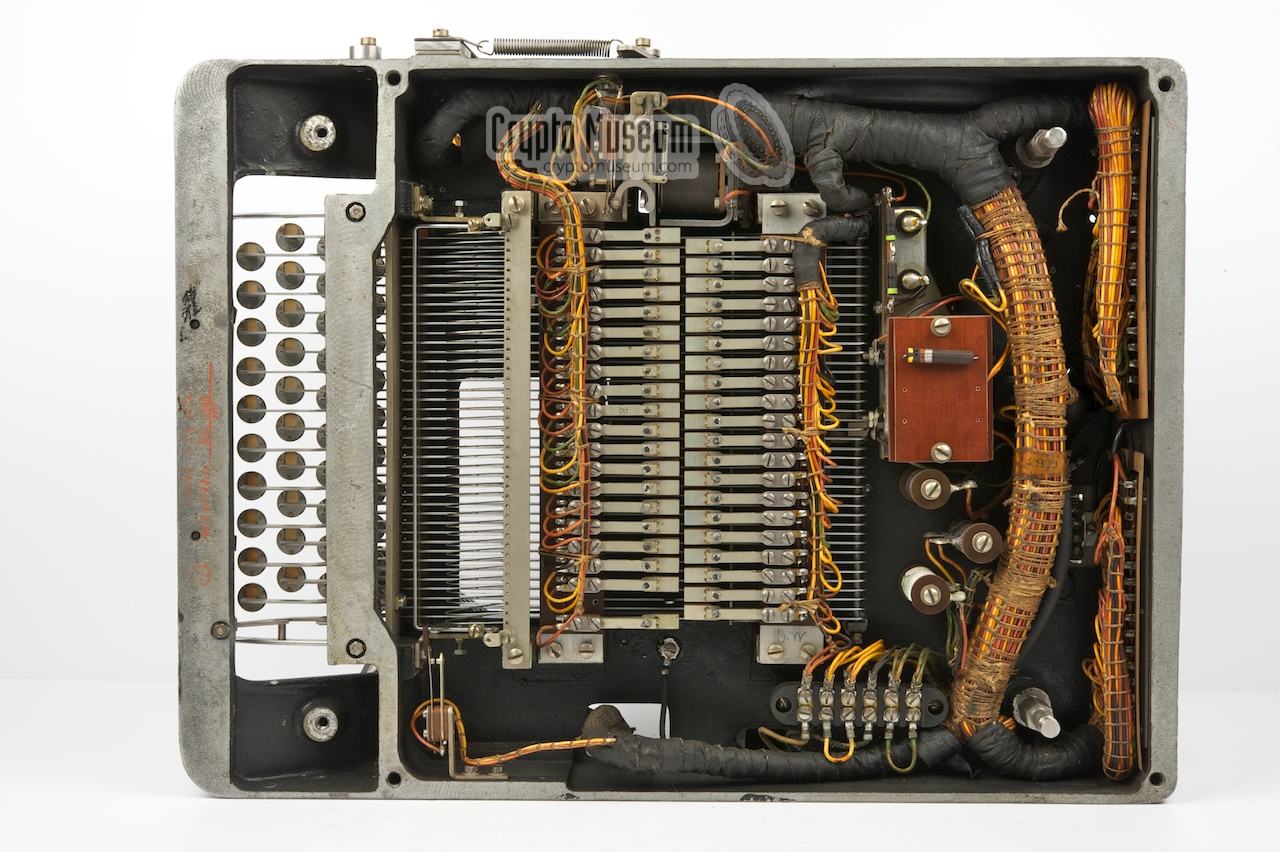
The image on the right shows the interior of the bottom section, with the
keyboard at the left. At the center are two arrays with switch contacts.
These switches are operated directly by the keys of the keyboard.
The rest of the bottom section is taken up by large bundles of cables and
some additional electrical components.
|
|
|
|
At the right in the image above, are the two large input and output
connectors.
The top section of the machine can be accessed by removing the large metal
hood that is held in place by two bolts at the front and a hidden one
inside the rear, behind the motor assembly (mode-switch set to O).
|
The image on the right shows the interior of the top section, seen from the
front right. The empty space at the right is normally contains the motor
and the main driving shaft. Unfortunately they are missing from our machine
(see below).
The shiny construction at the front right of the machine, is the mode selector.
It consists of a large vertical array of
stacked switches with a knob
at the top. It allows selection between cipher (C), decipher (D) and
plain-text (P) mode.
It can also be used to turn the machine off (O) when it is no longer used.
|
|
|
|
The printer unit is at the front right. It can be removed completely
and is described above. Behind the printer, at the left rear,
is the rotor basket. The one shown here is a CCM rotor basket
and is described in more detail above.
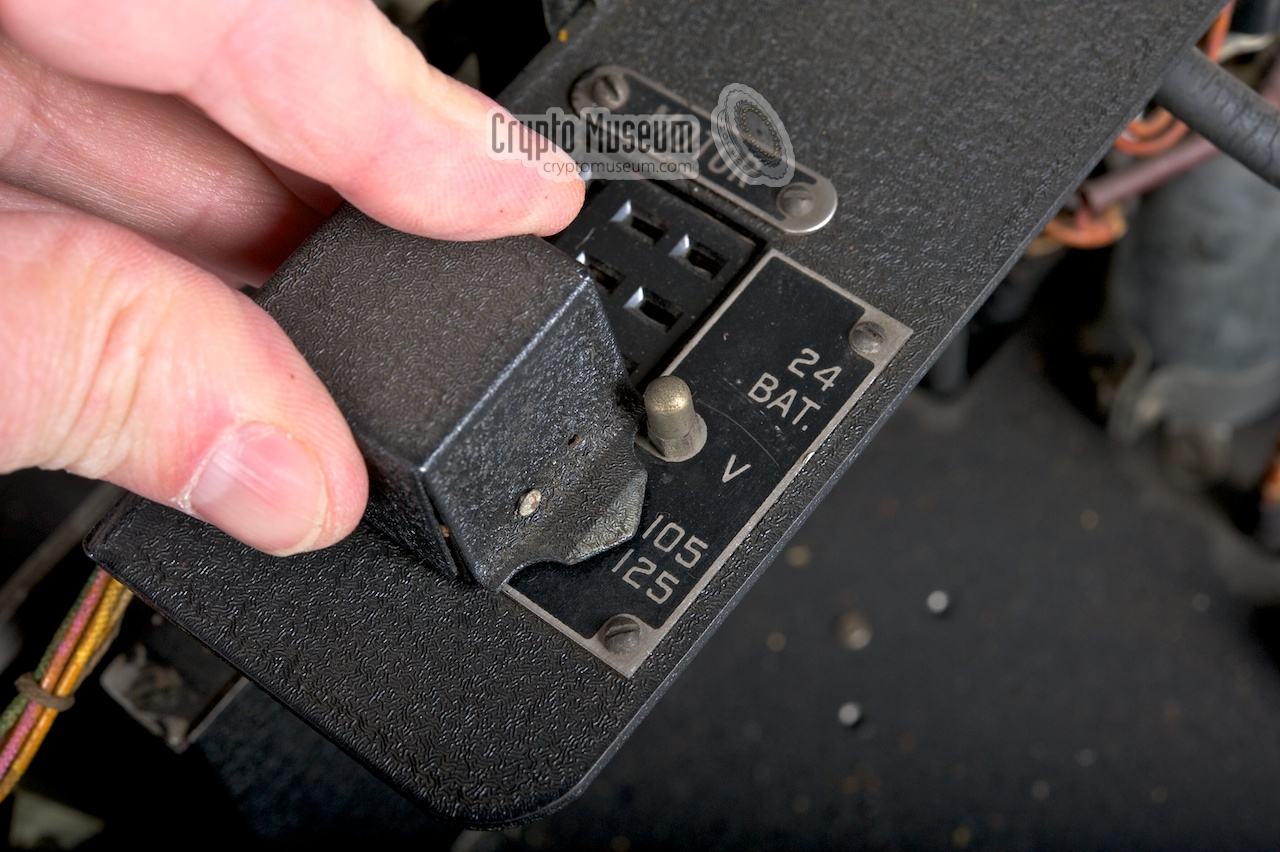
To the right of the rotor basket is a small panel with a
square plug
that can be used to select the operating voltage: 24V DC or 110V AC
(no 220V setting!).
|
|
The SIGABA can print its output directly onto a pre-gummed paper
strip. The printer uses an ink ribbon and is mounted at the front of the
machine, directly above the keyboard.
The paper is fed to the printer from a reel that
is mounted in a circular space at the right side of the machine.
|
The letters are printed onto the paper strip by a rotating print head
with embossed characters around its circumference.
The print head is driven mechanically from the rear right by the main motor shaft. A series of solenoids inside the printer
select the point at which the print head is stopped when the hammer
at the bottom pushes the paper strip against the head.
The printer can easily be removed from the machine by releasing
four large bolts at the bottom.
The image on the right shows the bare printer once it is removed from
the machine.
|
|
|
|
At the left of the printer are two large sockets
for the connection between the electrical circuits at the bottom of the
machine and the solenoids inside the printer. Two thick cables, each with
a large connector at the end,
are slotted into these sockets.
A similar printer, with a rotating print head and solenoids,
was used in the early 1950s with the later
American KL-7 cipher machine.
|
The CCM/SIGABA shown on this page has probably been used with NATO in
the years following WWII. Unfortunately, certain critical parts have
been removed, so we suspect that this machine has been cannibalized
for spare parts in order to repair other machines.
We would very much like to get it running again.
In the drawing below the missing parts have been coloured.
We have recently (May 2012) cleaned the machine and restored the existing
parts. Below are some photographs of the restoration process.
In case you have any parts for this machine or if you have additional
information, please contact us.
The following parts are currently missing:
|
- Yellow: ZEROIZE switch with cable
- Light blue: Motor with worm wheel
- Red: Main shaft
- Dark blue: Left bearing
- Five large cipher wheels
|
|
It is quite possible that the ZEROIZE button was not used on the CCM
version of the SIGABA at all. As we haven't found (part of) the cable
assembly or any contact terminals in the bottom section, it is possible
that the switch was never mounted on this version.
|
Device Rotor-based ciphermachine Purpose Secure military and diplomatic traffic Name SIGABA Designator ECM Mark II, M-134, CSP-888/889, other (see below) Inventors William Friedman, Frank Rowlett, Laurence Safford Rotors 5 + 5 + 5 Quantity 10,060 [15]
|
- SIGABA
ECM Electric Cipher Machine ECM II Electric Cipher Machine mark II - ECM Mark II
Converter M-134 Army designator for SIGABA CSP-888/889 Navy designator for SIGABA - CSP-2900
ASAM 5 SIGABA + CCM basket (Navy variant) CSP-1600 SIGABA + CCM basket (Army and Air Force variant) CSP-1700 CCM version of SIGABA with fixed rotor basket (Navy variant) 1 SIGROD Same as CSP-1700 (Army and Air Force variant)
|
-
The machine featured on this page is a CSP-1700.
|
- NSA, Cryptologic Almanac 50th Anniversary Series, AFSAM-7
Declassified by NSA on 12 June 2009.
- Laurance F. Safford, Donald W. Seiler, U.S. Patent 6,175,625
Filed 15 December 1944. Published 16 January 2001.
- JJG Savard & RS Pekelney, The ECM Mark II: Design, History and Cryptology
Cryptologia, Vol. 23, No. 3, June 1999, pp. 211-228.
- R Pekelney, ECM MARK 2 and CCM MARK 1
Operating instructions for ECM Mark 2 (CSP 888/889) and CCM Mark 1 (CSP 1600).
- Rich Pekelney, Electronic Cipher Machine (ECM) Mark II
Detailed description of the ECM Mark II (SIGABA).
- Michael Lee, Cryptanalysis of the SIGABA
Thesis for the degree Master of Science in Computer Science.
University of California, Santa Barbara. June 2003.
- Wing On Chan, Cryptanalysis of SIGABA
Project Report for the degree Master of Science.
San Jose State University. May 2007.
- Heather Ellie Kwong, Cryptanalysis of the SIGABA Cipher
Thesis for the degree of Master of Science.
San Jose State University. December 2008.
- John Savard, The ECM Mark II, also known as SIGABA...
Website, discussing the operation of SIGABA. Retrieved June 2012.
- Wikipedia, Combined Cipher Machine
Retrieved November 2012.
- Jerry Proc's crypto pages, CCM Mk II (Combined Cipher Machine)
Retrieved November 2012.
- NATO, CCM Systems for NATO
SGM-1922-51. 10 November 1951. NATO SECRET.
Declassified by NATO on 12 October 1994 (IMSM-431-99).
- US Navy, Comments on Army Proposals Regarding the CCM
10 January 1948. SECRET.
Declassified by NSA on 20 September 2013 (EO 13526).
- Richard James Aldrich, Espionage, Security and Intelligence in Britain, 1945-1970
ISBN 0-7190-4955-5 (hardback) 0-7190-4956-3 (paperback).
1998. pp. 51-53.
- Timothy J. Mucklow, The SIGABA/ECM II Cipher Machine: A Beautiful Idea
NSA, Center for Cryptologic History, 2015.
- George Lasry, A Practical Meet-in-the-Middle Attack on SIGABA
Cryptologia Volume 47, 2023 - Issue 1.
|
|
|
|
Any links shown in red are currently unavailable.
If you like the information on this website, why not make a donation?
© Crypto Museum. Created: Wednesday 12 August 2009. Last changed: Thursday, 27 March 2025 - 07:02 CET.
|
 |

|
|
|