|
|
|
|
|

|
|
Enigma Tree Rotor Enigma A → ← Die schreibende Enigma
Printing Enigma Model H29 · 1929
- wanted item
Enigma H 1 or Enigma Model H29, is an Enigma cipher machine,
introduced in 1929 by
Chiffriermaschinen AG in Berlin (Germany),
as the successor to the Schreibende Enigma
of 1926.
It was the last in a series of machines that printed directly to paper.
The Enigma H29 was used by the German Wehrmacht, where it was known
as Enigma II (Roman number 2). It is known that some machines were
sold to Hungary, where it was used as a printing device for modified
Enigma G.
|
The official model number of the Enigma H was H29 and the internal
designator used by the manufacturer was Ch. 14.
The Reichswehr (later: Wehrmacht) referred to it as Enigma II (say: 2).
The machine had 8 rotors, but only the middle 4 were used for
scrambling the electric signals. The others were used to
control the turnovers of the electric rotors.
Each electric rotor had 26 contacts at either side (A-Z).
The device could handle letters, numbers and punctuation marks.
The Enigma H printed directly onto paper, using push-bars
(or shift-bars) but was not
a reliable machine. Despite various improvements,
there were many complaints about blocking machines.
|
|
|
The price of an Enigma H was rather high: it was offered for RM 8000 2
to Mr. Walter Edström in September 1929 [11], and for no less than
RM 12000 to the Spanish Government in 1931 [12].
Not many H29 machines were ever built and even fewer have survived.
The only example that is currently known,
is in the Military Museum in Budapest (Hungary).
It is not in working condition, and several
parts are missing, but has been restored cosmetically
(more information below).
The Enigma H was the last printing Enigma
before the glowlamp-based Enigma took over completely.
|
-
The meaning of the letter 'H' was probably Handelsmaschine
(trade machine).
-
RM = Reichsmark, the German currency in those days.
|
The image below provides an overview of the features of
the Enigma H29. The machine itself looks like a rather bulky electric
typewriter and measures approx. 65 x 45 x 38 cm. It weights
nearly 60 kg and is mounted on a
wooden panel
that contains the wiring
of the entire system. When not in use, a wooden hood would
normally be fitted over the machine to protect it against dust.
The machine could be carried by pulling out two
metal grips at the front and rear.
The machine is powered by an (external) 80-90V DC power source
that is connected at the rear.
By using large power resistors, it was possible to connect it
directly to the 110V or 220V DC mains (where available).
For use on AC networks, an optional external rectifier
had to be used.
Power was turned on and off with a standard electrical switch that
was mounted on the wooden bottom panel at the
right front.
Is has been removed from the machine shown here.
An indicator at the top left
of the keyboard showed that power was turned on.
It should be noted that the machine is not motor-driven,
but that it is completely operated by means of electrical solenoids.
As a result, the machine only makes noise when a key is softly pressed.
|
|
A number of H29 machines were sold to Hungary before the outbreak
of WWII, probably around 1931. The Hungarians ordered an unknown
number of H29 machines with a printer connection, and 24
Enigma G31 models with a socket for connection to the larger machines
(Ch.15b) [7].
|
We were given access to the machine and Dr. Ravasz put his office
at our disposal for the day. The machine has serial number H221
and was in pretty bad condition at the time. It had probably been used
as a parts-donor when repairing other H29 machines. Several keys were
missing from the keyboard and the paper carriage at the rear
was missing completely.
Furthermore, some of the smaller parts, such as one of the windows
and the Enigma logo, had been removed as well.
Nevertheless, we were very exited about the find of this this extremely rare
machine.
All images on this page are of the H221 and were taken at the museum.
We believe that this is the first time this machine has been publicly documented.
Thanks are due to Dr. Ravasz for granting us access.
|
It is unknown at present how many H29 machines were bought
by the Hungarians. According to the museum historian,
the Hungarian Army had three machines in their inventory at one time.
Each machine was marked with a painted number, with the
H221 carrying the number 2 on its rear panel.
This has yet to be confirmed, as no supporting documents
have been found to date.
➤ More about the rediscovery of the H221
|
|
A year after our rediscovery of the Enigma H221 on 31 July 2013,
we visited Budapest again to see what had become of this rare Enigma
family member. The machine was now on public display at the Hungarian Spy
Museum in the Royal Cellars in Budapest [13] and had been partly restored.
|
The missing keys – with the correct inlays – had been added in the previously
empty spots. Just above the keyboard, the second rotor window from the
left had been reconstructed, and the Enigma logo had been fitted
to the front of the machine. As a result, the Enigma H221 now stands out
pretty well in any crypto exhibition.
Despite the successful cosmetical restoration, the paper carriage is still
missing and it is doubtful whether the machine will ever run again.
Nevertheless it is a unique historical artifact that you must see on
a trip to Budapest.
|
|
|
The Hungarian Spy Museum was located in the Royal Cellars in Budapest,
just a few hundred metres from the Hungarian Military
Museum. It was closed in early 2014 due to lack of interest, and the
website [13] has since disappeared. The current whereabouts of the H29
are unkown.
|
|
Setting the key of the H29 is rather straight forward.
As all cipher rotors are permanently mounted on a single
axis, they cannot be removed or swapped. When setting the
key, the user first has to press a large knob (Lock) at the
right side of the machine to disengage the rotors.
|
Now that the rotors can be moved freely, the user can then set all
eight rotors to the desired Message Key (Spruchschlüssel) by
moving the protruding thumbwheels up and down.
It is also possible to change the setting of the index rings
(Ringstellung) on each of the rotors, by unlocking
and raising the metal rotor cover.
Altering this setting is called the Basic Setting (Grundstellung)
and has no impact on the overall cipher security. It is merely a way of
obscuring the key from the user. Once the Grunstelling has been altered,
the top lid can be sealed.
|
|
|
Once the cryptographic key is set, the locking knob at the right side
has to be pulled out in order to engage the rotors again.
The machine is now ready for operation.
The main mode of operation is selected by means of a
large lever at the left side of the machine.
This lever has three settings:
Chiffrieren (Ciphering), Klarschrift (Plaintext) and Dechiffrieren
(Deciphering). Ciphering has to be enabled first by setting
a slide switch from Code aus (code off)
to Code ein (code on).
|
The Enigma H29 features 8 rotors that are mounted on a single
axle. The middle 4 rotors are the actual electrical coding rotors,
which are similar to the rotors of a glowlamp-based Enigma.
Each rotor has 26 spring-loaded contacts on one side and 26 flat-faced
contacts on the other side. The letters of the alphabet (A-Z) are
engraved at the circumference of each rotor (index ring).
The outer 4 rotors (i.e. the leftmost two and the rightmost two)
control the stepping of the electrical rotors. Each stepping
rotor has a different number of steps (26, 27, 29 and 31)
and controls one of the electrical rotors. As some rotors have
more than 26 possible positions, they have numbers on the
index ring in addition to the alphabet.
All eight rotors are shown above.
Based on the brochure, the patent description and on observations
of the machine, the drawing above should illustrate the basic
operation of the machine. The outer 4 rotors are the stepping rotors (red).
The rightmost stepping rotors of each set are driven by a common axle.
Apart from driving the corresponding cipher rotor, they also control
the stepping of the adjacent stepping rotor by means of a cog-wheel
with 5 gaps (i.e. 5 teeth missing). The total period is then:
5 x 5 x 26 x 27 x 29 x 31 = 15,777,450
The brochure [2] confirms that the cipher period is indeed 15770450
and claims that the machine is capable of generating 17,576 different
alphabets (26 x 26 x 26). This gives a total number of 277,304,461,200
unique keys that can be entered by the user.
As the 4 electric rotors each have 26 contacts, the number of
substitution alphabets is calculated as 264 = 456,976.
The rotors are all mounted on the same axle and can not be
removed. The position of the rotors can be controlled with
two knobs (one at either side of the machine) and manually
by moving the outer thumbwheel. In addition, the index ring
of all 8 rotors can be altered (Ringstellung)
as part of the machine's basic key (Grundstellung). This has
no effect on the cryptographic strength.
Above the rightmost three rotors is a
5-digit odometer that
counts the number of characters entered on the keyboard.
The counter can be zeroized my means of a knob at the right.
When the rotor cover is closed, the counter can be read through
a small window at the top right.
|
|
The mechanism of the Enigma H29 shows great resemblance to the
Russian M-130 (Koralle), which was
introduced in 1965.
The M-130 features the same principle of
separate stepping rotors and electric rotors, although some
improvements have been implemented in the M-130.
|
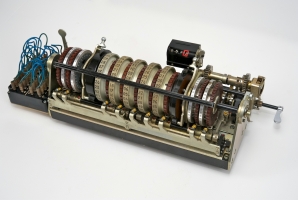
The image on the right shows the cipher unit of the
Russian M-130. At the center are 5 electric rotors
(as opposed to 4 in the Enigma H29) and 2 stepping rotors
at either side. Even the counter is mounted at the same
position. The extra rotor makes the
M-130 cryptographically stronger.
Another improvement is the addition of two plugboards,
located at the far left. Electrically, one plugboard
is inserted at either side of the scrambler.
Although similar to the plugboard of Enigma i,
it is cryptographically much stronger as it's single-ended
rather than double-ended.
|
|
|
It is possible that the Russian design was influenced by the H29,
as the Russians probably had knowledge about its technical details.
Several H29 machines had been used during WWII by the Hungarian
Army which, after the war, came under the influence of the USSR.
➤ More about the M-130
|
|
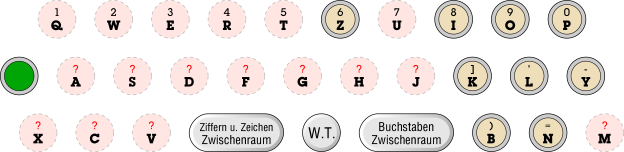
The keyboard
of the H29 consists of 26 ordinary keys, plus 3 special
keys at the bottom row. Two of the special keys are extra wide and
are engraved with the text Ziffern u. Zeichen Zwischenraum
(Numbers and Punctuation marks / Space)
and Buchstaben Zwischenraum (Letters / Space).
At the far left is a green key that can be pulled-out.
It allowed switching to upper case characters (shift).
|
The wider keys have a double function. They act as a shift
from letters to numbers and vice versa, but also insert a SPACE
in the text when they are pressed. When in letter-mode, the leftmost
space bar should be pressed in order to enter number-mode. Whilst
in number mode, spaces are inserted with this key as well.
To revert to letter-mode, the rightmost space bar should
be used. Whilst in letter-mode, this key can be used to insert
spaces in the text.
The WT-key, in between both space bars,
was used to move the carriage (Wagen Transport).
|
|
|
Some old black-and-white photographs of an Enigma H29
show a keyboard with bakelite keys.
The Hungarian H221 however, has metal keys with a glass window.
It is unclear which keys are the older ones, but it is likely that
bakelite keys were used later as a cost-saving measure.
The keyboard of the H221 was incomplete
and many of its key-tops were missing. This is another indication
that the machine might have been used for spare parts.
Fortunately though, the key tops
are screwed onto a threaded shaft,
making it relatively easy to restore the keyboard.
|
Although the exact layout of the keyboard was initially
unknown, the drawing below shows the position of the missing
letters. By observing the three characters on each of the
type bars, it was possible to reconstruct the
full keyboard layout
and add the punctuation marks to the key tops.
As each ci[her rotor has 26 contacts, only 26 letters can be
encoded. Normally this would be the full Latin alphabet (A-Z),
but as we need two characters for letter-shift and number-shift,
two letters had to be given up. According to patent
DE425566 of 28 February 1924,
this might have been done by sacrificing the letters J and Q.
Typing the J on the keyboard would produce an I and typing
a Q would produce a K so that the clear text output would
still be comprehensible.
|
|
Although electrical typewriters were not commonly used in 1929,
they were available from some manufacturers both in Germany
and abroad. Converting an electric typewriter for use as a cipher
machine however, must have been a real challenge for the designers
at Chiffriermaschinen AG.
|
The first Printing Enigma (Die Handelsmaschine)
had a rotating letter-wheel, but this imposed so many problems that
in the Schreibende Enigma it was replaced
by regular type-bars (Typenhebel). In the Enigma H29 however,
the type-bars were replaced by so-called push-bars (Stoßhebel).
Unfortunately, the carriage of the Enigma H221 is missing
completely. The image on the right shows a rear view of the
machine at the position where the carriage once was. It now
gives us a clear view of the carriage transport mechanism,
the ink ribbon and the typing mechanism.
|
|
|
The printer features a rather high ink ribbon (26cm) that was not
uncommon in those days. Below the ink ribbon spool is a
bell that was probably used to indicate
the end of a line when entering text.
Each push-bar contains 3 characters: a lower-case letter, an
upper-case letter and a number or punctuation mark.
When typing, the letter bars
would move forward and push the ribbon against the paper on the
carriage, thereby printing the selected letter onto the paper.
|
|
|
Using the H29 as a printer
|
|
|
|
Some Enigma H29 models were equipped with a special connector to allow
the large machine to be used as an external printer to a (smaller)
glowlamp Enigma machine, such as the
Enigma G (Model G31) and the
Enigma I.
The glowlamp machine had to be modified for this as well.
Please note that the Enigma H29 is not compatible with any of the
glowlamp Enigma machines. When connected to a small glowlamp machine,
the H29 is only used as an external printing device.
|
The image on the right shows the special socket
with 28 electrical contacts that is present on the left side of the H221.
When unused, the socket is normally covered by a
circular panel.
A lever
at the front side
of the machine allowed selection between
Große Maschine (big machine) and Kleine Maschine
(small machine). When the H29 was used as a stand-alone cipher machine,
the big machine
had to be selected (leftmost position). This was default operation.
When the machine was used as a printer for a glowlamp Enigma,
the lever was set to small machine.
|
|
|
Selecting the small machine would disengage the cipher mechanism
of the H29 and bypass the electric rotors. In this position, the
machine was used as an ordinary electric typewriter. Please note
that the expansion connector shown here was not present on all
Enigma H29 models. Although it is visible on the
H29 brochure
that was supplied to the Spanish Embassy in 1931 [2],
it was missing from the photograph on an
earlier leaflet
[3]
published in Cryptologia in 2002 [4].
|
The use of the H29 as a printing device for a glowlamp Enigma
is described in German patents DE536556
and DE595075.
The image below was taken from one of these patents.
At the right is the H29 with the lever clearly visible on the
front panel (14). More related patents below.
At the left is a modified glowlamp Enigma; in this case a
Zählwerk Enigma with a special socket (12) at the
right instead of the battery compartment. Whether any lamp-based Enigma
was ever modified in this way remains to be seen. The connector was
more likely located at the left side.
|
In 2009, a special version of the Enigma Model G31 appeared at
an auction house in Germany [9]. It appeared to be an
Enigma-G
– sometimes called the Abwehr Enigma –
with serial number G-111.
It turned out that this machine was an extended version of
the standard Enigma-G (Ch.15a) that featured a printer socket,
just like the H221 shown above. It is known as Ch.15b.
The image on the right shows the printer socket on the G-111,
which is located at the left side of the machine, towards the
rear. A circular cut-out in the wooden case gives access to the
socket.
|
|
|
On 1 July 2009, Crypto Museum was invited to visit the auction house
in Munich, where Paul Reuvers and Marc Simons were given the opportunity
to take a closer look at the machine [5].
Our findings have been published in the report
Enigma G111: A rare Zählwerk Enigma variant
[6].
The exploded view below should clarify things somewhat.
Please note that during our investigation, we were unable to dismount
the switch assembly and are therefore uncertain about the shape
of the centre part and the cylindrical contacts.
We had to make a few 'educated guesses', based on our knowledge
of the German manufacturing skills.
The same is true for the shape of the plug.
The socket on the side of the H221
appears to be similar to the one on the G111, but not identical.
The flat-faced contacts on the pertinax panel are spaced differently.
The G111 socket features 28 contacts arranged in a zig-zag pattern,
whereas the socket on the H221 has 26 contacts in a zig-zag pattern
and the remaining two contacts (33 and 34) in the inner circle.
This means that the cable between the two machines had two different
plugs. In order to prevent the cable from being inserted the wrong way
around, the index key at the center of the plug at the Enigma-H side,
has longer teeth. It would not fit the socket on the G111.
The image above shows an educated guess of what the plug might
have looked like. It shows a cross-section of the socket with a
rotary switch on the right, and the actual plug on the left.
The rotary switch was used on the G-111 to
switch between the 26 lamps and the (external) printer.
The Enigma-H does not have such a switch.
Instead, it has a lever
to switch between normal operation (Große Maschine
= big machine) and printer-use
(Kleine Maschine = small machine).
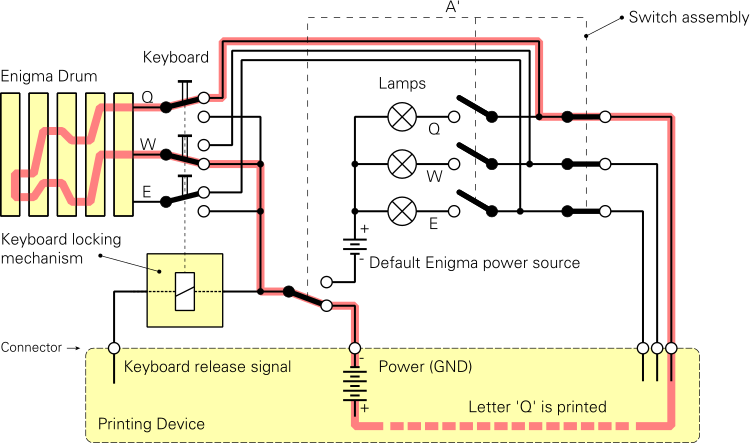
The simplified circuit diagram above shows how the electric current
would flow between the two machines. In this diagram, the H29 machine
is represented by the yellow rectangle at the bottom, marked as
'Printing Device'. The upper part shows the lamp-based Enigma
with disabled lamps.
➤ More about Enigma G111
|
|
At the rear of the H29 machine is a metal plate with a long list of
international patent numbers. This is a rather unique feature that we
previously also found on the Enigma G-111. These plates
were probably attached to both Enigma models,
because the machines were also sold abroad.
|
The image on the right shows a close-up of the patent plate.
The first two columns show the German Patents, or Deutches Reichs
Patent (DRP), whilst the other columns list the patents in the USA,
Great Britain (England), France (Frankreich) and The Netherlands (Holland).
The list also indicates that it has Patents Pending
(ang. = angemeldet) in Germany and in the USA.
The line at the bottom reads: Weitere Patente in allen Kulturstaaten
(More patents in all civilized countries).
For a full overview of Enigma-related patents, please refer to the
Enigma Patents page.
|
|
|
Although the patent plate is similar to the plate that was mounted to
the rear of the G-111, and both machines were developed around the same time,
it shows a number of different patents. They are listed below.
A star (*) indicates that this patent was also listed on the
Enigma G-111.
|
- DE383594 / 12 February 1922
Patent for a ciphering machine with electric rotors,
filed by Securitas Amsterdam (Netherlands). This patent was
also filed in other countries, e.g.
United Kingdom (GB193035),
USA (US1657411),
and France (FR561910).
- DE409301 / 20 September 1921
Patent for a ciphering machine with a reduced number of contacts
(by introducing multiple shift keys), electric rotors,
and a printer with a rotating drum. Filed by Securitas Berlin
(Germany). This patent is similar to US1584660.
- DE411126* / 18 Aug 1923
Patent for the use of index rings (letter rings) on the rotors
and on other parts of the turnover system, in order to set the message key.
Filed by Securitas Amsterdam (Netherlands).
- DE412582* / 25 March 1924
System for blocking the various cipher components after each key-press.
This should avoid a cipher rotor from making more than one step on a
single key-press.
- DE416219* / 23 February 1918
This is the first Enigma-related patent, filed by Arthur Scherbius,
issued 23 February 1918. It was released on 8 July 1925.
- DE425147* / 26 Sep 1920
Patent for a cipher machine in which each key-press causes an irregular
movement of multiple cipher discs. The drawings clearly show an early
concepts of an electrical cipher machine with drums for ciphering and
deciphering.
- DE425566 / 28 Feb 1924
Patent for allowing two different alphabets (letters and numbers/punctuation
marks) to be enciphered, using just the 26 letters of the telegraph alphabet.
This was done by replacing 'j' by 'i' and 'q' by 'k', and using the contacts
for 'j' and 'q' to select between letters and numbers.
- DE429122* / 26 March 1924
Patent for a cipher machine in which cog-wheels with a varying
number of teeth (prime numbers and numbers without a common factor)
are used to create a pseudo-random generator with a very long period.
This patent is clearly related to the design of the very first
Enigma model: Die Handelsmaschine, introduced in 1923.
It is also related to later machines.
- DE454392 / 30 Jan 1924
Patent for enhancing the irregular movement of the rotors during
encipherment, in order to increase cipher security, by allowing
a rotor to make multiple steps on a single key-press.
|
|
The following German patents are also related to the Enigma H29, but
were pending at the time the H29 was released:
|
- DE541702 / 30 January 1929
Patent for the use of electromagnets in a typewriter or
ciphering machine, in order to print a character on paper.
Invented by Arthur Scherbius and Willi Korn.
- DE524754 / 30 January 1929
Patent that describes the construction of a cipher machine in which
all keying elements are mounted on the same geometrical axis, making the
setting of a message key much simpler as before. This
includes both the electrical cipher rotors and the notched cog-wheels
that drive the cipher rotors.
In previous systems a separate axle was used for each driving notched cog-wheel.
This patent clearly describes the Enigma H29.
- DE550796 / 5 February 1929
Patent for the addition of extra switching rotors, outside both
fixed end-discs, to allow easy selection between cipher,
decipher and plain text, without the need for large - expensive -
multi-pole switches.
- DE536556 / 22 June 1929
Patent for connecting a printing Enigma (Schreibende Enigma),
such as the H29,
to a lamp Enigma (Glühlampenmaschine)
so that it can be used as a printing device. Invented by Willi Korn.
The Enigma G111
is an example of a lamp-Enigma that was used this way.
- DE595075 / 4 November 1930
Supplement to patent DE536556.
Patent for a switching connector
inside the Enigma, allowing the lamps to be switched off when
a printer is connected. Invented by Willi Korn and Karl Röpke.
Enigma G111
is an example of a lamp-Enigma that was issued with this connector.
|
- US1533252* / 18 Sep 1920
This is the US-version of the original
Dutch Patent NL10700. It is filed by
NV Securitas in Amsterdam (Netherlands) and lists Hugo Alexander
Koch as the inventor.
- US1584660 / 7 December 1922
Patent for a ciphering machine with a reduced number of contacts
(by introducing multiple shift keys), electrical cipher rotors,
and a printer with a rotating drum. Filed by Arthur Scherbius
on behalf of Securitas Amsterdam (Netherlands).
- US1657411 / 6 February 1923
First US patent that clearly resembles an Enigma machine,
filed in the US by Arthur Scherbius
on behalf of Chiffriermaschinen AG (Germany). Note that this
patent is identical to DE383594,
filed by Securitas Amsterdam (Netherlands)
and British patent GB193035, also filed by Securitas.
- US1520089 / 15 Feb 1924
Patent for an Electric Typewriting Machine and improvements of such
machines, filed on behalf of Arthur Scherbius.
This patent is used in the Enigma Model H29.
|
- GB163357* / 10 November 1919
Improvements in and relating to Ciphering and Deciphering Machine.
This patent is basically the British version of Koch's original
Dutch Patent NL10700.
- GB193035 / 3 February 1923
Patent for a chiphering machine, filed by
NV Ingenieursburo Securitas of Amsterdam (Netherlands).
This patent is identical to American patent
US1657411, which
was filed by Arthur Scherbius of Chiffriermaschinen AG.
- GB213968 / 8 January 1923
Ciphering Machine. Using multi-switches to select between subsitution
alphabets. This patent is similar to
German Patent DE385682 (19 May 1922)
and was filed by NV Securitas in Amsterdam (Netherlands). It is clearly
related to the printing Enigma machines.
- GB231502* / 25 March 1925
Patent for improving ciphering machines by using multiple
ciphering discs and a complex irregular rotor turnover
pattern by using special drive rotors. Filed by
Chiffriermachinen AG of Berlin (Germany)
- GB325020 ???
This patent is mentioned on a plate mounted to the
rear of the Enigma H29.
However the patent is clearly not related to the Enigma in any way.
It is possible that this was a so-called abandonned patent,
and that the number was later reused by the patent office.
|
- NL10700* / 7 October 1919
First Enigma-related patent registered in The Netherlands on 7
October 1919 by Hugo Alexander Koch. On 5 May 1922, the patent
rights were transferred to Naamloze Vennootschap Securitas
in Amsterdam, and on 28 January 1927 to Chiffriermaschinen
Aktiegesellschaft in Germany (Scherbius).
- NL12762 / 17 May 1922 (priority 23 May 1921)
Patent for changing number-pairs into letter-pairs and vice versa,
in order to avoid mistakes in sending (secret) telegrams.
The patent was filed by NV Ingenieursbureau Securitas of Amsterdam
on 17 May 1922, but claimed a priority of 23 May 1921 as a result of
an earlier German registration. The patent is nearly identical to
German Patent DE378238 which was filed by
Arthur Scherbius a day later (24 May 1921).
It was later transferred to Chiffriermaschinen AG in the same
Act as the previous patent (see below).
|
- Act of Transfer 886 / 5 May 1922
On 5 May 1922, the legal rights of Patent Application 13046
(the later Patent NL10700)
were transferred from Hugo Alexander
Koch to NV Ingenieursbureau Securitas in Amsterdam (Netherlands)
for the amount of NLG 500 (approx. EUR 225).
- Act of Transfer (10700 and 12762) / 28 January 1927
On 28 Janury 1927, the legal rights of both patents above
(NL10700
and NL12762)
were transferred by Hugo Alexander Koch,
acting on behalf of NV Securitas (Amsterdam), to Chiffriermaschinen
Aktiengesellschaft in Germany (Scherbius) for NLG 600 each.
|
Device Rotor-based cipher machine Brand Enigma Type H Model H29 Designator Ch.14 Year 1929 Manufacturer ChiMaAG Country Germany Customers see below Rotors 8 (4 stepping, 4 electrically wired, all fixed in place) Turnovers 1 per rotor (notch attached to rotor body) Reflector no Wiring unknown Stepping Cog-wheel gear Plugboard no Extras Crank Price RM 13,000 (1929) Quantity 25 ~
|
- German Army (Reichswehr)
- Hungarian Army
- Argentina
- Deutsche Stikstoff Syndikat (German Nitrogen Syndicate)
|
- Enigma H
- Enigma model H29
- Ch.14
- Enigma II
|
H201 - H210 1929 Reichswehr H211 - H215 ? ? H216 - H219 1930 Reichswehr H220 - H221 1931 Hungary
|
H221 Museum for Military History, Budapest (Hungary)
|
- Eric Tischer, Early full-colour photograph of Enigma H221
Personal correspondence. 11 January 2008.
- Chiffriermaschinen Aktiengesellschaft, Enigma H29 brochure
Kurze Beschreibung der schreibenden ENIGMA-Chiffriermaschine.
Date unknown, but probably from 1931. Crypto Museum #300302.1
- Chiffriermaschinen Aktiengesellschaft, Enigma H29 leaflet
Date unknown, but probably from 1929. Also published in [4].
- Louis Kruh and Cipher Deavours, The commercial Enigma:
Beginnings of Machine Cryptography.
Cryptologia, January 2002, Volume XXVI, Number 1, pp. 1-16.
- Paul Reuvers and Marc Simons, Description of Enigma G-111
Crypto Museum website, August 2009.
- Paul Reuvers and Marc Simons, G-111: A rare Zählwerk Enigma variant
Detailed description of the re-discovered Enigma G-111. August 2009.
- Frode Weierud, Black-and-white photograph of Enigma H29
Personal correspondence. Date unknown. Retrieved June 2009.
- Matt Crypto (pseudonym), The Eight-Rotor Printing Enigma
Blog. 25 October 2005. Retrieved August 2012.
- Hermann Historica, International Auctions
May 2009. Investigation 1 July 2009.
- Hadtörténeti Intézet és Múzeum (War History Institute and Museum)
Budapest, 1 August 2012. With special thanks to Dr. Ravaz István.
- Chiffriermaschinen Aktiengesellschaft, Herrn Direktor Walter Edström
Offering for Schreibende Enigma and Glühlampenmaschine mit Zählwerk (German).
16 September 1929. Crypto Museum #300304.2
- Chiffriermaschinen Aktiengesellschaft, An die Spanische Botschaft
Letter to the Spanish Ambassy, offering Enigma Z30, A27 and H29.
Berlin, 19 November 1931. Crypto Museum #300300.1
Hungarian Spy Museum
Retrieved December 2013. (Website defunct as of January 2014.)
- David Kenyon and Frode Weierud, Enigma G: The Counter Enigma
Bletchley Park and Crypto Cellar Research, 5 May 2019. Updated 15 June 2019.
|
 |
|
-
Documents kindly supplied by Arturo Quirantes.
-
Document kindly supplied by Frode Weierud [7].
|
|
|
|
Any links shown in red are currently unavailable.
If you like the information on this website, why not make a donation?
© Crypto Museum. Created: Sunday 13 September 2009. Last changed: Monday, 02 December 2024 - 10:00 CET.
|
|

|
|
|




![Opened Enigma H29 seen from the right [7]](img/h_thumbnail.jpg "image # h_full.jpg")
![Opened Enigma H29 seen from the left [8]](img/h29_left_thumb.jpg "image # h29_left_full.jpg")


![Opened Enigma H29 seen from the left [8]](img/h29_left_full.jpg)


![Photo by Eric Tischer in 2005. Reproduced here by kind permission [1].](img/h_col_thumbnail.jpg "image # h_col_full.jpg")


![Photo by Eric Tischer in 2005. Reproduced here by kind permission [1].](img/h_col_full.jpg)