|
|
|
|
|

|
|
Rotor Enigma Abwehr G219 → G111 → ← A28
Zählwerksmaschine G31
Enigma G, or Enigma Model G31, is an
Enigma cipher cipher machine,
developed around 1931 by Chiffriermaschinen AG
(ChiMaAG) in Berlin (Germany).
It is a so-called Zählwerksmaschine (counter machine)
and can be seen as a smaller version of its predecessor,
Enigma Model A28. The machine is popularly known as
Abwehr Enigma and also by its factory
designator Ch.15a. During World War II,
the codebreakers at Bletchley Park (BP) referred to it
as the 11-15-17 machine, after the number of turnover notches on the rotors.
~ 350 units were produced [12].
|
Enigma G is one of the few Enigma machines that feature
irregular stepping. It has three electrically wired cipher rotors
with 17, 15 and 11 turnover notches respectively, that are driven
by firmly coupled cogwheels and pinion wheels. Mistakes can be
corrected by turning the rotors one or more steps backward in
full synchronism, using a crank that can be inserted at the side.
In addition, the settable reflector (UKW) moves during encipherment.
To the right of the rotors is a 4-digit counter
which increments with every key press, so that it is easier
to correct mistakes.
The machine is different from all other Enigma models.
Apart from the counter and cogwheel-driven stepping mechanism,
it has a sloped lamp panel with an extended
character set, and a lever protruding the top lid,
just behind the rotors.
|
|
|
 |
-
H&R was the successor of ChiMaAG. It developed the machines, but
did not mass-produce them. The actual manufacturing took place at
Konski & Krüger in Berlin (Germany).
|
The image below shows the various features of the (opened) Enigma G31.
The upper half of the image shows the inner side of the sloped top lid.
The lower half shows the machine with (from top to bottom) the cipher
rotors, the lamp panel and the keyboard. Note the sophisticated cogwheel
driven rotor stepping gear that is an exclusive feature of
Enigma A28 and Enigma G31.
This machine does not have a large battery compartment 1 like the
other models, but a much smaller one that is integrated with
the power switch assembly at the top right. After releasing the two locking bolts,
the switch assembly can be removed and the batteries are exposed. 2
The battery box has room for two regular (civil) 4.5V flat batteries that are
connected in parallel.
On one version a printer socket is available at the left side.
It is shown here with a dotted line.
|
|
|
Differences with earlier machines
|
|
|
|
The enclosure and the wooden transit case of Enigma G31 are smaller
than those of an Enigma K (A27)
or Zählwerk Enigma (A28).
This was probably done to make it more portable.
The transit case measures 25 × 27 × 16.5 cm.
The following differences with the above machines have been recorded.
The features in the rightmost column are shared with the
Zählwerk Enigma A28.
|
- Smaller transit case
- Smaller enclosure
- Smaller cipher rotors
- Smaller battery compartment 1
- Sloped lamp panel
- No lamp test socket
- Letters, numbers and symbols
|
- Cogwheel driven stepping gear
- Gear coupling lever
- Crank (for corrections)
- Counter
- No double-stepping anomaly
- Irregular stepping
- Driven UKW
|
-
The G31 accepts two 4.5V flat batteries.
Other models use a large 4.5V Wehrmacht battery.
-
Thanks to Glenn Miranker for first noticing the presence of a
battery compartment in 2015.
|
Enigma G31 is based on the design of Enigma A28, which was
developed in 1928. Although the two machines are interoperable,
the A28 has the more usual form factor of the
Enigma K (A27) and the rotors have the same diameter as the
rotors of the Enigma K and Enigma I.
Like Enigma G31, it features irregular stepping, has a driven UKW,
and a cogwheel-based coupled stepping mechanism.
➤ More about Enigma A28
|
|
|
|
|
Ch.15a — Standard version
|
|
|
This is the standard version of the Enigma G31.
Most Enigma G machines that have survived, are of this type.
A good example is the Enigma G312 that is part of the Bletchley Park
collection, and the G260 that was found in Argentina towards the
end of World War II.
The machine described on this page
(G219), is also of this type.
➤ Restoration of the G219
|
|
|
|
|
Ch.15b — With printer socket
|
|
|
This version is functionally identical to the standard model (Ch.15a),
but has a circular socket at the left, that allows another machine — such as
the Enigma H — to be used as a printer attachment.
A good example is Enigma G111, shown in the image on the right,
and the relic of G110 that is on public display at Bletchley Park.
Ch.15b is also known as Enigma mit Zählwerk und Küpplung (Enigma with
counter and coupled gear).
➤ More information
|
|
|
According to the personal notes of Enigma-developer
Willi Korn,
this version had a fixed UKW and a plugboard [12]. However,
as the standard Steckerbrett (plugboard) was used
exclusively for the military machines, it is likely that an alternative
design was used instead — perhaps an externally pluggable reflector.
At least two prototypes were made, but
there are no known surviving examples of this version.
|
|
|
The simplified circuit diagram below, shows how the Enigma G works.
At the right are the keys (switches), the lamps and the battery. The current
is supplied to the contacts of the right side of the first rotor, via the
entry disc (German: Eintrittswalze, or ETW). The current then passes
the three cipher rotors, each of which can be advanced by a key-press
like the odometer of a car.
At the far left is the reflector (German: Umkehrwalze, or UKW), which
is driven by the notches of the other rotors. It returns
the current through the rotors (blue). The current leaves the rotors via the
ETW again, and causes a lamp to be lit. Note that the process is symmetric,
or reversable, meaning that the same settings can be used for coding and
decoding. This is a property of the reflector. Unfortunately it has the
unwanted side effect that a letter can never be enciphered into itself.
This is the case with all glow lamp Enigma machines.
At the bottom right is the four-position rotary selector that acts as the
power switch. It allows selection between hell (bright), dkl (dunker, dark),
aus (off) and sammler (external). When set to dkl, a series resistor (R)
reduces the current through the lamps. When sammler is selected,
the voltage from an external battery or transformer can be applied
to the terminals (P).
|
The rotors of the Enigma model G31 are smaller than those of
all other Enigma machines. 1 The largest diameter is approx. 85 mm (3.5 inches),
whereas the regular rotor are ~ 100 mm (4 inches). In order to accomodate
the 26 spring loaded contacts, they are arranged in a zig-zag pattern.
The contact pads at the other side of the wheel have the shape of
a tear-drop.
|
| |
The wheels of Zählwerk Enigma A28 (left) and Enigma G31 (right)
|
The diagram above shows the rotors of Enigma G31 (right) next to the rotors
of its predecessor Enigma A28. It is likely that the smaller rotors
were developed to lower the overall weight and size of Enigma G.
Like on Enigma A28, the stepping of the rotors of Enigma G31 is different from
the more regular Enigma K or Enigma I.
A regular Enigma rotor is driven by a
ratchet wheel at its right side, 2
whereas the an Enigma G31 rotor has a
cogwheel with 52 teeth
in that position. In addition, the left size of a regular rotor has a ring with
one or two turnover notches,
whereas an Enigma G31 rotor has a
cogwheel of which some teeth are missing.
This is equivalent to 11, 15, and 17 notches respectively, which are
responsible for the irregular stepping of the Enigma G31.
|
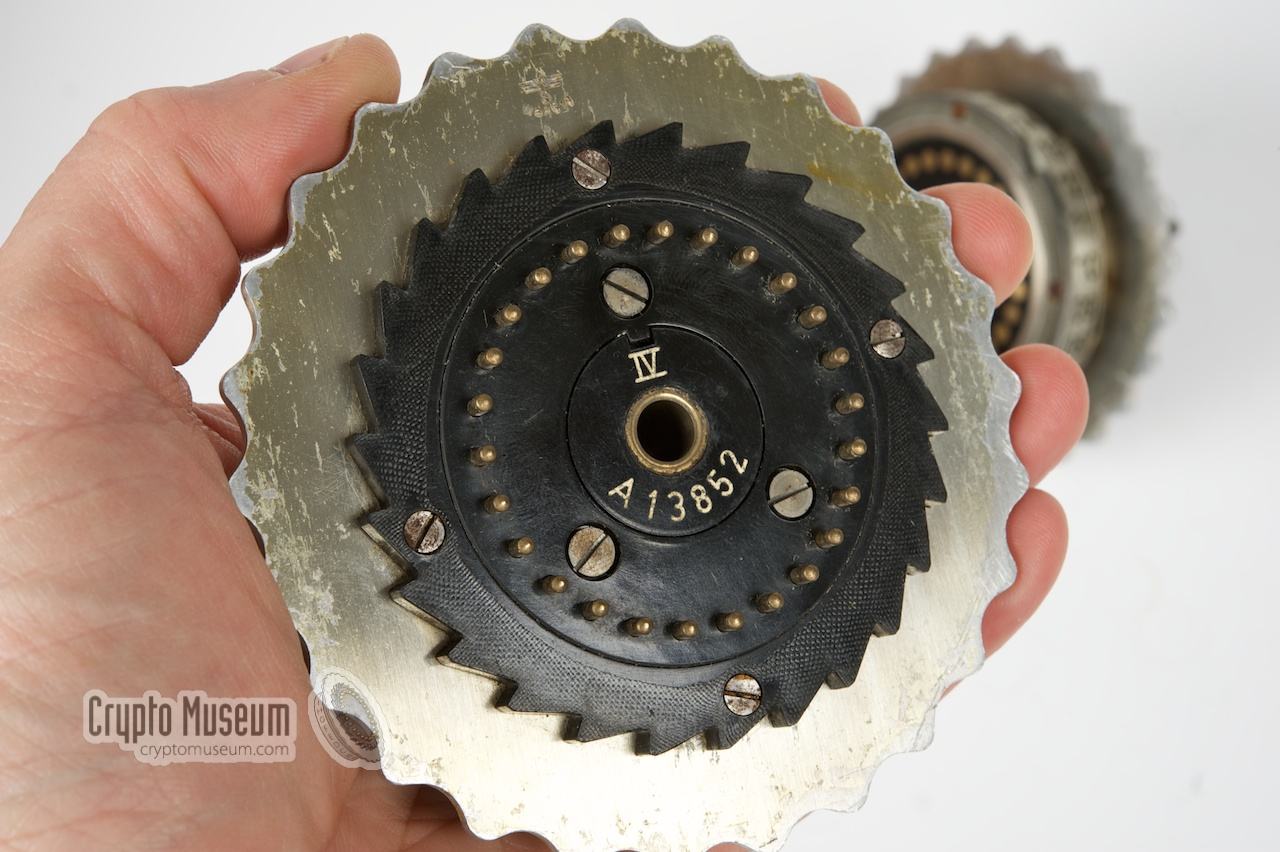
The image on the right shows an exploded view of an Enigma G rotor that
was recovered from a lake in Germany in the 1980s. 3
It has been converted to an exploded view for demonstrations.
When inside the machine, the three rotors and
the UKW are firmly coupled by means of
small pinion wheels
that are located behind the rotors.
Once coupled, the rotors can no longer be moved manually. In order to
alter the basic setting of the machine, the rotors first have to
be decoupled. This is done with the coupling lever,
which is located behind the rotors.
|
|
|
Most machines were supplied with just three rotors that could be installed on
the spindle in six different orders (3 x 2 x 1).
These rotors (I, II and III) had 17, 15 and 11 notches 4 respectively.
The positions of these notches are identical on all surviving machines,
regardless of their wiring and regardless of the customer.
It is known that some machines were supplied with more than three wheels.
For example, the Hungarian Enigma G31 machines (Ch.15b)
came with five rotors, in which case three of these rotors could be picked
and installed in 60 different orders (5 × 4 × 3).
It is likely that the additional rotors (IV and V) had 9 and 7 notches respectively.
➤ Technical description
|
|
When creating an encrypted message, the operator has to use two cryptographic
keys: (1) a daily key – picked from a key list – which is changed every 24
hours, and (2) a message key – unique for each new message – which consists of
4 letters that are randomly picked by the operator.
The message key is always sent at the beginning of the message, and is
encrypted with the daily key.
|
When setting the machine up for the daily key, the operator had to open
the lid of the Enigma, decouple the rotors,
release the UKW and remove
the spindle with the three rotors.
He would then alter the
Ringstellung (ring setting)
for each wheel as prescribed in the key list.
This is done by pushing the small spring-loaded pin (shown in the image on the
right) to the right and turning the letter ring until the desired letter is
lined up with the pin. The pin is then released. Note that this is
different from altering the ring setting on a rotor of a regular Enigma
machine.
|
|
|
|
The rotors are then placed on the spindle in the prescribed order, after
which the rotor stack (spindle with three rotors) is placed back in the
machine beteen the ETW and the UKW. The UKW is then
shifted to the right and locked in place by
placing its lever in the frontmost position.
|
Next, the lid is closed and the four rotors (UKW and three cipher rotors) are
set to the desired Grundstellung (basic setting). This is done by turning
the rotors until the four letter prescribed in the key list, are visible
in the four windows.
Once this is done, the coupling lever
must be set to the frontmost position,
so that all four rotors are firmly coupled – via the pinion wheels – to the
driving cogwheel. This is done by
pulling the lever upward, shifting it to the
front and then releasing it. The machine is now ready for use.
The user must now create the message key.
|
|
|
This is done by randomly picking four letters of the alphabet (e.g. ADXH).
He then types these four letters on the machine (which is configured for the
basic setting) and writes down the output (e.g. BSTU).
In case of the Abwehr, the message key had to be entered twice
(e.g. BSTU ADFL).
The operator then temporarily releases the coupling and sets the rotors to his
randomly picked message key (ADXH), after which the coupling is engaged again.
He then enters the message and writes down the output.
At the receiving end, the operator sets his machine to the daily key (as per
key list) and enters the first four-letter group. This reveals the message key.
He then sets the rotors to the message key, enters the rest of the message
and writes down the plaintext output.
|
|
In case of the Abwehr, the operator had to enter the first eight letters
of the message, which revealed the message key twice. This was done as an
extra check to ensure that the correct settings had been used. At the same
time, this procedure of entering the message key twice, introduced a
cryptographic weakness that was exploited by
Dilly Knox and his team at
Bletchley Park.
Although the German Army was aware of this weakness —
they abandonned this procedure at the beginning of the war — this
knowledge apparently never reached the Abwehr, as for the remainder of
the war they kept using the double encrypted message key.
|
|
-
With exception of the numbers-only Enigma Z30.
-
The ratchet and pawl arrangement is responsible for the double-stepping
anomaly of the middle rotor of a regular Enigma [14].
-
At the end of the war, the Germans threw much of their equipment into
deep lakes, to prevent them from falling into enemy hands.
-
For analogy with a regular Enigma, we use the term notches to
indicate a turnover position. In reality however, it is the presence
of a pair of teeth on an Enigma G31 rotor that causes a turnover.
|
Around 1926, the Enigma manufacturer
— Chiffriermaschinen AG —
started the development of a series of new machines, all based on the chassis
of commercial Enigma D (A26).
For the Reichswehr (the predecessor of the Wehrmacht),
they developed the Enigma I and for various
other civil and military customers the
Enigma A27 (later also known as Enigma K)
was introduced.
At the same time, development was started of an improved
machine that was described as follows: [3]
Glühlampen-Chiffriermaschine "ENIGMA"
mit Zählwerk
und zwangläufiger
Kupplung der Chiffrierwalzen.
Translated: Lamp-Enigma with counter and coupled cipher rotors.
It has a cogwheel-driven rotor-turnover mechanism that features
irregular stepping, making it cryptographically stronger than
the regularly stepping Enigma D and K.
Several models were based on this new concept.
All these machines have a counter that registers the number of key-presses,
which is why they are also known as Zählwerksmachine (counter machine)
or Zählwerk Enigma (counter Enigma).
|
After the first prototypes in 1927,
the first machine with this mechanism was released in 1928
as the Zählwerk Enigma A28. Two versions of this machine
exist (Mk.1 and Mk.2), the latter of which is shown in he image on the right.
It has the same form factor as a regular Enigma K.
A few years later, around 1930, a
numbers-only version of the machine
was released as the Z30.
Enigma A28 eventually evolved into the smaller Enigma G
(or model G31), which was released in 1931.
The two Enigma models are interoperable.
Three versions of the Enigma G were developed, but finally
the Zählwerk branch of the Enigma Family Tree died off
around 1943
and no further models based on this principle were developed.
|
|
|
Another early customer of the Enigma G was the Royal Dutch Navy.
They had already purchased six Enigma model A28 machines – the
predecessor of Enigma G – in 1928 and ordered their first
Enigma G (G128) in 1931, shortly after the Hungarians.
It was probaly used for evaluation and for testing the compatibility
with the Enigma A28 machines.
They bought at least another 71 Enigma G machines between 1937 and 1939,
all of which were used aboard naval ships and submarines.
Another six machines were ordered just before the outbreak of WWII,
and were delivered on 9 May 1940,
one day before the German invasion of The Netherlands [21].
It is believed that these machines were subsequently confiscated by the
Germans along with an unknown number of other Enigma G machines and rotors that
were kept in storage at the (bombed) Frederik Kazerne in The Hague.
At least one of the Dutch machines, G209, was rewired in 1943 and
used by the Abwehr in Argentina [12].
It is clear that the Dutch Navy was the largest
customer of Enigma G machines outside Germany. They purchased at least
93 Counter Enigma machines (A28 and G31) [12].
A good example of an Enigma G machine used by the Dutch Navy, is the
G219 in the collection of Crypto Museum. Similar machines are held
in the collections of the Dutch Naval Museum in Den Helder (Netherlands) and in the
internal collection of the Dutch intelligence service AIVD.
➤ Detailed description of the G219
|
The largest Enigma G customer was the German intelligence
and security service — the Abwehr — which is why the
machine is often dubbed Abwehr Enigma. This name is a disnomer however,
as it was not the only cipher system that was used by the Abwehr, nor
was the Abwehr the only user of the Enigma G31. The machine had various other
customers in Germany and abroad.
The Abwehr used differently wired wheels and sometimes also a differently
wired reflector (UKW). To hide the wiring even from the manufacturer,
they were ordered as blanks (i.e. unwired) and were wired by the
Abwehr themselves. Furthermore, different Abwehr radio nets used differenly
wired wheels, and it seems likely that during the course of the war,
some of them were rewired.
Good examples of Enigma G machines that were used by the Abwehr,
are G312 in the collection of the Bletchley Park Museum,
and G260 that was used by the Abwehr or the
Sicherheitsdienst (SD) in Argentina.
From 1944 onwards, the Abwehr and the SD both resided under the RSHA.
➤ More about the Abwehr
|
- I.G. Farben
- OKW/Chi
- DWStK
|
|
During World War II (WWII), the Abwehr Enigma signals were first broken
at Bletchley Park in October 1941
by codebreaker Dilly Knox.
It was achieved by studying the double encrypted message indicators
in combination with a technique known as rodding.
Rodding was an improvement of a codebreaking technique developed
in 1927 by Hugh Foss at GC&CS,
after analysing a commercial Enigma D that had been purchased
by Commander Edward Travis in Berlin back in 1926 [15].
It prompted Foss to write his report
The Reciprocal Enigma
[17][18].
|
The break of the Abwehr Enigma led to the establishment of
Intelligence Service Knox (ISK) which was
located in Bletchley Park's Cottage.
At the Cottage, Knox and 'his girls' worked on solving non-steckered Enigma,
which included the Enigma K used by the Italian Navy and
the Enigma G used by the Abwehr.
By the end of the war, the people at ISK had decrypted and
disseminated no less than 140,800 messages.
The Cottage is also the place where codebreaker
Alan Turing
later worked on Naval Enigma M4.
|
|
|
|
Below is an overview of the Enigma G machines we've encountered
over the years. As each machine has a fascinating history, further
information can be found by clicking the images.
|
|
|
G111 - Printer socket
Ch.15b
|
|
|
Enigma G111 — also known by its factory designator
Ch.15b — belongs to the very first batch of Enigma G
machines. It was supplied to the Hungarian Army
and features a 28-contact connector at its left side, used
for connection of an external printing device
(i.e. Enigma H29).
In 2009, the G111 turned up at German auction house
Hermann Historica in Munich (Germany)
and was subsequently investigated by Crypto Museum.
It is described here in great detail.
➤ More information
➤ Our paper about the G111
|
|
|
Enigma G219 was delivered to the Royal Dutch Navy
in 1938 or 1939 and was used during WWII by the
Dutch Navy operating in British waters.
After the war it was used on communication links between
The Netherlands, the Dutch Antilles and the Dutch East Indies.
The G219 is now part of the Crypto Museum Collection.
Its full history and restoration is described here.
➤ More information
|
|
|
Enigma G312 was used by the German Abwehr and is now part of
the internal collection of GCHQ. It is on
permanent public display at the Bletchley Park Museum (UK).
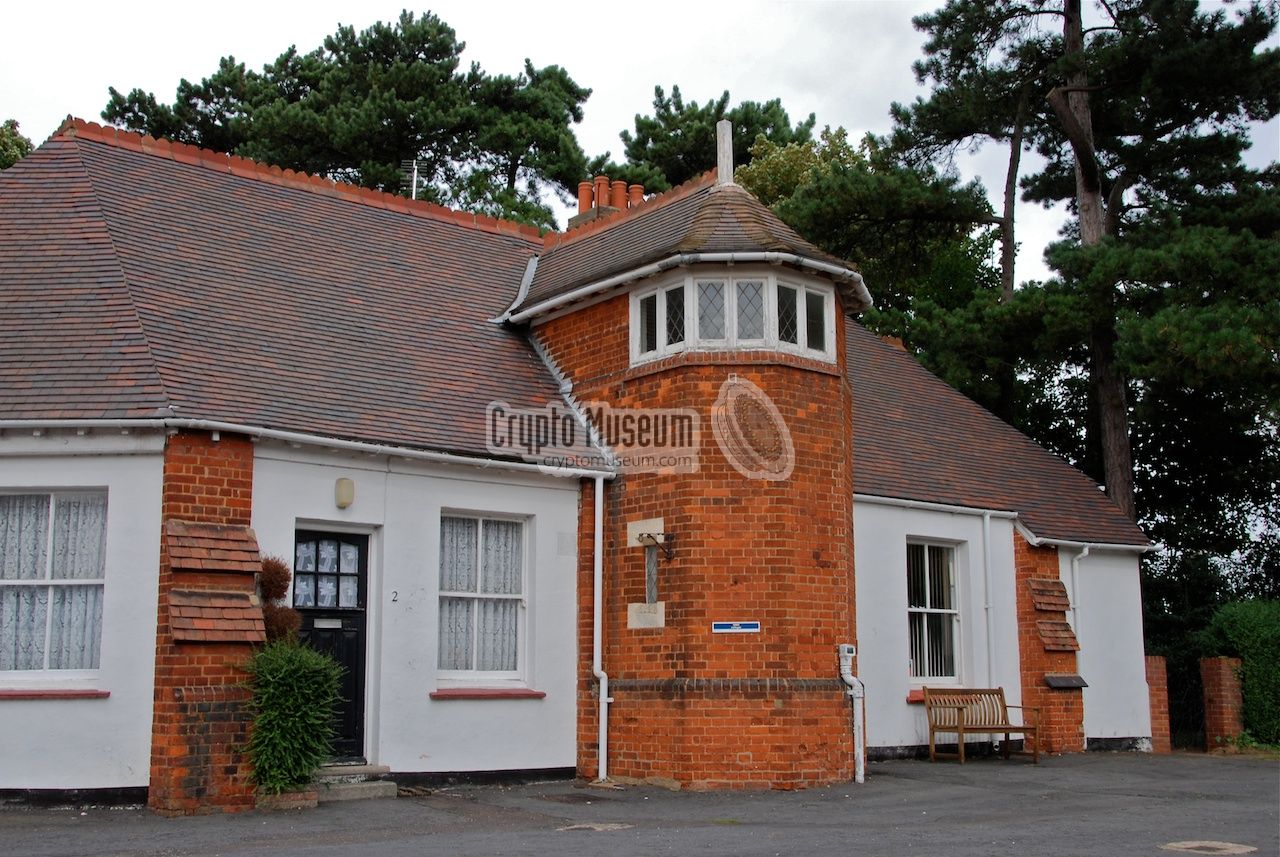
This machine attracted a lot of attention after it was stolen
from the museum on 1 April 2000. Luckily it was returned to the museum
later that year, after it had been sent anonymously to BBC presenter
Jeremy Paxman.
➤ More information
|
|
|
|
|
Standard commercial wiring
|
|
|
|
The table below shows the default wiring of the Enigma G, which is
identical to the wiring of the commercial Enigma K.
The only difference is the number of notches on each wheel.
The wiring and the position of the notches is identical to that of
the Zählwerk Enigma A28.
Please note that some (military) users later changed
the wiring of the cipher wheels and that the
German Abwehr even ordered wheels without wiring.
In most cases the wiring of the UKW was not changed.
|
| Wheel | ABCDEFGHIJKLMNOPQRSTUVWXYZ | Notch | Turnover | # |
|
|
| ETW | QWERTZUIOASDFGHJKPYXCVBNML | |
|
|
| I | LPGSZMHAEOQKVXRFYBUTNICJDW | ACDEHIJKMNOQSTWXY | SUVWZABCEFGIKLOPQ | 17 |
| II | SLVGBTFXJQOHEWIRZYAMKPCNDU | ABDGHIKLNOPSUVY | STVYZACDFGHKMNQ | 15 |
| III | CJGDPSHKTURAWZXFMYNQOBVLIE | CEFIMNPSUVZ | UWXAEFHKMNR | 11 |
| UKW | IMETCGFRAYSQBZXWLHKDVUPOJN | |
|
|
|
|
The table below shows the wiring of the G111
(version Ch.15b),
that was from the first batch of Enigma G machines ever manufactured.
It was part of a batch of 24 machines
(G-101 to G-124) that were delivered to Hungary, probably in 1931.
It is believed that this machine was used by the Hungarian Army
or the Hungarian intelligence services, who bought it alongside the
Enigma H29.
Note that only wheels I, II and V were
found with this machine.
➤ More about the G111
|
| Wheel | ABCDEFGHIJKLMNOPQRSTUVWXYZ | Notch | Turnover | # |
|
|
| ETW 1 | QWERTZUIOASDFGHJKPYXCVBNML | |
|
|
| I | WLRHBQUNDKJCZSEXOTMAGYFPVI | ACDEHIJKMNOQSTWXY | SUVWZABCEFGIKLOPQ | 17 |
| II | TFJQAZWMHLCUIXRDYGOEVBNSKP | ABDGHIKLNOPSUVY | STVYZACDFGHKMNQ | 15 |
| III | ? | CEFIMNPSUVZ | UWXAEFHKMNR | 11 |
| IV | ? | ? | ? | ? |
| V | QTPIXWVDFRMUSLJOHCANEZKYBG | AEHNPUY | SWZFHMQ | 7 |
| UKW 2 | IMETCGFRAYSQBZXWLHKDVUPOJN | |
|
|
|
As we can learn from the above table, the number of notches as well as the
turnover positions of wheels I
and II are identical to those on the same wheels of other Zählwerk machines
(17 and 15 notches respectively).
It is most likely that the (unknown) wheel III had 11 notches and that the
turnover positions are the same as on other machines.
They are shown here in red.
It is likely (but not certain) that the number of turnover notches on the
unknown wheel IV is 9.
The current whereabouts of this machine are unknown.
➤ More about Enigma G111
|
|
|
G227 and G228 are two machines that were used on the Grün (Green)
network of the Abwehr. The rotors (I-III) were
wired on 10 July 1943 according to the drawings Ch.15 Tz 125a-c, created in 1939.
The UKW is wired according to Ch.15 Tz 115 of 14 July 1936 [12].
in 2015, the G228 was unexpectedly offered for sale from an anonymous seller
in Argentina, and was subsequently acquired by a private collector.
The wiring below was taken from this machine [18].
|
| Wheel | ABCDEFGHIJKLMNOPQRSTUVWXYZ | Notch | Turnover | # |
|
|
| ETW | QWERTZUIOASDFGHJKPYXCVBNML | |
|
|
| I | JDZLYKXVOUCMRAGTSBIWQHPENF | ACDEHIJKMNOQSTWXY | SUVWZABCEFGIKLOPQ | 17 |
| II | SKQXFDVNGMUETJBRZLAHYWIODP | ABDGHIKLNOPSUVY | STVYZACDFGHKMNQ | 15 |
| III | GRMKJBSAIXHWDQUYOEZVPNLFCT | CEFIMNPSUVZ | UWXAEFHKMNR | 11 |
| UKW | RULQMZJSYGOCETKWDAHNBXPVIF | |
|
|
|
This machine is currently held in the private collection of Glen Miranker (USA) [19].
|
|
In March 1945, just before the end of WWII, the Argentine police arrested the
German spy Johann Siegfried Becker. In his posession was an Enigma model G31
with serial number G260. Two months later, the machine was handed over to the
Americans [7].
Although Becker was believed to work for the German intelligence service,
the Abwehr, the G260 was most likely used by the
Sicherheidsdienst (SD) — the German Security Service — on its
Rot (Red) network.
They were wired differently from the machines used by the Abwehr
on its Grün (Green) network [11].
|
| Wheel | ABCDEFGHIJKLMNOPQRSTUVWXYZ | Notch | Turnover | # |
|
|
| ETW | QWERTZUIOASDFGHJKPYXCVBNML | |
|
|
| I | RCSPBLKQAUMHWYTIFZVGOJNEXD | ACDEHIJKMNOQSTWXY | SUVWZABCEFGIKLOPQ | 17 |
| II | WCMIBVPJXAROSGNDLZKEYHUFQT | ABDGHIKLNOPSUVY | STVYZACDFGHKMNQ | 15 |
| III | FVDHZELSQMAXOKYIWPGCBUJTNR | CEFIMNPSUVZ | UWXAEFHKMNR | 11 |
| UKW | IMETCGFRAYSQBZXWLHKDVUPOJN | |
|
|
|
The current whereabouts of this machine are unknown.
|
|
The table below shows the wiring of the G312. Although the machine is
believed to have been used by the German Abwehr,
it is the only one every found with this wiring.
Different wirings were used for different
sections of the Abwehr,
and also for different radio nets. It is
possible that some machines were rewired a number of times
during their lifetime. Note the rewired UKW.
|
| Wheel | ABCDEFGHIJKLMNOPQRSTUVWXYZ | Notch | Turnover | # |
|
|
| ETW | QWERTZUIOASDFGHJKPYXCVBNML | |
|
|
| I | DMTWSILRUYQNKFEJCAZBPGXOHV | ACDEHIJKMNOQSTWXY | SUVWZABCEFGIKLOPQ | 17 |
| II | HQZGPJTMOBLNCIFDYAWVEUSRKX | ABDGHIKLNOPSUVY | STVYZACDFGHKMNQ | 15 |
| III | UQNTLSZFMREHDPXKIBVYGJCWOA | CEFIMNPSUVZ | UWXAEFHKMNR | 11 |
| UKW | RULQMZJSYGOCETKWDAHNBXPVIF | |
|
|
|
Zählwerk Enigma (counter Enigma) is based on the design of the
Enigma D (A26) and Enigma K (A27),
but has additional features and improvements. Most of these
extras are described in two German patents:
DE534947 [8]
and DE579555 [9].
The most important difference with earlier models is the way
in which the rotors advance when a key is pressed.
In the earlier Enigma K, and also in the later Enigma I,
the rotors are advanced by means of pawls, ratchets and notches.
As a result, a rotor can only step forward.
Under certain conditions, the middle rotor
can make an additional step on two successive key presses.
This is known as the double stepping anomaly [14].
This stepping behaviour is also known as Enigma stepping.
With Zählwerk Enigma however, the rotors are advanced by a cogwheel-driven
mechanism that does not suffer from the double stepping anomaly.
In addition, the number of notches on each wheel has been increased.
It is different for each wheel, does not share a common factor and cannot
divide 26. By using 17, 15 and 11 notches respectively,
the longest possible cipher period is obtained.
This stepping behaviour is also known as irregular stepping.
Another difference with Enigma K is that the reflector (UKW)
can not only be set to any of 26 positions,
but also moves during encipherment. This is known as
a movable or driven UKW.
The three cipher rotors are mounted on a removable spindle,
just like with other glowlamp Enigma machines, but the movable UKW
is fitted permanently. It cannot be removed easily.
Each rotor has a full cogwheel with 52 teeth attached to its
right side. On the left side of the rotor is another cogwheel with the same
spacing, but with a number of teeth missing.
The presence of a pair of teeth is equivalent to a notch on an
regular Enigma rotor.
When the rotors are engaged, they are firmly coupled by means of 4 small pinion
wheels with teeth of alternating length.
|
| |
Both sides of an Enigma G rotor
|
As a result, the entire mechanism can be stepped forward and backward,
without losing the relation between the position of the wheels. A crank
can be inserted into a hole in the body of the machine, allowing the
mechanism to be wound back to the desired position.
This was used to correct mistakes,
but could theoretically also be used as part of the cryptographic procedure.
|
| |
Regular Enigma wheels (left) and the wheels of Zählwerk Enigma A28 (right)
|
The rotors of the initial Zählwerk machine — Enigma A28 — have the
same diameter as the rotors of a regular Enigma, such as Enigma K.
With the later G31 model however,
smaller wheels are used, as illustrated below.
In order to accomodate the spring-loaded contacts,
they are arranged in a zig-zag pattern, whilst the contact pads at the other
side have an oval or tear-drop shape.
|
| |
The wheels of the Zählwerk Enigma model A28 (left) and the Enigma model G31 (right)
|
Most machines were supplied with just three rotors that could be installed on
the spindle in six different orders (3 x 2 x 1).
These rotors (I, II and III) had 17, 15 and 11 notches 1 respectively.
The positions of these notches are identical on all surviving machines,
regardless of their wiring and regardless of the customer.
It is known that some machines were supplied with more than three wheels.
For example, the Hungarian Enigma G31 machines (Ch.15b)
came with five rotors.
It is very likely that the Zählwerk Enigma was originally intended for
commercial use, as the wiring of the UKW, and in some cases the wiring
of the rotors as well, was identical to the wiring of the commerial
machines.
Sometimes the rotors were rewired by the customer, but in most
cases the wiring of the UKW was left unchanged.
The Abwehr ordered unwired rotors [10].
|
|
-
For analogy with a regular Enigma, we use the term notches to
indicate a turnover position. In reality however, it is the presence
of a pair of teeth on an Enigma G31 rotor that causes a turnover.
|
|
The Enigma G is usually mounted inside a wooden transit case with a
hinged lid. It is fixated to the bottom of the case by means of four large bolts.
After removing these bolts, the machine can be lifted from the case.
At the bottom of the chassis are 4 rubber pads that may have dried out.
|
The machine itself is housed in a folded metal enclosure with a hinged lid,
painted with black wrinkle paint. The interior can be accessed by
removing the U-shaped case shell, which is held in place by 4 screws
at the left, 4 at the right and 8 at the rear. After removing all 16
screws, the case shell and the hinged lid can be taken off.
A separate panel at the front – held in place by 6 screws – should also
be removed in order to access the keyboard. The image on the right shows
the machine after the case shell, the top lid and the front cover have
been removed.
|
|
|
|
In the Enigma G, the rotors are firmly coupled by means of
small pinion wheels located at the the
rear of the rotors.
When altering the position of the rotors (Grundstellung), the
pinions must first be disengaged by placing the coupling
(i.e. the large lever at the top)
in the rearmost position.
|
Once the mechanism is decoupled and the
UKW is released, the spindle with
the rotors can be removed. This leaves us with an
empty stepping mechanism in which
the pinions and the sping-loaded rubber guide wheels are
clearly visible.
At the far right is the entry disc (ETW),
which is firmly fitted to the chassis. Around the ETW are a
ratchet wheel and a cogwheel with 52 teeth.
When pressing a key, an actuator advances the ratchet wheel by one step.
At the same time, the cogwheel advances by two teeth.
The image on the right shows the actuator in its rest position.
|
|
|
Note that the ratchet wheel and the cogwheel are part of
a cylinder that revolves around the ETW, whilst the ETW itself
stays in place. The actuator and its adjustment are
further described here.
The large cogwheel mates with a pinion wheel at the rear, which in
turn drives the rightmost rotor.
It also drives the 4-digit counter
that is fitted at the far right of the chassis.
For further details about the machine's interior, please refer
to our page about the restoration of the G219.
➤ Restoration of the G219
|
|
|
Manufacturing differences
|
|
|
- Case height
Early Enigma G31 machines come in a wooden case that is 10 mm higher than
later ones. This is done to accomodate the four rubber feet that are mounted at
the bottom early machines. Note that in practice the rubber feet serve
no purpose, as the bolt by which they are mounted to the machine sticks out
at the bottom, as a result of which cut-outs had to be made in the bottom
of the wooden case. When fitting an early Enigma G in a later wooden case,
the rubber feet have to be removed.
- Crank receptacle
The axle for the crank (inserted at the right side) is thinner on early
Enigma G machines. As a result, the crank for a later Enigma G will be loose
when used on an early machines, whilst an early crank does not fit on a
later machine.
- Recessed screws on the lamp panel
On the lamp panel there are 8 small threaded holes for fitting recessed screws
that hold the lamp mask and film. In addition, there are two larger
threaded holes for fitting the clips to hold a green filter.
In practice however, the 8 smaller holes are left unused on many (most?)
Enigma G machines, whilst two larger recessed screws are present hold the
lamp mask and film in place. G219 (Dutch Navy) is an example
of such a machine.
In some cases, the 8 smaller holes are used for permanently fitting a
green filter. One example is the G193 (Abwehr)
that was sold at an auction in Germany in May 2024 [20].
- Manufacturer name tag
Machines that were delivered between 1931 and 1935 carry a name
tag of Chiffriermaschinen AG
at Steglizer Str. 2 in Berlin W.35. On 31 July 1935, manufacturing was taken
over by Heimsoeth und Rinke,
initially at the same address, but in March 1936 Steglizerstraße 2 was
renamed Ludendorffstraße 6, and in December 1938, the company moved to
a new premises at Uhlandstraße 136 in Berlin-Wilmersdorf.
Each time, the name tags that were mounted inside the top lid of the
wooden case, were updated accordingly.
- Decals
Some (but not all) machines that were delivered to another country were
given a metal tag with the text Made in Germany (in English),
mounted inside the top lid of the wooden case, along with the other decals.
Note that some machines, especially the ones manufactured during the war,
came without any decals (even without a manufacturer name tag).
In addition, some machines were given an acceptance stamp or burn mark,
by the (foreign) agency that checked and approved the machine after delivery.
|
Device Rotor cipher machine Brand Enigma Type G Model G31 Designator Ch.15a, Ch.15b or Ch.15c Manufacturer ChiMaAG, (later: H&R) 1 Years 1931-1943 (est.) Country Germany Customers see below Predecessor A28 (Ch.15) Successor none Rotors 3 (optionally choosen from a set of 5) Turnovers 17, 15, 11, ?, 7 Reflector Settable and movable (driven) Wiring see above Stepping Irregular (coupled gear) Plugboard no 2 Extras Crank, green filter (optional), maintenance booklet Dimensions (HWD) 160 × 250 × 275 mm Opened (HWD) 345 × 250 × 410 mm Weight 7.2 kg (bare), 9.4 kg (with wooden case) Quantity 350 (est.)
|
-
From 1923 to 1935, the name of the company was Chiffriermaschinen AG
(ChiMaAG). It was succeeded in 1935 by Heimsoeth und Rinke (H&R).
-
Only on the Ch.15c version, which was probably not taken into
production.
|
|
The Enigma G is known under the following names:
|
- Enigma G
- Enigma Model G31
- Abwehr Enigma
- Ch.15a
- 11-15-17 machine
- Zählwerk Enigma G31
- Zählwerksmaschine G31
- Counter Enigma
|
|
Below is a list of known Enigma G serial numbers, mainly based on
surviving TICOM documents, complemented by our own findings.
Detailed information and backgrounds can be found in the article
Enigma G: The Counter Enigma
by David Kenyon and Frode Weierud of May 2019 [12].
The list does not include the serial numbers of the compatible
A28 machines.
|
G101 - G124 1931 Hungarian Army 1 G128 1931 Dutch Navy G138 - G141 1938 (est.) Dutch Navy 2 G145 - G188 1938 Dutch Navy G189 - G194 1938 Abwehr 6 G195 - G221 1939 (est.) Dutch Navy G209 ? Dutch Navy / Abwehr (Rot) 4,5 G222 - G224 ? I.G. Farben G227 - G228 1939 (est.) Abwehr (Grün) 4 G247 ? OKW/Chi G249 - G250 ? OKW/In 7/IV G256 - G257 ? I.G. Farben G260 ? Abwehr (Rot) 4 G263 ? Abwehr (Rot) 4 G275 ? OKW/Chi G292 ? DWStK G298 - G303 1940 Dutch Navy 3 G312 - G317 ? Abwehr 6 G404 - G407 ? I.G. Farben G426 ? ?
|
|
-
All these were modified (Ch.15b) for connection to
printing Enigma H29.
-
Neither the delivery date nor the exact quantity is known [12].
-
These machines were delivered on 9 May 1940, one day before the
German invasion of The Netherlands. It is likely that these machines
were confiscated by the Germans [12].
-
Used by the Abwehr in Argentina.
-
G209 had initially been sold to the Dutch Navy and was confiscated by the
Germans when they invaded The Netherlands in May 1940.
It was rewired for the Abwehr in August 1943 [12].
-
Uncertain, but likely.
|
- David Hamer, G-312: An Abwehr Enigma
Cryptologia, January 2000, Volume XXIV, Number 1.
- Christine Large, Hijacking Enigma
31 May 2004. ISBN 978-0470863473.
- David Kenyon and Frode Weierud, Enigma G: The Counter Enigma
Bletchley Park and Crypto Cellar Research, 5 May 2019. Updated 15 June 2019.
- Frank Carter, The Abwehr Enigma Machine
Explanation of the terms 'crab' and 'lobster'.
Undated, but probably 2017.
- Paul Reuvers and Marc Simons, G-111: A rare Zählwerk Enigma variant
Full details of the Enigma G-111 (Ch.15b) with high-resolution drawings.
Crypto Museum, August 2009. Version 2.00, 10 December 2025.
➤ Publication
➤ More
|
- BBC, 2000: Wartime coding machine stolen
1 April 2005. Retrieved February 2013.
- Crypto Museum, Photographs of Enigma G-312
Bletchley Park, August 2002, November 2004.
- Chiffriermaschinen Aktiengesellschaft, Herrn Direktor Walter Edström
Offering for Schreibende Enigma and Glühlampenmaschine mit Zählwerk (German).
16 September 1929. Crypto Museum #300304. 1
- David Hamer, G-312: An Abwehr Enigma
Cryptologia, January 2000, Volume XXIV, Number 1.
- BBC, Photograph of Jeremy Paxman with Enigma G-312
Copyright BBC News, 2000. Retrieved November 2005.
- Christine Large, Hijacking Enigma
31 May 2004. ISBN 978-0470863473.
- US Military Attaché in Argentina, Intelligence Report about G260
US Navy Intelligence Division. 30 May 1945.
NARA CBKI 13, Box 5395, nr. 1574 1
- German Patent DE534947 (9 November 1928)
Patent for the cog-wheel driven wheel-turnover mechanism and the Ringstellung.
- German Patent DE579555 (17 November 1928)
Patent covering multiple notches on the wheels fixed to the index ring.
- Frode Weierud, Personal correspondence
Crypto Museum, May 2009.
- Phil Marks, Personal correspondence
Crypto Museum, May 2013.
- David Kenyon and Frode Weierud, Enigma G: The Counter Enigma
Bletchley Park and Crypto Cellar Research, 5 May 2019. Updated 15 June 2019.
- Paul Reuvers and Marc Simons, G-111: A rare Zählwerk Enigma variant
Full details of the Enigma G-111 (Ch.15b) with high-resolution drawings.
Crypto Museum, August 2009. Version 2.00, 10 December 2025.
➤ Publication
➤ More
- David Hamer: Actions involved in the 'double stepping' of the middle rotor 2
Cryptologia, January 1997, Volume XX, Number 1.
- Frank Carter, The Abwehr Enigma Machine
Explanation of the terms 'crab' and 'lobster'.
Undated, but probably 2017.
- Günter Hütter, Conversion of rotor G274/I for exploded view display
Austria, 22 October 2023.
- Hugh Foss, The Reciprocal Enigma 1
TNA, HW25/14. Undated, but probably 1927/28.
- Hugh Foss, Reminicences on Enigma
1949. Published in Chapter 3 of the book Action This Day.
Michael Smith & Ralph Erskine, 2001. ISBN 978-0-593-06357-6.
- Glen Miranker, Wiring of G228
Personal correspondence, February 2019.
- Chiffriermaschine 'Enigma-G' der deutschen Abwehr,
Nummer 'G 193', komplett mit Holzkasten
Hermann Historika (Auction), 10 May 2024.
- Memorandum, Holland (Vertraulich)
Supply of 6 Enigma G31 machines and rotors (G298-G303) to Holland (German).
Heimsoeth und Rinke. Berlin, 9 May 1940.
|
|
|
-
Documents kindly supplied by Frode Weierud [10].
-
Reproduced here by kind permission from the author.
|
|
|
|
Any links shown in red are currently unavailable.
If you like the information on this website, why not make a donation?
© Crypto Museum. Created: Tuesday 11 August 2009. Last changed: Friday, 29 May 2026 - 07:02 CET.
|
|

|
|
|
|
|
| | |





![Rotor I of an Enigma G31 with serial number G274. Thanks to Günter Hütter for creating the exploded view [16]](img/304104/000/full.jpg)




![BBC presenter Jeremy Paxman with the returned Enigma G312. Photo courtesy BBC News 2000 [5].](img/paxman.jpg)