|
|
|
|
|

|
Cipher machines and cryptographic methods
The German Enigma cipher machine is arguably the
world's most well-known cipher machine,
mainly because of the vital role it played during
WWII.
There are however many other interesting cipher machines, such as
the mechanical series from Boris Hagelin
and the Russian M-125 Fialka.
This page shows a number of interesting historical cipher machines.
Some of the entries refer to a whole family of machines, whilst
others are listed separately.
Click any of the images on this page for further information.
If you are looking for a specific machine or model,
you might want to check the index first.
It is also recommended to check the
Glossary of crypto terminology.
We are always interested in acquiring additional historical cipher machines
for our collection. If you have anything to offer,
please contact us.
➤ Glossary
➤ Mission Statement
➤ Index of machines and manufacturers
|
The name Enigma does not refer to a single machine, but rather to a large
family of rotor-based cipher machines, most of which are not compatible with
each other.
The Enigma was introduced around 1923 and was widely used in large quantities
by the German Army before and during WWII.
➤ More information
|
|
|
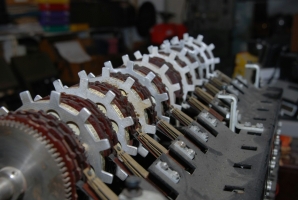
In 1921, Boris Hagelin developed his first cipher machine.
Since then, he produced a wide range of machines, of which the
M-209 (shown here) is probably the most well-known one.
After WWII, the company (Crypto AG) developed numerous other
machines and models, and is still in business today.
➤ More information
|
|
|
Shortly after WWII, the Russians developed an advanced cipher machine
that is clearly based on the Enigma-design.
It contains many improvements over the Enigma, such as irregular
wheel stepping, more wheels (10) a coding card and a built-in printer.
Furthermore, one of the major flaws of the Enigma (i.e. that a letter can
not be enciphered into itself) has been fixed in this machine.
➤ More information
|
|
|
Like many other European electronics companies, Siemens developed
a number of cipher machines over the years. The most famous one is
probably the T-52,
also known as the Geheimschreiber, that was
used by the German High Command during WWII.
After the war, Siemens
developed mixer-machines (based on the Vernam principle)
and later electronic cipher equipment.
➤ More information
|
|
|
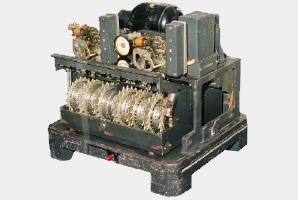
During WWII, the German High Command used this advanced Lorenz
SZ-40 cipher machine for messages at the highest level. It was an
add-on for teleprinter systems (telex) and was connected between
the teleprinter and the line.
Codenamed TUNNY by the codebreakers at Bletechley Park,
it proved to be a real challenge to them. Eventually, the Lorenz
machine was broken by means of Colossus (see below).
➤ More information
|
|
|
Colossus was arguably the first programmable electronic computer.
In any case it was invented well before the American ENIAC.
Colossus was developed during WWII for the sole purpose of breaking
the Lorenz SZ-40/42 machine that was used by the German High Command.
After the war, GPO engineer Tommy Flowers, who designed the machine,
was not recognised for his work due to the official secrets act.
➤ More information
|
|
|
In the 2nd half of the 20th century, Dutch defence electronics
manufacturer Philips Usfa, developed and produced a wide range
of crypto machines. Some of these were proprietary, but others
were compatible with NATO standards.
Philips Usfa/Crypto was closed down in 2003.
➤ More information
|
|
|
During WWII, the Swiss developed the NEMA (Neue Maschine) as a
replacement for their Enigma K machines, after they had
discovered that both the Allies and the Germans were reading
their traffic.
The machine closely resembles the Enigma and has even
inhertited some of its weaknesses.
➤ More information
|
|
|
Transvertex was a small company in Sweden that produced cipher
machines, similar to Hagelin. In order to prevent patent infringment however,
the machines had to be based on a different principle.
The HC-9 (shown here) is the most well-known Transvertex machine.
➤ More information
|
|
|
Gretag, or Gretacoder Data Systems was a manufacturer of crypto equipment,
based in Regensdorf, Switzerland.
It was led by Dr. Edgar Gretener who was not only a direct competitor
of Hagelin, but also co-operated with them
on a number of projects.
Over the years, Gretag produced a range of commercial, industrial and
military cipher machines.
➤ More information
|
|
|
Although the German inventor Rudolf Hell
is mainly known for his famous HELL-Schreiber and his range of
graphical equipment,
it is little known that in the years following WWII, he built
a number of mechanical cipher machines.
The machines were built under license of Boris Hagelin
for the German Army (Bundeswehr).
➤ More information
|
|
|
OMI
was an opto-mechanical factory in Italy, who had specialised in
stereo photography and cartography. Towards the start of WWII, they were
asked to develop a high-end cipher machine, similar to the German Enigma.
The first machine was the OMI Alpha,
which was released in 1939, followed
by the Criptograph in 1954
and the Cryptograph-CR in 1958.
➤ More information
|
|
|
Over the years, the USA produced many different cipher machines. In some
cases, these machines were developed by the NSA
(National Security Agency),
but sometimes they were bought 'of the shelf' from existing manufacturers.
As it is sometimes unclear who the developer or the manufacturer of a machine
is, we've listed them separately.
➤ More information
|
|
|
Like the USA, the former Sovjet Union, or USSR, has a long cryptographic
history. Over the years they produced a wide range of cipher machines of which
only little is known.
➤ More information
|
|
|
Before, during and after WWII, some interesting cipher machines were
developed in the UK, the most famous of which is probably the
war-time Typex, which was effectively an improved
copy of the German Enigma machine.
Other wheel-based cipher machines were used as well, and electronic
crypto devices were developed by manufacturers such as
Racal.
➤ More information
|
|
|
During the Cold War, the former Yugoslav Republic, developed a range
of radio sets and encryption products, most of which were built by the
television factory Rudi Čajavec in Banja Luka.
The devices range from simple voice scramblers to advanced wide-band and
narrow-band digital encryption devices.
➤ More information
|
|
|
Telsy is a manufacturer of voice and IP (internet) encryption devices
in Turin (Italy). The company started in 1971 and is still in business today
(2012).
During the 1970s, 80s and 90s, Telsy was a major supplier of voice encryption
devices for the police in many European countries.
➤ More information
|
|
|
Tadiran was a large electronics company in Israel, that developed and produced
a lot of radio and COMSEC equipment for the Israel Defense Forces (IDF),
and the Department of Defense (DoD) of more than 40 countries.
In the late 1970s and early 1980s, Tadiran produced a series of COMSEC
cryptographic devices that could be integraded with the combat radio
networks of that era. Some of these devices have been in use until
recently.
➤ More information
|
|
|
Racal was a British manufacturer of military radio electronics such
as radios and cryptographic equipment. It was founded in 1950 and
was once the 3rd largest electronics company in the UK. Racal was
sold to the French company Thomson-CSF (now Thales) in 2000.
Over the years, Racal produced many different communications and
cryptographic devices, with a varying degree of sophistication.
➤ More information
|
|
|
STK,
or Standard Telefon og Kabelfabrik,
was a telephone, electronics
and cable company in Oslo (Norway). They are commonly referred to as
Standard. STK was establised in 1915 and was later
owned by ITT, Alcatel and finally Thales.
They are best known for the ETCRRM
mixer machine and the
electronic RACE (KL-51) cipher machine.
➤ More information
|
|
|
For many years, US-based electronics manufacturer Motorola
produced secure communications products, such as high-grade
crypto phones, two-way radio systems, police data terminals
and dedicated crypto chips.
Although Motorola no longer produces such devices, their products are
still in use by many agencies worldwide.
➤ More information
|
|
|
AT&T was at one time the largest telephone (network) operator
in the US. The company also produced a series of high-end encryption
devices, such as the STU-III crypto phone, for the US Government and others.
AT&T Technologies was later renamed to Lucent Technologies and was
then acquired by General Dynamics, who continued
the product range.
➤ More information
|
|
|
|
|
Tele Security Timmann (TST)
|
|
|
Tele Security Timmann, or Timmann, or TST, was a German manufacturer
of advanced electronic cipher machines who was established in the late
1970s. The company was based in and around Tutzing near Munich (Germany)
until 2009.
➤ More information
|
|
|
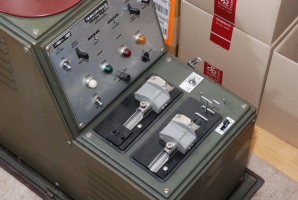
A key transfer device is an electronic device that is used (most commonly
by the military) for the distribution of cryptographic material, such as
crypto keys and frequency hopping tables.
Key fillers often use a standard data protocols,
but proprietary protocols are used as well.
Many key fill units have the same 6-pin U-229 connector
allowing connection to standard radio sets, such as
Have Quick
and SINCGARS.
➤ More information
|
|
|
This section deals with secure voice cipher equipment (voice crypto)
from a variety of manufacturers. Most of the units shown here, are
also available in other categories on this website.
➤ More information
|
|
|
Sometimes, when voice communication is not possible or is considered not-secure,
an Electronic Message Unit (EMU) is used in combination with an existing
radio set. Such EMUs are commonly used in combination with
military radio sets and generally employ some level of
cryptography.
➤ More information
|
|
|
Over the years, and especially in the beginning of cryptography,
many different methods have been developed for manual encryption.
These are often referred to as 'hand methods'.
The methods vary from the use of simple tables and discs, to
complex slide rulers and disc arrays. An example is the so-called
Caesar Box shown here.
➤ More information
|
|
|
A codebook is a very old and effective method for concealing the contents of a
message.
In many cases, frequently used words or even complete sentences were replaced
by three or five-letter abbreviations.
On their own they aren't very safe, but when used in combination with other
cipher methods, they can be a real nightmare for the average code breaker.
➤ More information
|
|
|
Since the late 1990s, dedicated cipher machines are more and more replaced
by modern PCs on which crypto is implemented in software.
This is also the case with the Armed Forces, where special reggedized PCs
are now being used.
Despite strict TEMPEST rules, however, PCs are non-secure devices by nature,
due to the use of standard operating systems.
In many cases, external crypto units are still needed.
➤ More information
|
|
|
Over the years, many devices have been developed to allow secure phone
conversions to be held over standard telephone lines, ranging from voice
scramblers to state-of-the-art digital encryption.
This section covers a range of secure telephones, including
the Philips PNVX
and the famous American STU-III.
➤ More information
|
|
|
Although the FS-5000 is actually a (spy) radio station, it is listed
here, as it contains serious cryptographic capabilities using a 120-bit key.
The unit was codenamed Harpoon and was designed as a common radio set for
all stay-behind organisations in Europe
during the Cold War. It was manufactured by
AEG Telefunken
in Ulm (Germany) around 1988.
➤ More information
|
|
|
Skanti was a manufacturer of MF/HF transceivers and digital voice
scramblers that were intended for the maritime market. The DS-6001
voice scrambler was used worldwide aboard fishing vessels.
It was commonly used in combination with the TRP-6000 MF/HF transceiver
shown in the image on the right.
➤ More information
|
|
|
Tait is a large international supplier of (secure) communications
equipment, based in Christchurch (New Zealand).
➤ More information
|
|
|
Thales is a large multinational electronics manufacturer who also
makes encryption equipment. Some of this equipment is acquired from
Thomson CSF who in turn acquired it from former Norwegian manufacturer
STK.
➤ More information
|
|
|
|
|
|
Any links shown in red are currently unavailable.
If you like the information on this website, why not make a donation?
© Crypto Museum. Last changed: Thursday, 16 April 2026 - 20:50 CET.
|
|

|
|
|