|
|
|
|
|

|
|
Enigma Tree A28 → KD → Swiss-K → T → Railway → ← D
Confusingly, Enigma K initially had serial numbers starting
with the letter A, just like all other models.
From 1936 onwards, the serial numbers of the Enigma K were
prefixed by the letter K. 2
Many Enigma K machines were built for German users, such as the
Reichsbahn (railway), but they were also sold
to a number of foreign users.
It is known that the Italian Navy (Supermarina)
used Enigma K machines throughout WWII. Modified versions of the Enigma
K were also used during the Spanish Civil War (1936-1939)
and a by the Swiss Army
during and after WWII (Swiss-K).
|
|
|
The machine was developed and released in 1927, hot on the heels of
the very similar but short-lived Enigma D (A26).
It was the first machine on which the
turnover notch was attached to the letter ring rather than
to the body of the rotor. 3 This increased the cipher's strength.
Other differences are the mounting of the power switch and
the terminals for an external power supply, as well as the presence of
numbers printed above the lamp panel and on the upper row of keys.
Initially, each rotor had a single turnover notch (regular stepping),
but on some variants multiple notches were used to obtain irregular stepping.
For example: Enigma T of 1942 had five notches on each
rotor, and the rotors of Enigma KD of 1944 even had nine turnover
notches each.
There are several variants of Enigma K, some of which remained
in production until 1944.
|
 |
-
The actual manufacturing took place at Konski & Krüger
(K&K) in Berlin.
-
At the same time, a new number range was used, started with K201.
-
Enigma K (A27) (Ch.11b) was developed in parallel with
Reichwehr Enigma D (Ch.11a), which later evolved into
Enigma I. On both machines, the notch ring is attached to the
letter ring rather than to the rotor body.
|
|
|
Enigma K variants on this website
|
|
|
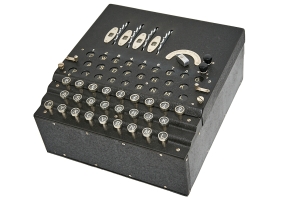
The image below provides a quick overview of the features of the
commercial Enigma K. The machine has a keyboard with 26 keys and a
lamp panel with 26 lightbulbs, both of which are layed out in the
order of a German typewriter (QWERTZ). The machine is powered by
an internal 4.5V battery. At the top right is the power knob, which
allows selection between hell (bright), dkl (dim), aus (off)
or Sammler (external power source). To its right are the
external power terminals.
The machine has four settable rotors, the leftmost of which
is the reflector (Umkehrwalze, UKW). The other three are the
cipher rotors, each of which has a single turnover notch.
When typing, the rotors are driven by pawls and ratchets,
resulting in an odometer-style movement. This is known as
Enigma Stepping.
Under certain circumstances, the middle rotor can make an addional
step on two successive key-presses.
This misfeature is known as the double stepping anomaly [3].
Inside the lid of the wooden transit case are 10 spare lightbulbs,
a green filter that can be placed over the lamp panel, and three
metal shields: the oval Enigma logo, the name and address of the
manufacturer (ChiMaAG) and a 'made in Germany' shield.
These shields were normal on pre-war Enigma machines.
The machine shown here (serial number A818) was manufactured in
1927 or 1928 and was sold to Austria between 1928 and 1935 [4][6].
|
|
|
Differences with Enigma D
|
|
|
|
Compared to its predecessor – Enigma D – the following differences
can be observed. Note that the first two are functional differences, the
rest are merely manufacturing changes.
|
|
-
Not to be confused with the wrinkle paint used on later machine.
-
This refers to the way the side panels of the wooden transit
case are joined at the corners. ➤ Wikipedia
|
In 1939, just before the outbreak of WWII, the Swiss bought Enigma K
machines that were used by the Swiss Army, the Air Force and the Foreign
Office. These machine have been expanded with an external lamp panel and
are therefore housed in a larger wooden transit case.
As these machines were made after 1936, the serial number is prefixed with
the letter 'K'.
➤ More information
|
|
|
This is a special version of the Enigma K that was made for
the Militärisches Amt (Abwehr).
This machine has a field-rewirable reflector (UKW-D or Dora)
and rotors with nine turnover notches each. It therefore
features irregular stepping.
Enigma KD first appeared on 3 December 1944 and remained in use
throughout the war.
At the Enigma Reunion 2009 at Bletchley Park, this Enigma variant
was on public display for the duration of the event, courtesy the
Swedish FRA.
➤ More information
|
|
|
During WWII, the German Railway (Reichsbahn) used a special version of
Enigma K, in which the UKW and the rotors were rewired. In addition,
the position of the turnover notches of rotors I and III were swapped.
➤ More information
|
|
|
Enigma T (Tirpitz) was a special version of the Enigma K that was made for
the Japanese forces. It was introduced in 1942 and was supplied with 8 rotors
with 5 turnover notches each. Furthermore, the entry disc (ETW) was wired
differently.
The serial numbers of this variant were all prefixed with the letter 'T'.
➤ More information
|
|
|
The simplified circuit diagram below, shows how the Enigma K operated.
At the right are the keys (switches), the lamps and the battery. The current
is supplied to the contacts of the right side of the first rotor, via the
entry disc (German: Eintrittswalze, or ETW). The current then passes
the three cipher rotors, each of which can be advanced by a key-press
like the odometer of a car.
At the far left is the reflector (German: Umkehrwalze, or UKW), which returns
the current through the rotors. The current leaves the rotors via the
ETW again, and causes a lamp to be lit. Note that the process is symmetric,
or reversable, meaning that the same settings can be used for coding and
decoding. This is a property of the reflector. Unfortunately it has the
unwanted side effect that a letter can never be enciphered into itself.
This is true for all glow lamp Enigma machines.
At the bottom right is the four-position rotary selector that acts as the
power switch. It allows selection between BRIGHT (hell), DARK (dkl), OFF
(aus) and EXTERNAL POWER (Sammler). When set to DARK, a series resistor (R)
reduces the current through the lamps. When EXTERNAL POWER is selected,
the voltage from an external battery or transformer can be applied
to the terminals (P).
|
Enigma K has three cipher rotors and a settable reflector (UKW).
All four rotors protrude the top lid of the machine. As the UKW has a thumbwheel
for setting its position, it is nearly identical to a cipher rotor. As a result,
the machine is sometimes erroneously classed as a 4-rotor Enigma. In reality it is
a 3-rotor machine with a settable UKW. The UKW does not move during encipherment.
Each rotor has 26 positions and 26 contacts at either side, corresponding to the
letters A-Z that are engraved in the outer ring. This index-ring can also be set
to 26 positions (Ringstellung).
The rotors and the UKW of the Enigma K are very similar to those of its predecessor
– Enigma D – but there are some important differences in the construction of
the rotors. This is illustrated in the drawing above.
To compare the rotors,
move the mouse over the drawing to see a rotor of the earlier Enigma D.
First of all, an Enigma K rotor is 2 mm narrower than an Enigma D rotor.
More importantly however, the ratchet ring is now attached to the thumbwheel
by means of recessed screws. As a result, the raised bearing at the centre is
no longer needed and the spring-loaded contacts can be depressed 2 mm further,
which increases contract pressure and improves contact reliability of the entire
machine. This was a weak point of the Enigma D.
As a result, the rotor stack of Enigma K is 12 mm narrower than that of Enigma D,
which means that the UKW and ETW are 12 mm closer together.
For this reason, Enigma D and K rotors are not interchangeable.
|
| |
Distance between the rotors of Enigma K.
Move the mouse over this image to see the rotors of the earlier Enigma D.
|
|
|
|
Standard commercial wiring
|
|
|
|
Below is the wiring for the standard Enigma K model (A27).
This wiring is commonly known as handelsübliche Schaltung (commercial wiring).
Internally, the wiring for the rotors I, II and III was known by the H&R
designator Ch 11 Tz 87a-c whilst the UKW wiring was known as
Ch 11 Tz 86.
Regardless the customer, each Enigma K was supplied with this wiring,
unless ordered otherwise. Note that the wiring of some special Enigma K variants,
such as Railway Enigma, Swiss Enigma K and
Enigma T (Tirpitz)
(see above), was different.
See the individual pages for more information.
|
| Rotor | ABCDEFGHIJKLMNOPQRSTUVWXYZ | Notch | Turnover | # |
|
|
| ETW | QWERTZUIOASDFGHJKPYXCVBNML | |
|
|
| I | LPGSZMHAEOQKVXRFYBUTNICJDW | G | Y | 1 |
| II | SLVGBTFXJQOHEWIRZYAMKPCNDU | M | E | 1 |
| III | CJGDPSHKTURAWZXFMYNQOBVLIE | V | N | 1 |
| UKW 1 | IMETCGFRAYSQBZXWLHKDVUPOJN | |
|
|
|
-
The wiring of the UKW is measured using the contact at the white dot as the
reference point. When the UKW is installed in the machine with its
ring setting at 'A' and the letter 'A' visible through the window in the lid,
this is the contact just in front of the contact at the top.
|
|
|
Spanish and Italian wiring
|
|
|
|
Six different wiring schemes have been identified, that were used
in Enigma K machines that had a connection with Spain and or Italy.
They are labelled A-F. Wirings A, C, D and F were used in machines
that had been delivered to Spain [5].
Currently only wiring schemes D and F are known.
Below is an overview of the technical drawings (Tz) of these wirings
and their release dates [5].
|
| Scheme | Rotor I, II, III | Issued | Description |
|
|
| A | Ch 11 Tz ? | 1936-01-21 | Wiring currently unknown |
| B | Ch 11 Tz 171a-c | 1936-09 | Wiring currently unknown |
| C | Ch 11 Tz 172a-c | 1936-09 | Wiring currently unknown |
|
D
|
Ch 11 Tz 173a-c
|
1936-09-09
| |
| E | Ch 11 Tz 175a-c | 1936-11-11 | Wiring currently unknown |
|
F
|
Ch 11 Tz 174a-c
|
1936-09
| |
|
| Rotor | Drawing | Issued | Description |
|
|
| UKW | Ch 11 Tz 86 | 1927-07-27 | Default wiring |
| IV, V | Ch 11 Tz 183c-d | 1937-03-01 | K209-K212 (E) |
| IV, V | ? | ? | A1226-A1229 (B) |
|
|
|
Wiring scheme D — Italian Navy
|
|
|
|
Below is the wiring scheme for the Enigma K machines used
by the Spanish Naval Attaché (SNA) and by the Italian Navy.
Examples of machines with this wiring are A1252, K240 and K261 [5].
Note that the ETW and UKW have the default commercial wiring.
The rotors are wired according to wiring diagram Ch 11 Tz 173a-c,
issued on 9 September 1936.
The Italian Naval Enigma was supplied with 6 rotors, but so far
only the first three (I, II, III) have been recovered.
|
| Rotor | ABCDEFGHIJKLMNOPQRSTUVWXYZ | Notch | Turnover | # |
|
|
| ETW | QWERTZUIOASDFGHJKPYXCVBNML | |
|
|
| I | CIAHFQUYBXNUWJLVGEMSZKPDTR | G | Y | 1 |
| II | KEDXVBSQHNCZTRUFLOAYWIPMJG | M | E | 1 |
| III | NUJPHWFMGDOBAVZQTXECLKYSIR | V | N | 1 |
| UKW 1 | IMETCGFRAYSQBZXWLHKDVUPOJN | |
|
|
|
|
Below is the wiring scheme (F) for the Enigma K machines used
in Spain.
Examples of machines with this wiring are A1241, A1242, K205 and K289 [5].
Note that the ETW and UKW have the default commercial wiring.
The rotors are wired according to wiring diagram Ch 11 Tz 174a-c.
|
| Rotor | ABCDEFGHIJKLMNOPQRSTUVWXYZ | Notch | Turnover | # |
|
|
| ETW | QWERTZUIOASDFGHJKPYXCVBNML | |
|
|
| I | HFOTWPDURMCGXKLQEIVZAKBNAY | G | Y | 1 |
| II | MUHTASIPJYNCVKLOXFDZEGQBWR | M | E | 1 |
| III | DKWOJVUNGLFTZCSYIBEARHXQPM | V | N | 1 |
| UKW 1 | IMETCGFRAYSQBZXWLHKDVUPOJN | |
|
|
|
|
With the first Enigma machines, the operating instructions were no more
than a few A4 pages created on a typewriter. With the arrival of
Enigma D, and also with Enigma K,
a professionally printed instruction manual
was included, complete with photographs and a fold-out at the rear.
|
Original operating instructions are extremely rare, but it is known that
the contents of the booklet were revised several times, probably to reflect
the differences between Enigma D and K.
The image on the right shows an original A5-size instruction booklet that was
probably supplied with an Enigma K. The first page of this booklet however,
shows a photograph of an earlier model, which is most likely an
Enigma D.
Although it is a low-resolution photograph, it is clear that there are
no numbers printed above the upper row of lamps on the lamp panel.
|
|
|
The photographs in the fold-out at the rear of this booklet,
show a different machine on which the numbers (0-9) are printed
above the upper row of letters on the lamp panel. Likewise, the
upper row of keys holds both letters and numbers. This is thought
to be a property of Enigma K.
Furthermore, the power selector is of a later construction, in
which the knob was fitted to the lid. On Enigma D,
the knob is fitted to the power selector and
protrudes a cut-out in the top lid.
➤ Read the booklet
|
About the booklet
The front cover holds a stamp with the number 33. The meaning of this
number is not known, but it could be the year in which it was issued (1933).
In the upper right corner,
the number A833 is written with a red pencil. This is probably
the serial number of the machine it was issued with.
As the machine with serial number A818 in the Crypto Museum Collection
has been identified as an Enigma K,
it is likely that A833 was also an Enigma K.
|
The machine featured on this page – serial number A818 – was rediscovered
in 2011 in a attic in Vienna (Austria), during a house clearing of a deceased
family member. It was wrapped in paper and appeared to have been untouched
since WWII. It is unknown how it came into this person's possession.
However, it is known from a list of 21 October 1935 [4] that it is one of the
Enigma K machines that were sold to Austria between 1927 and 1935.
Their serial numbers are:
|
- A793
- A794
- A795
- A796
- A805
- A806
|
- A807
- A808
- A809
- A810
- A811
- A812
|
- A813
- A814
- A815
- A817
- A818
- A819
|
- A820
- A821
- A822
- A824
- A830
- A831
|
|
|
|
From information about the delivery of
steckered Enigma I machines
— that had serial numbers in the same A-series range at the time —
it can be deduced, that the Enigma K machines with serial numbers
A793 to A836 were manufacturered in late 1927 or early 1928.
This includes the A818. The last two serial numbers listed above
(A1247, A1248) were made in late 1931 or early 1932.
|
In February 1934, three machines were prepared with special wirings.
They had serial numbers A1219, A1220 and A1221, and were
designated Ch.11b. This means that they were model A27, or type
Enigma K. The machine with serial number A1219 was delivered with
the standard commercial wiring
for rotors I, II and III, but also
with three additional rotors (IV, V and VI) with special wirings.
This machine was called
Österreichische Heeresmaschine (Austrian army machine).
This proves that the Austrian Army used Enigma K prior to the outbreak
of World War II (WWII).
It is therefore possible (but not certain) that A818 was also used
by the Austrian Army [4].
A1220 and A1221 also had an extra set of three rotors, but these
were numbered I, II and III (just like the basic three rotors) and
had red numbers on the index ring rather than black letters.
They were delivered to Polizei M — short for
Police München (Munich, Germany). 1
At the same time, by secret order, and extra set of identically wired
rotors I, II and III with red numbers on the index ring,
was sent to Herrn Ingenieur
Hugo Wimmer, Rembrandstraße 5 in Wien (Vienna, Austria) [4].
The above suggests that there was some kind of secure intercommunication
between police in München (Germany) and the police (or army) in Vienna
(Austria) in 1934, long before WWII.
|
|
-
Delivered to Oberleutnant von Berchem, Haslangstraße 3,
München 2 NW (Germany) [4].
|
|
The following Enigma K machines are known to have been supplied to
Sweden:
|
A801 STAB, Ivar Kreuger A802 STAB, Ivar Kreuger
|
|
|
|
|
- K289 (F)
- K290
- K291
- K292
- K293
- K294
- K295 (F)
- K296
- K298
|
- K356
- K357
- K358
- K693
- K694
- K723
- K726
|
|
Enigma K was also used by the Italian Army, Air Force and Navy.
Although the machines for the Italian Navy and Army had been wired
according to wiring scheme D, the Italian Air Force
used machines with the standard comercial wiring.
|
|
|
- K233-K282 (D)
- K297 (D)
- K302-K311
|
|
On 2 October 1936, 22 machines were ordered for use by the Condor Legion,
Hitler's elite troops that were sent to Spain to aid the Spanish Nationalists
under General Franco [5]. Although these machines were ordered by the Germans,
they were used in Spain, where some of them were left behind. Other machines
were returned to Germany and were reused (and possibly rewired) later.
|
|
|
Croatian Home Defence Forces
|
|
|
|
In November 1943, some machines were rewired for use by the Croatian
Home Defence Forces. Some of these machines were from the
former Condor Legion, which had returned to Germany in April 1939 and
had since been abolished. The following machines were (re)used in Croatia [5]:
|
|
From surviving TICOM reports it is known that the German Inspectorate 7/VI
(In 7/VI) was able to read the messages sent by the Croatian Home Defence
Forces (see below) [7].
|
A837 CHEMNYCO New York (used by German censor)
|
The first analysis of the commercial Enigma – at the time the Enigma D
– was done in 1927 by Hugh Foss of the
Government Code & Cipher School (GC&CS,
later: GCHQ). He developed a theoretical attack against the machine.
Ten years later, in 1937 during the Spanish Civil War (1936-1939),
it helped codebreakers William Bodsworth and
Dyllwyn (Dilly) Knox to break
Enigma traffic between the Spanish Navy of General Franco, and the Italian
Navy of dictator Mussolini.
During WWII, Knox led a special group
– known as Intelligence Service Knox (ISK) –
at the British codebreaking centre Bletchley Park (BP).
ISK did research on ciphers that had not yet been broken.
Although the Enigma traffic of the Italian Navy was originally broken by
Knox, it had meanwhile become unreadable.
It was broken again at ISK in March 1941 by 19 year old codebreaker
Mavis Lever (later: Batey).
The brake was possible after Mavis noticed that a test message sent by a
German operator did not contain the letter 'L'. Knowing that on Enigma
a letter can never be enciphered as itself, she assumed that the operator
had repeatedly hit the key at the bottom right of the keyboard (L).
It enabled the team to reconstruct the wiring and the current settings of
the machine, and eventually to the Allied victory in the
Battle of Cape Matapan on 28 March 1941 [8].
|
-
A 'crib' is a piece of known or guessed plaintext.
-
In the TICOM report [7], Konski & Krüger (K&K) is
mentioned as the supplier of the rotor wiring details. Although K&K was the
actual manufacturer, they worked under contract from H&R, and it was
probably H&R who supplied the wiring details.
|
The image below shows the interior of the Enigma K, as seen from the
rear left corner. All significant features, in particular the differences
with the Enigma D are highlighted. It is the first machine of which the
main body in housed by a metal U-shaped enclosure. Furthermore, the battery is
now installed in a dedicated box with a hinged lid.
It accepts a standard Wehrmacht battery.
Also new on this device is the changed construction of the power selector and
the terminals for applying external power. They are located
in front of the battery box,
but the knob for the selector and the actual power terminals
are part of the hinged lid
that covers the rotors. They are constructed in such
a way that they mate with the power selector when the lid is closed. This
makes sense, as the previous solution on the Enigma D
requires the knob of the power selector – which protrudes the lid – to be
placed in the north/south position
before the lid can be opened.
|
Device Rotor cipher MachineBrand EnigmaType KModel A27Designator Ch.11bManufacturer ChiMaAG (until 1934), H&R (after 1934) 2Country GermanyYears 1927-1943Customers Commercial, Reichsbahn (railways), Austrian ArmyPredecessor Enigma DDescendants Swiss K, Enigma T, Enigma KD, ReichsbahnRotors 3 (removable)Turnovers 1 per rotor, notch fitted to letter ring 3Reflector Settable (26 positions)Wiring CommercialStepping Regular (Enigma stepping)Plugboard noExtras Green filterDimensions 300 × 280 × 155 mm (incl. wooden case)Weight 10.6 kg (incl. wooden case)Quantity 614 (est.) 4
|
- Enigma K 1
- A27
- Ch.11b
- Commercial Enigma 2
- INDIGO (US cover name)
|
-
Initially, the machine was identified by its model number (A27).
In 1936, the Type identificatio 'K' was introduced. From then on,
all serial numbers started with 'K', whilst the model number remained A27.
-
Not to be confused with Enigma D (A26) which is also known as
'Commercial Enigma'.
|
|
|
Known serial numbers before 1936
|
|
|
|
Until 1936, the serial numbers for all Enigma machines with an A-prefix,
were issued sequentially, regardless the model. Consequently,
the serial numbers of the early Enigma K machines are not contiguous.
The following list was compiled from various sources, including [4].
|
- A766
- A793
- A794
- A795
- A796
- A801
- A802
|
- A805
- A806
- A807
- A808
- A809
- A810
- A811
|
- A812
- A813
- A814
- A815
- A817
- A818
- A819
|
- A820
- A821
- A822
- A824
- A830
- A831
- A832
|
|
- A1213
- A1214
- A1215
- A1216 (D)
- A1219
- A1220
|
|
|
|
|
|
|
Serial numbers from 1936 onwards
|
|
|
|
In 1936, the name Enigma K was introduced as an alternative to the model
number A27. From then on, Enigma K had its own serial number range that
was prefixed by the letter 'K', starting with serial number K201.
The following number ranges are known to have been issued:
|
-
K240, K256 and K261 were found in Spain.
|
A766 1927 NCM, USAA818 1927 Crypto Museum, Netherlands
A1214 ? Bletchley Park Museum, UKA1216 ? CNI, SpainA1241 ? Ministry of Defence, SpainA1242 ? Foreign Ministory, SpainA1246 ? Army HQ, SpainA1252 ? Army Museum, Spain
K205 1936 Army Museum, SpainK240 1937 Private collector, SpainK256 1937 Army HQ, SpainK261 1937 Ministry of Defence, SpainK289 1937 Bletchley Park Museum, UKK295 1937 Army HQ, SpainK296 1937 Army HQ, SpainK356 1939 Army HQ, SpainK357 1939 Army HQ, SpainK358 1939 Army HQ, SpainK693 ? Army HQ, SpainK694 ? Army HQ, SpainK723 ? Army HQ, SpainK726 ? Army HQ, Spain
|
|
The following people have contributed to this page:
|
- Paul Reuvers
- Marc Simons
- Frode Weierud
|
-
There are different versions of this booklet. The machine shown on the first page
is probably an Enigma D, whilst the machine shown in the fold-out at the back,
is an Enigma K.
|
- David Hamer, Geoff Sullivan and Frode Weierud
Enigma Variations: An Extended Family of Machines
Cryptologia, July 1998, Volume XXII, Number 3.
- Paul Reuvers and Marc Simons, Wiring of Enigma A818
Crypto Museum, October 2011.
- David Hamer: Actions involved in the 'double stepping' of the middle rotor 1
Cryptologia, January 1997, Volume XX, Number 1.
- Frode Weierud, Enigma K history
Personal correspondence, September 2011, July 2024.
- Spanish Enigma: A History of the Enigma in Spain
José Ramón Soler Fuensanta, Francisco Javier López-Brea Espiau
and Frode Weierud.
Cryptologia, Volume 34, Issue 4, October 2010.
DOI: 10.1080/01611194.2010.485414
➤ Author's copy
- Memorandum, List of commercial glow-lamp Enigma machines 1935-1926
Heimsoeth und Rinke, 21 October 1935.
Document kindly provided by Frode Weierud [4].
- European Axis Signal Intelligence in WWII - Volume 2
Notes on German high level cryptography and Cryptanalysis.
Army Security Agency (NSA), 1 May 1946. TOP SECRET CREAM. 1
- Wikipedia, Battle of Cape Matapan
Retrieved January 2014.
- Christos Triantafyllopoulos, The compromise of the
Croat Enigma K cipher machine by the German Army's codebreakers
Christos military and intelligence corner. 1 February 2017.
- Christos Triantafyllopoulos, The compromise of the
Swiss diplomatic Enigma K cipher machine in WWII
Christos military and intelligence corner. 1 October 2017.
|
|
-
Reproduced here by kind permission from the author.
|
|
|
|
Any links shown in red are currently unavailable.
If you like the information on this website, why not make a donation?
© Crypto Museum. Created: Monday 14 September 2009. Last changed: Friday, 29 May 2026 - 07:26 CET.
|
|

|
|
|
|
|
| | |