|
|
|
|
|

|
|
Germany Telefunken Crypto SBO BND DSU →
The Field Station (FS) consists of a number of individual modules that can
be combined in several ways in order to perform a variety of tasks.
The image on the right shows a complete FS-5000 radio set with all modules
installed.
The unit is powered by a set of two batteries at the front left, that are charged
by a mains power supply and battery charger at the rear right. At the rear left
is the actual transmitter with its automatic antenna tuner. The separate receiver
is located at the front center, in between the batteries and the
control/crypto unit (DSU).
|
|
|
The system was developed by AEG Telefunken
in 1985 [5] and gradually became operational in the following years.
Judging from the date codes on the electronic components, most sets we've seen
were built around 1988.
In most countries it was rolled out in 1990 and 1991, just before nearly all
European countries dismantled their
stay-behind organisations
(in or around 1992).
It is currently believed that the FS-5000 uses the secret
NATO-approved
Aroflex/RACE
cryptographic algorithm — developed by
Philips Usfa around 1980 —
for the encryption of its messages [11].
As each country had its own independent stay-behind
operation, the FS-5000 (Harpoon) was sometimes given a different name.
In The Netherlands, for example, it was known as AZO-90,
which is the abbreviation of
Automatische ZendOntvanger 1990
(Automatic Transceiver 1990).
The FS-5000 was designed exclusively for NATO Special Services [5]
but was also supplied to the Special Forces of the German Army (Bundeswehr)
in 1994 and to some intelligence services.
In 1998 the FS-5000 was followed by the compatible
HRM-7000, which was part of the
HF-7000 family.
The Terminal Crypto Unit, TCU 7000 XP, shows great
resemblance to the DSU of the FS-5000,
and its BS-7010 base station
was sometimes used in combination with the FS-5000 [B].
|
 |
-
Gladio was the name of the Italian
SBO.
As it was the first SBO to become publicly known, 'Gladio' has become a
generic name, and is often used
by the public as a synonym for SBOs in general.
➤ More
|
WARNING —
Anyone with an FS-5000 in his or her collection, who wishes to use or
demonstrate the device, MUST read the following notice.
Inside the mains power supply unit (PSU)
are a number of capacitors that are likely to explode after a number of years.
It is important to replace all RIFA capacitors in the PSU before connecting
it to the mains again, even if it has worked before.
➤ Learn more...
|
|
Recent changes to this page
|
|
|
- FS-5000 (HARPOON)
This is the standard version of the device, developed for the
Stay-Behind Organisations (SBO). It was developed by
AEG Telefunken
under contract of the BND, and came in an executive style briefcase.
As far as we know, there was only
one version, although it is possible that there were different firmware
releases.
- FS-5000/M
This is an aftermarket-modified version of the standard FS-5000,
used by the German Special Forces (Fernspäher). It uses the same hardware,
but with a simplified/modified version of the firmware that was created
especially for this purpose. Furthermore, red plastic caps were added to
protect the connectors, and provisions for an alternative battery were
added.
|
|
The FS-5000 has a highly modular design. It is beautifully designed with
a keen eye for the smallest detail and was certainly state-of-the-art when
it was developed in 1985. The system consists of a large number of units
(modules) each of which consists of a purpose-built die-cast aluminium box
with mil-spec PCBs inside. The various modules are shown in de drawing below:
|
|
|
FS-5000 modules - click any module for a detailed description
|
|
The reason for the modular design is that the various units had to be
used in a variety of possible set-ups. The modules can be combined in various
ways in order to create (partially) stand-alone solutions.
Additional accessories, such as the H-bar, are provided
to allow even more set-ups.
A number of possible configurations is demonstrated below.
|
High-quality connectors are used between the units and
some units could also be used stand-alone.
The complete FS-5000 radio station consists roughly of the following units:
To protect the units against water and other environmental impact,
all units are completely sealed and water-tight connectors are used.
The image on the right shows the fully assembled radio station that nicely
fits a regular briefcase.
|
|
|
|
The FS-5000 consists of the following modules:
|
| # | Short | Designator | Description | |
|
|
| D | DSU | SR 5000 | Digital Storage Unit (controller, crypto) | |
| R | RX | E 5000 | Receiver | |
| T | TX | S 5000 | Transmitter | |
| A | ATU | - | Automatic Antenna Tuner | |
| C | Charger | - | Battery Charger/Inverter | |
| M | PSU | - | Mains Power Supply Unit 110-240V AC | |
| B | Battery | BA 5000 | Rechargeable Battery (2x) | |
| H | H-bar | - | Versatile stand-alone adapter | |
| F | Fast | - | Fast discharger (active dummy load) | |
| S | Slow | - | Slow discharger (2x, part of toolkit) | |
| X | X-unit | - | Test box for Transmitter and DSU | |
| - | Cable | VK 5000 | DSU extension cable 1.5m (FS-5000/M only) | |
| - | Tools | - | Toolkit with accessories | |
| - | Brackets | - | Various mounting brackets (locks) | |
|
In the early 1980s, the ACC (Allied Clandestine Committee),
attached to NATO headquarters SHAPE in Mons (Belgium), decided to develop a
pan-European communication system for all stay-behind organisations in Europe,
including non-NATO countries such as Sweden and Switzerland.
In the early days of the Cold War, it was believed that the governments of most
European countries would make their way to England when their countries were
invaded by the Soviets. For this reason, some Harpoon FS-5000 sets were
installed there.
Later, when nuclear weapons became available to the USSR, the general consent
was that the European goverments would escape to the US.
Arrangments were therefore made,
to have some FS-5000 radio sets in the US as well. These sets were delivered
to the American National Security Agency (NSA).
The FS-5000 was suitable for this, as it was specified for a range of 6000 km!
As it was impossible for the (secret) stay-behind organisations to deal
directly with Telefunken, the German intelligence service
BND acted as a facade and ordered 854 units from
Telefunken, for a total
amount of 130 million German Marks (equivalent to 65 million Euros) [4].
The first sets were delivered in 1988, and by March 1991 all FS-5000 radio
sets had been delivered to the various countries [6].
Stay-behind personnel was trained on the new radio and the first
long-range field tests (LOR) were successfully completed in 1990 [6 p.139].
Shortly afterwards, after a series of scandals, most European countries
decided to dismantle their stay-behind organisation.
By the end of 1992, Gladio had become history. All field agents had
been detached and the Harpoon radio sets (FS-5000) were collected and stored.
As the cost of development of the FS-5000 was quite substantial, a new
destination was sought for some of the equipment.
|
In 1991, the USA decided to give the FS-5000 a real-life field test,
by using it in the First Gulf War. The American Special Forces (SF) however,
had trouble operating the radio and concluded that it was impractical
and unsuitable for SF use. They were probably right, as the radio set was
developed for a total different purpose. In 2000 some of these American
FS-5000 units accidently appeared on the surplus market, albeit without
the DSU. When the mistake was discovered, the remaining sets
were quickly withdrawn, but a mere 22 units had already found a new home.
Whether or not the above story is correct, remains to be seen. It is very
unlikely that the American SF or the CIA would use former stay-behind
equipment in a war theatre, whilst they had plently of alternative equipment
available from US sources. It is far more likely that the story of 'bad
radios' was invented to masquerade the accidental and unintended
release of FS-5000 units in the US.
|
Around 1993, Germany decided to give the remaining FS-5000 sets
a new lease of life, by using them as a gap-fill solution
for their Special Forces (Fernspäher).
After a few modifications to the radio set (FS-5000M), it was successfully
used for many years during training sessions, until it was replaced by the
newer HF-7000 series.
In 2012, a number of these FS-5000M sets appeared on the German surplus
market, this time complete with the Digital Storage Unit (DSU).
|
|
|
Digital Storage Unit (DSU)
|
|
|
The Digital Storage Unit (DSU) was the heart of the FS-5000 radio station.
Without the DSU, the set can not be operated.
It contains the user interface, the frequency adjustment, the Real Time Clock
(RTC) and the cryptographic engine.
The DSU is fitted at the bottom right and is connected to the receiver.
It can also be detached and operated via an extension cable.
➤ More information
|
|
|
The Receiver is a separate unit that is connected to the transmitter and
to the DSU. It gets its power and antenna signal from the transmitter
and is suitable for frequencies between 500 KHz and 30 MHz.
The receiver can also be used stand-alone in case of an emergency (e.g. when
other modules have broken down). In that case an earphone can be connected to
the front panel for the reception of spoken messages or
morse code signals.
➤ More information
|
|
|
The transmitter is normally stacked below the Automatic Antenna Tuner
and is suitable for frequencies between 2 and 30 MHz in steps of 1 KHz,
under control of the DSU and the receiver.
The transmitter delivers an output power of 25W and is suitable for the
transmission of QPSK signals. In a full FS-5000 station is links the
other modules together.
➤ More information
|
|
|
An automatic antenna tuner was used in combination with the transmitter,
to allow the FS-5000 to be operated by non-technical users. A 15-meter
wire was sufficient to obtain good results on all frequency bands.
➤ More information
|
|
|
The battery charger allows the batteries to be charged either in
situ (whilst installed in the radio station) or separate from the set
(stand alone). It takes its power from the PSU that is normally mounted
on top of it.
The unit also contains a power inverter that allows an external 12V
source to be used instead of the PSU.
➤ More information
|
|
|
The PSU is a highly compact and efficient Switched Mode Power Supply (SMPS)
that is mounted on top of the Battery Charger. It accepts any
AC voltage between 110 and 240V.
➤ More information
|
|
|
The FS-5000 comes with two heavy-duty rechargeable NiCd batteries
that allows the radio station to be operated away from the mains
(e.g. in the field).
Special tools are provided for extending the battery's life, by
charging and discharging them properly.
➤ More information
|
|
|
The FS-5000 comes with a number of smaller accessories that
are stored inside a clever slim-line grey plastic box that can be installed as
part of the complete radio station, on top of the Digital Storage Unit (DSU)
at the front right. It is held in place by a retaining clip on the PSU.
➤ More information
|
|
|
The H-Bar is a versatile extension to the FS-5000 radio station.
It is a junction box in the form of a narrow plastic bar with various
connectors at either side to allow a different arrangement of the modules.
The H-Bar can be used for stand-alone battery charging as well as for
stand-alone usage of the receiver.
|
|
|
An active dummy load with heatsink is provided for fast battery
discharge. It is used as part of a recovery process that allows
batteries suffering from the so-called Memory Effect
to be reconditioned.
When connected to a battery, a green LED indicates that discharge
is in progress.
➤ More information
|
|
|
The X-unit is part of the Toolkit. It has connectors at three sides and
and offers three test functions.
It can be used to test the output power of the transmitter,
but can also connect the transmitter directly to the antenna in case the
Antenna Tuner is broken.
It can also be used to test the DSU's interface.
➤ More information
|
|
|
|
The following items are options and were not supplied with all FS-5000
units. Some items were added for different users, such as Special Forces (SF).
Some items below have been reported by our readers. If you know of any
other options that are not listed here, please contact us.
|
It was possible to use an (optional) extension cable between the
receiver and the DSU. The extension cable has purpose-built connectors
at both ends and is approx. 1.5 meters long.
Special locking mechanisms are provided for a secure connection in
the (battle)field. The cable allows a more convenient operation of the DSU.
➤ More information
|
|
|
The battery shown here was developed for the later HRM-7000 manpack radio.
It uses LiMnO2 technology and is therefore not rechargeable,
which means that it has to be discarded (or recycled) after use.
In 1994 it was adapted for use in combination with the FS-5000M, for use
by Special Forces. This resulted in a rather clumsy solution.
➤ More information
|
|
|
In order to use the BPU-7000 battery (above) with the FS-5000, the special
adapter cable shown on right was available.
The battery was mounted upside-down
on top of the ATU and the cable was used to connect it to the leftmost
battery socket on the transmitter.
➤ More information
|
|
|
This double-size battery was designed as an alternative for the two
standard NiCd batteries. It made use of LiMnO2 technology
and was therefore not rechargeable.
The battery shown here was a prototype.
It is not clear whether it was ever produced in large quantities.
➤ More information
|
|
|
A special tool was available to allow the DSU to be used off-line
when batteries were dead (or running low).
It takes the place of the two 3.5V batteries inside the DSU and has
wires that can be connected to an external DC power source.
The tool is shown in the image on the right. It was supplied only for
use by stay-behind personnel. Thanks to Jim Meyer [1] for supplying
this image.
➤ More information
|
|
|
The V-Bar was a shorter version of the H-Bar.
Like the H-Bar it could be used to charge the two standard batteries
in combination with the PSU. The V-Bar was not suitable for stand-alone
use of the transmitter.
➤ More information
|
|
|
|
|
Alternative configurations
|
|
|
|
In the description above the complete FS-5000 station is shown with all
modules installed at their default position. It was however possible to
group some of the modules together in a different manner, so that the
set could be used for more than one application. Below is a description
of the currently known configurations. If you know of another one,
please let us know.
|
The image on the right shows a complete and fully assembled FS-5000
radio station, with all modules in their default position.
In this configuration, the radio can be powered either by the PSU or
by the batteries. As the PSU can generate spurious (radio) signals,
it may interfere with the reception of weak signals. For this reason
battery operation was recommended.
When turned off, the PSU can be used to charge the batteries, simply by
pressing a button.
|
|
|
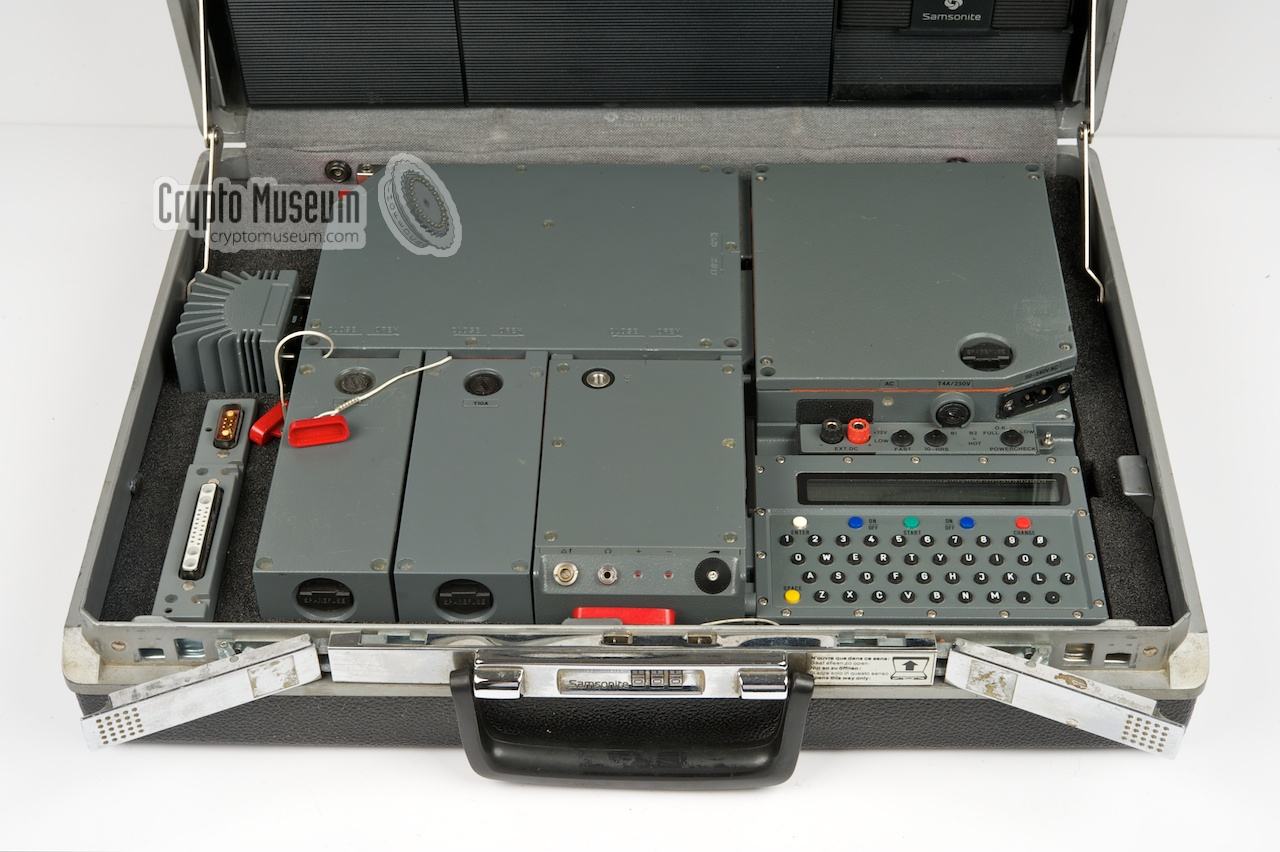
Depending on the required task, the FS-5000 was sometimes supplied in
a rugged military suitcase or in a standard attaché briefcase, such as
the Samsonite briefcase shown on the right.
The size of the complete radio station is designed in such a way that
it fits nicely inside a standard briefcase, leaving enough room for
the ancillaries and any support documents. The unit connects to the mains
power and can be operated with minimum of fuzz.
|
|
|
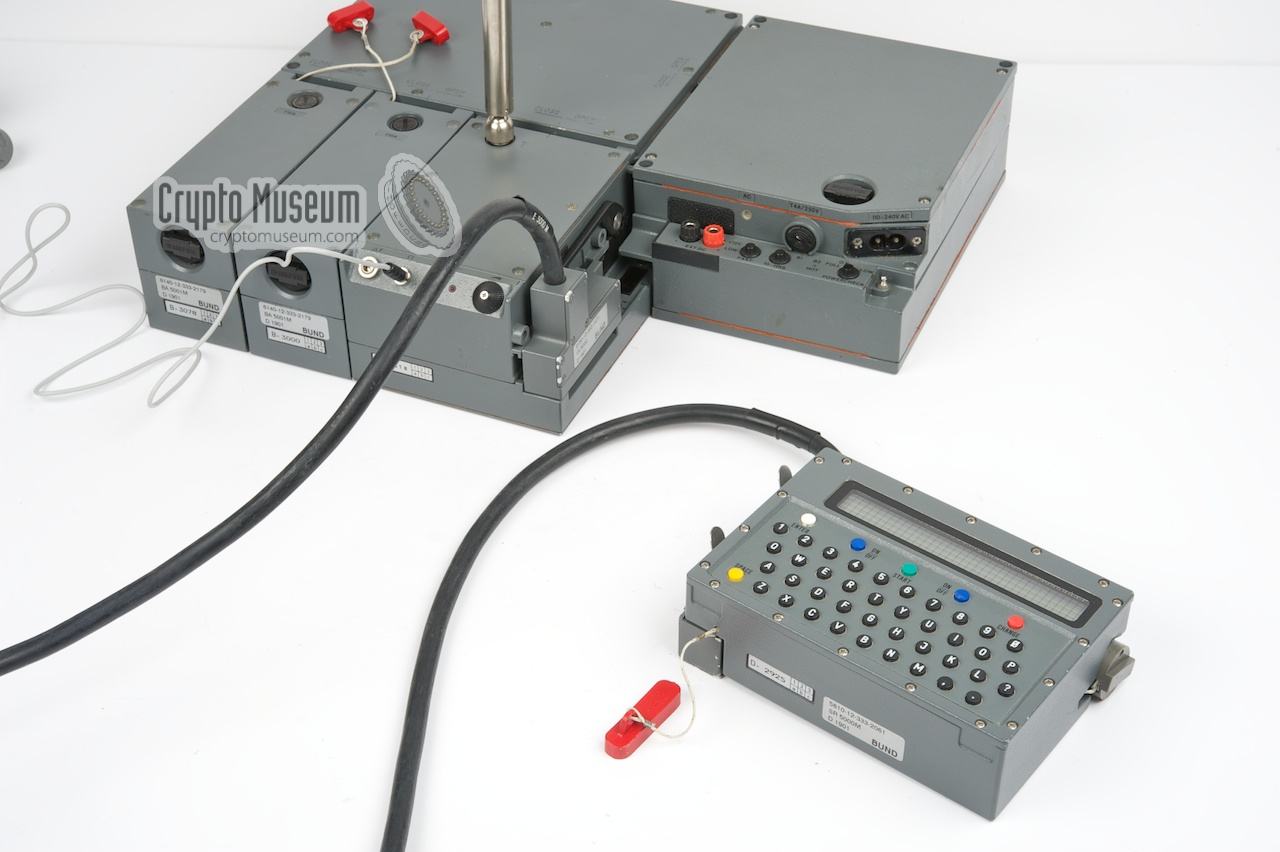
In normal operation, the DSU is located
to the right of the receiver,
so that the connectors of the two devices mate. This is how the FS-5000
was designed in 1985. A later extension cable,
called VK-50000, allows the DSU to be used as a console.
It was probably introduced in 1992.
The image on the right shows the DSU detached from the main station
and connected via the VK-5000 cable.
➤ More information
|
|
|
The DSU can be used stand-alone in which case it is powered by the
internal backup batteries. This allows messages to be entered and read
off-line (i.e. being away from the radio station).
Messages are retained in the internal memory of the DSU and it is even
possible to have scheduled transmissions and receptions.
➤ More information
|
|
|
In some countries it was possible to use the receiver stand-alone
in case of an emergency (e.g. when the other units failed).
The H-bar was then used to connect the receiver to a single battery
and the small control panel on the side of the receiver was used
to adjust the frequency.
Please note that this mode of operation was not possible with the
FS-5000M that was used in Germany.
It can be modified however.
➤ More information
|
|
|
The batteries could be charged independently from the radio station.
This was done by using the power supply/charger in combination with
the H-bar, allowing the two batteries to be connected directly
to the PSU.
The image on the right shows two batteries connected to the PSU via
the H-bar. The black wire on the right is connected to the mains.
➤ More information
|
|
|
By default the radio station was powered by the two NiCd batteries.
In some countries it was not allowed to leave the PSU connected to
the transmitter, so the transmitter was shielded-off at that side.
The image on the right shows the two batteries and the receiver
connected to the transmitter. The DSU is connected to the receiver
at the front right.
|
|
|
The image on the right shows the FS-5000 in battery-operated
configuration, whilst the PSU is used to charge an additional
set of batteries.
This was the main configuration in a number of countries that
used the FS-5000.
|
|
|
For application in the (battle)field, it was possible to use
battery-operation in combination with a detached DSU. It allows
the radio station to be installed in a more convenient location
or in a back-pack, whilst the DSU is hand-held.
The image on the right shows the portable self-contained radio
station with detached DSU.
|
|
|
For the Special Forces of the German Army, the so-called Fernspäher,
the BPU-7000 battery
of the later HRM-7000 manpack radio
was adapted for use with the FS-5000, as an alternative for the
increasingly deteriorating
standard BA-5001 battery.
The result is the improvised and rather clumsy solution shown here, in which
the BPU-7000 battery is connected with an
adapter cable that easily comes off.
➤ More information
|
|
|
|
All FS-5000 sets were supplied by the factory in a large carton box,
with each module (or set of modules) packed inside a sealed water tight
green fiber container. The total set consisted of 8 containers: 4 small
ones and 4 double-size ones. They were packed as two stacks of 3 high.
|
The image on the right shows the contents of the carton.
There were 4 large and 4 smaller containers, each holding one or more
modules. The modules themselves are each packed in plastic, in order to
protect them when stored for longer periods of time. A small container
with the DSU is missing in the picture.
Each container has a label with the serial number and a letter denoting
the module that is stored inside it. If more than one module is packed
inside a container, multiple labels are present. The meaning of the
letters is listed above.
|
|
|
If the FS-5000 was going to be stored for a long period of time, e.g.
as part of a cache, the set had to be taken apart and each module had
to be stored in its container again. The batteries had to be removed
from the DSU. The containers were then sealed
with water-proof adhesive tape.
|
For the transmission of message bursts, the transmitter
uses a very sophisticated modulation technique, called Vestigial Side Band Modulation (VSB or C1D), compatible with ECHOTEL.
This allows the transmitter to send a message
over a channel with an extremely narrow bandwidth at a speed of
2000 baud. As a result, sending a 55 character message takes no more
than 0.8 sec. [A], making Direction Finding (DF) practically impossible!
Although this technique was already used in 1967 for (computer) modem signals,
it was relatively new for use on HF-radio in 1985.
The principle is explained in a number of US patents that were filed around this time
[7]
[8]
[9].
The receiver uses Single Side Band (SSB or J2B) with
single-channel FSK for the reception of data messages at a speed of 75 baud.
As the receiver uses a different type of modulation and a different baud rate,
it is not compatible with the transmitter.
It is therefore not possible to communicate directly
between two FS-5000 field stations. Communication was only possible between
an FS-5000 and a BS-5000 (or BS-7010)
base station.
The block diagram above shows roughly how the various components of the
FS-5000 are used together. All frequencies and tuning signals are derived
from the receiver where they are generated by a synthesizer running
on a 10MHz TCXO. The DSU controls all units and set the RX and TX frequencies.
The antenna signal for the receiver is normally supplied by the
Antenna Tuner
(ATU) through the transmitter.
Only when the alternative telescopic antenna is used,
a separate pre-amplifier is activated. More details on the relevant pages.
A good explanation of the mathematical backgrounds of VSB is given
by Phil Schniter on the Connexions website
[B].
|
Device Automatic spy radio set Purpose Stay-behind organisations agent-base communication Model FS-5000 Codename HARPOON Manufacturer AEG Telefunken Development 1985-1988 Year 1988-1991 Country Germany Waveform SSB, VSB Encryption Proprietary Dimensions ? Weight ? Price DM 69.900 (1988) 1 Quantity 854
|
-
Price in German Marks (DM), equivalent to EUR 19,950 EUR in 1988.
The total cost for the project, including base sations,
was DM 130 million, including the development.
|
- Technisches Handbuch, Feldstation FS-5000M - Teil 1, Beschreibung
Technical Manual, Field Station FS-5000M - Part 1, Description (German).
March 1994.
- Technisches Handbuch, Feldstation FS-5000M - Teil 2, Bedienungsanleiting
Technical Manual, Field Station FS-5000M - Part 2, User Manual (German).
March 1994.
- Technisches Handbuch, Feldstation FS-5000M - Teil 3, Bedienungsanleiting
Technical Manual, Field Station FS-5000M - Part 3, User Manual (German).
March 1994.
|
- Helmut 'Jim' Meyer, HS0ZHK, My way to Ham - Radio and beyond
Website QRZ.COM. Personal correspondence.
Retrieved June 2008.
- Louis Meulstee, Wireless for the Warrior, volume 4
ISBN 0952063-36-0, September 2004
- Dr. D. Engelen, De Nederlandse stay behind-organisatie in de koude oorlog 1945-1992
Ministerie van Algemene Zaken, Ministerie van Defensie & Rijksarchiefdienst/PIVOT
The Netherlands, National Archives, Institutional Investigation, 2005. (Dutch)
- Daniele Ganser, NATO's secret Armies: Operation Gladio and Terrorism in Western Europe
ISBN 978-071465607-6, 2005
- Telefunken Racoms, History
Timeline -> 1985, SY5000 adaptive HF system to NATO special services.
Telefunken website. Retrieved May 2009.
- Geschiedenis van de Sectie Algemene Zaken, Hoofdstuk VIII,
Van Stroomlijning tot Opheffing
History of the Section General Affairs, Chapter 8,
From Streamlining to Dissolution. (Dutch)
Describing the period May 1987 - January 1994.
Dutch National Archives. Top Secret.
Partly declassified and released in 2007 under the FOI Act.
- United States patent 4,780,884, Suppressed Double-Sideband Communication System
Filed 13 April 1987. Approved 25 October 1988.
Previously filed as 741,026 (3 June 1985) and 835,265 (3 March 1986), both
abandonned. Retrieved April 2012.
- United States Patent 4,730,345, Vestigial Sideband Signal Decoder
Filed 4 April 1986. Approved 8 March 1988. Retrieved April 2012.
- United States Patent 5,663,773, Demodulator for a Complex-Value VSB Signal
Filed 20 November 1995 on behalf of ANT Nachrichtentechnik GmbH, Backnang (Germany). Approved 2 September 1997. Retrieved April 2012.
- Phil Schniter, Mathematical backgrounds of Vestigial Sideband Modulation (VSB)
Retrieved April 2013.
- Operators Manual for PC-KAYSAT-KAYNARD-RACE Software
Instructions for the NL-developed message and encryption handling software (English).
May 1991. SECRET.
|
|
|
|
Any links shown in red are currently unavailable.
If you like the information on this website, why not make a donation?
© Crypto Museum. Created: Wednesday 14 October 2009. Last changed: Sunday, 11 January 2026 - 13:51 CET.
|
|

|
|
|
|