|
|
|
|
|

|
|
← Crypto Germany Manufacturer
Siemens & Halse
Like many other European electronics companies, the
German
multinational
Siemens developed
a number of cipher machines over the years. The most famous one is
probably the T-52,
also known as the Geheimschreiber, that was
used by German High Command during WWII. After the war, Siemens
developed a series of mixer-machines
based on the Vernam principle.
➤ More about Siemens
|
|
|
|
|
Siemens cipher machines on this website
|
|
|
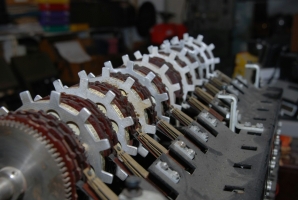
The T-52 was one of the strongest cipher machines used by the
Germans during WWII. Is is based on the Vernam principle, whereby
the digital 5-bit code of a teletype is mixed with a 5-bit random
number. The random number generator, however, is built-in and is
based on mechanical wheels, notches and pins.
➤ More information
|
|
|
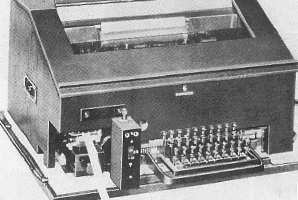
The T-43 was probably the first machine in the mixer class.
It mixes clear text with the characters from a random key tape, using
XOR operations.
The T-43 was introduced relatively late in the war (1944) and only a small
quantity was ever built. The machines were captured by the Allies,
along with a number of German crypto-experts.
➤ More information
|
|
|
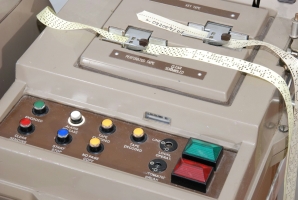
Schlüsselgerät D (cipher machine D) was a compact one-time tape (OTT)
cipher machine, also known as a mixer, that was introduced in 1959.
It is based on the same principle as the earlier
T-43 and is the predecessor
of the M190.
The machine has a Siemens T.send.77f double tape reader at the front.
The control logic inside the machine is built with electric relays.
➤ More information
|
|
|
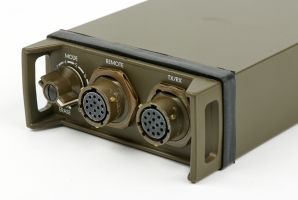
Military voice encryption unit with room for 8 different
crypto keys. Intended for use with the AN/PRC-77 radio.
Provides a high level of security on narrow band FM radio
channels.
➤ More information
|
|
|
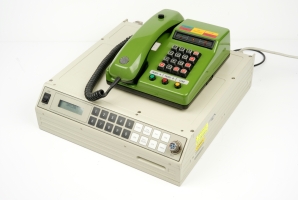
In the early 1990s, Siemens entered the secure phone market by selling
this rebadged Philips PNVX crypto phone.
It features symmetric key encryption, using a smart card for identification
and key exchange.
Except for its colour, it is identical to the PNVX.
➤ More information
|
|
|
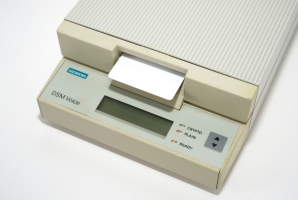
The DSM Voice was a telephone encryptor was developed around 1996. It was
connected between the phone and the network and used a smart card for
authentication. The card is also used for public key exchange.
MRCELP vododer technology is used to provide good quality speech
in encrypted mode.
➤ More information
|
|
|
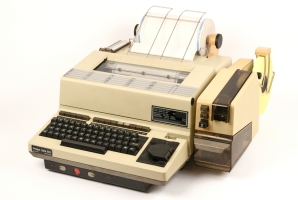
In the 1980s, Siemens sold this rebatched Philips Aroflex cipher machine
on the German market, as the Siemens T-1000CA. It is basically a Siemens
T-1000 teleprinter with the Philips Aroflex (UA-8116) unit mounted at its
underside.
➤ More information
|
|
|
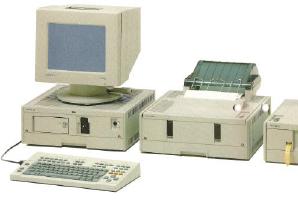
In the early 1990s, Siemens developed the T-1285CA
in close colaboration with Philips Crypto in The Netherlands.
Although it was a feature-packed machine, it hit the marked too late
and was never taken into mass production.
➤ More information
|
|
|
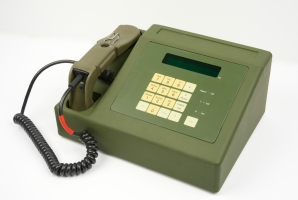
The CTE-020 was a secure military digital EUROCOM-standard phone, that was developed
by Siemens in Munich (Germany) in the early 1990s under contract for the German
Airforce.
It was intended as a Remote Digital Engineering Order-Wire (EOW) Terminal
as part of the Airforce's digital network, in places where the EOW
terminal is remote from the transmission equipment.
With optional crypto module.
➤ More information
|
|
|
|
|
|
Any links shown in red are currently unavailable.
If you like the information on this website, why not make a donation?
© Crypto Museum. Created: Wednesday 05 August 2009. Last changed: Wednesday, 11 October 2023 - 05:43 CET.
|
 |

|
|
|