|
|
|
|
|

|
|
Crypto Mixer OTT
Digital bit-wise XOR
The Vernam Cipher is a symmetric cryptographic principle for adding
a key stream to a plaintext, invented in 1917 by Gilbert Vernam (1890-1960).
It is based on the principle that each plaintext
character is 'mixed' with one character from a key stream.
If a truly random key stream is used, the result will be a truly
random ciphertext which bears no relation to the original plaintext.
In that case the cipher is similar to the unbreakable
One-Time Pad (OTP).
As it was generally used with teleprinters
and 5-level punched tape,
the system is also known as One-Time Tape
or OTT.
If the resulting ciphertext in the OTT system described above is truly random,
it can safely be sent over the air, without the risk of being deciphered
by an eavesdropper.
All the recipient has to do is mix the ciphertext with the same OTT
to reveal the original plaintext.
One only has to guarantee that the OTT is truly random, that there are only
two copies of it, that both copies are destroyed immediately
after use and that they are only used once. (More about security below.)
The above became possible after the introduction of digital telegraphy,
also known as Teletype 1
or Telex.
With a teletypewriter, each character is substituted by a digital 5-bit code –
represented by the 5 holes in a punched paper tape –
commonly used with telex machines.
This is commonly known as ITA2
or the Baudot-Murray code.
Digital codes can also be represented by a series of '1's and '0's,
where 1 represents the presence of
a hole and 0 represents the absense of a hole.
The ciphertext is created by applying the logical
XOR operation (exclusive-or) to the individual bits of plaintext
and the key stream.
The advantage of using the XOR operation for this,
is that it can be reverted, simply by carrying out the same operation again.
In other words:
plaintext + key = ciphertext
⇒
ciphertext + key = plaintext
In mathematics, the XOR operation is known as modulo-2 addition.
In our case, the individual bits of the plaintext are XOR-ed
with the individual bits of the key.
The resulting bit will only be '1' if the two
input bits are different. If they are equal (both 1 or both 0),
the result will be '0'.
Take the letter 'A', which is represented by 00011, and add it to
the letter 'B', represented by 11001.
A bit-wise XOR operation yields 11010 which,
in the ITA2 table, is the letter 'G'.
In fact, each bit from the key tells us whether or not the corresponding
bit from the plaintext should be inverted.
By inverting these key-bits again, as shown above,
the original character is revealed.
|
|
-
Although 'Teletype' is actually a brand name of the Teletype Corporation,
it has become a generic expression for
digital 5-bit telegraphy. The system
is also known as Teleprinter, Teletypewriter and Telex.
-
XOR = Exclusive OR.
|
The principle of the Vernam Cipher is perhaps easier understood by
looking at a message stored on a punched paper tape. In the example
below, we want to transmit the word HELLO which is stored on the
plain text tape.
We also have a pre-recorded key tape, with a series of random
characters; in this case the sequence AXHJB.
The contents of the plaintext tape are now XOR-ed with the
contents of the key tape.
The result (KMIVE) is shown here as the ciphertext tape:
|
| |
Mixing of the plaintext and the key
|
Now let us see what happens if we repeat this operation on the
resulting ciphertext tape with the letters 'KMIVE'.
In the illustration below,
the ciphertext tape is on the left. It is XOR-ed with a copy of the
original key tape (AXHJB), which results in the original plaintext: 'HELLO'.
|
| |
Mixing of the ciphertext and the key
|
This process of applying the XOR-operation to text and key
is often called mixing, and the cipher machines that use the
Vernam principle, are therefore known as mixers.
In the days when teletype systems were in widespread use, technicians
were often so experienced that they could read a text directly from
a paper tape, simply by looking at the holes and reading the bit patterns.
|
| |
Mixing of the ciphertext and the key with the human eye
|
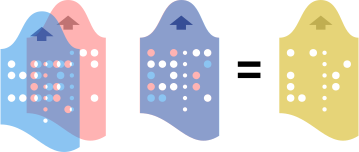
The same was often true for the maintenance engineers of OTT cipher
machines. By taking a ciphertext tape, overlaying it with a key tape
and then holding it against a bright light source,
they were often able to 'read' the plaintext directly.
This is illustrated in the above drawing, in which each half-transparent
hole should be interpreted as as a binary '1'.
|
| |
Mixing of the plaintext and the key with the human eye
|
|
|
The above procedure is 100% safe if, and only if, the following
conditions are all met:
|
- There are only two copies of the key-tape,
- Both sides of the communications link have the same key-tape,
- The key-tape is used only once,
- The key-tape is destroyed immediately after use,
- The key-tape contains truly random characters,
- The equipment is TEMPEST proof,
- The key tape was not compromised during transport.
|
If any of the above criteria is not met, the cipher will become
less secure. This means that – for example in a battlefield –
sufficient supply of key-tapes have to be prepaired and distributed
well in advance of a potential transmission. If you are communicating
with a station several thousands of kilometers away, it will be
very difficult to supply new key-tapes on a regular basis.
In practice, distribution of key tapes always was a big problem,
resulting in many violations of the above rules. In some cases
a key tape was used more than once, or was inserted the other
way around (i.e. starting at the end). There were even cases
where an operator would take a piece of key tape and use it
as an endless loop, simply by joining both ends with a piece of cellotape.
|
Although the OTP was, and still is,
the only cipher that is totally secure by design,
many systems based on the Vernam Cipher were
replaced by cipher systems that use a pseudo-random number
generator (PRNG) with a long period. If both ends of the
communication link initialize their pseudo-random key
generators identically, the Vernam principle can still be
applied.
With this method, the initialization of the pseudo-random generator
has become the key
or seed,
or initialization vector, which is typically much shorter than the
message itself. Such a short key produces far less distribution
problems, but also results in a reduced security of the cipher.
In practice it's a trade-off between the desired secrecy level
and the strength of the key.
|
It is also very important to consider how key tapes were made.
The cipher is only 100% safe, if the key tape contains evenly-spread
truly random characters. That would be the case if the tape was filled
with white noise from, say, a diode or an empty radio channel.
In practice, however, military organisations often used
pseudo-random number generators for the creation of the key tape.
The simple fact that such a generator is pseudo-random,
makes the cipher less secure. There is always the danger that
a potential enemy finds out what algorithm is used to generate
the pseudo-random sequence; either by mathematical methods or
through espionage.
Examples of proper key tape generators are the
Philips EROLET
and the Mils A-6723.
➤ More about generating key tapes
|
Cipher machines, intended for operation with teleprinter signals,
that use the Vernam Cipher, are generally called mixers
or mixing machines.
In most cases, they are equipped with two paper-tape readers,
one for the plaintext tape and one for the key tape.
➤ More information
|
|
|
The Vernam Cipher is named after Gilbert Sandford Vernam (1890-1960)
who, in 1917, invented the stream cipher and later co-invented the
OTP.
His patent US 1,310,719
was filed in 1918 and is, according to
the NSA,
perhaps the most important one in the history of cryptography [1].
Over the years, many have claimed the invention of the
OTT
and the mixer.
In 1921, the German manufacturer Siemens filed
patent DE 371,087 in which
a nearly identical principle is claimed. The patent drawing even shows
two puched paper readers side-by-side. One of Siemens' claims is that
it could be used as an online cipher system by driving the telegraph
relay directly [2].
During WWII, the German Army relied on
hand ciphers and
rotor-based cipher machines,
such as the Enigma,
the Siemens T-52 Geheimschreiber
and the Lorenz SZ-40/42. In 1943,
Siemens
developed their first online mixer machine based on the above principle.
It was named T-43
and less than 50 of them were built.
At the end of WWII, the Germans destroyed most of these
T-43 machines.
The ones that survived were captured by the Americans
and later also by the British.
|
|
In 1952, a similar patent was filed by Bjørn Røhrholdt – a Colonel,
engineer, veteran and liason of the Norwegian Army – and Kåre Meisingset
of STK in Norway
[3].
The collaboration of the two engineers eventually resulted in the
development of the ETCRRM,
a mixer machine that used valves (tubes) rather than electric relays.
The machine was soon adopted by the Americans
for communication at the highest level and later also by the newly
established NATO.
At height of the Cold War,
the ETCRRM was used at
the heart of the Hot line between Washington and Moscow.
|
|
|
The Dutch PTT and Philips
|
|
|
|
In the late 1950s, the Dutch PTT 1 developed its own range of
mixers,
again based on the same principle. As the PTT didn't have
sufficient production capacity, the machines were manufactured by
Philips Usfa in Eindhoven (Netherlands).
The first machine to be released in 1956 was the
Ecolex I. Like the ETCRRM,
it was valve-based.
It was followed in 1960 by the fully transistorized
Ecolex II. After that, Philips Usfa took over
the development of cipher machines, resulting in 1963 in the
Ecolex IV.
According to a former company director, Philips payed royalties
to Professor Dr. Ir. Oberman, the initial
developer at the Dutch PTT Research Labs,
for the use of his patents [4].
|
-
PTT = Staatsbedrijf der Posterijen Telegrafie en Telefonie.
(state company for post, telegraphy and telephony). Privatized in 1989
and currently known as KPN.
|
|
|
Modern use of the Vernam Cipher
|
|
|
The Vernam Cipher can also be implemented with modern computer technology.
Instead of the 5-bit word of a teletype system, computer words consist
of 8 or even more bits. The principle, however, remains the same as
the XOR-operation is applied to the individual bits of the data word.
The use of the XOR-operation is still at the heart of many
cryptographic algorithms today.
One warning however: always use a dedicated device for
One-Time Pad
communication,
and never use a common personal computer (PC), a tablet or a smart phone,
with a piece of software. Such systems are inherently usafe.
There is no such thing as a secure personal computer.
➤ More about the One-Time Pad (OTP)
|
|
|
|
Any links shown in red are currently unavailable.
If you like the information on this website, why not make a donation?
© Crypto Museum. Created: Saturday 11 August 2012. Last changed: Saturday, 21 December 2024 - 21:40 CET.
|
|

|
|
|