|
Rotor Germany Lorenz Colossus →
Teleprinter cipher attachment
- wanted item
The SZ-40 was an electro-mechanical wheel-based
cipher machine for
teleprinter signals (telex). It was developed by
Lorenz
and used during WWII by the German Army
for communication at the highest level.
The machine was improved twice (SZ-42a and SZ-42b) and was broken during
WWII by the codebreakers at Bletchley Park (UK),
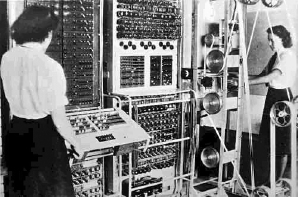
with the aid of Colossus, the first electronic
digital computer.
The SZ-40/42 was codenamed TUNNY
by the codebreakers at Bletchley Park (BP).
|
During WWII, the German Army used a variety of cipher machines, of which the
Enigma machine is probably known best.
For secure teleprinter communication (telex) they used the
Siemens T-52 Geheimschreiber,
the Lorenz SZ-40, and later also the
Siemens T-43 one-time pad machine.
The Lorenz SZ-40/42 was used by the German Army High Command
(Oberst-Kommando der Wehrmacht, or OKW) for communication at the
highest level, between Hitler and his Generals. The machine was called
Schlüsselzusatz (SZ) which means Encryption Add-on.
It was connected between a teleprinter and the line, and was suitable
for both online and offline use.
Only a small number of SZ-40
and SZ-42 units were ever built.
The image on the right shows one of the very few
machines that have survived.
It was found in Germany and is now on public display in the museum at
Bletchley Park.
|
|
|
Another SZ-42 will be on display at the
National Museum of Computing (TNMOC), also located at Bletchley Park.
Please note that the Lorenz SZ-40/42 is often mistakenly called Geheimschreiber,
for example in the 2012 BBC Documentary The Lost Heroes of Bletchley Park and on several websites.
Although being a general description, the name Geheimschreiber
(secret writer) is usually associated with the
Siemens T-52
and not for the SZ-40/42. Although the two machines use a similar principle,
they are not identical.
|
 |
|
|
|
The majority of messages sent by the German army during WWII, were encrypted
with the well-known Enigma machine. Such messages were always send via radio
by means of morse code. Generally speaking, these were messages of a tactical
nature. For the higest level in the command chain however, the Germans used
a variety of far more complex cipher machines, all of which operated on teleprinter
signals (telex). Three different cipher machines are known to have been used
by the German High Command: the Siemens T-52, the Siemens T-43
and the Lorenz.
The Siemens T-52,
also known as the Geheimschreiber, was mainly operated
via landlines rather than via radio, which is why it was hard to intercept
its messages. It was occasionally broken by BP and also by the Swedish
Intelligence Agency during WWII.
The Siemens T-43
was a so-called mixer machine that operated as a
One-Time Pad
and was therefore never broken.
The first non-morse transmissions by the Germans were intercepted in the
second half of 1940. Such transmissions were generally called FISH by
BP, and fish-names were used for the various networks. In June 1941
the Germans started the first expirimental link with a Lorenz SZ-40
machine, which was called TUNNY by BP.
In August 1941, the first breakthrough was achieved as two long messages
were received in depth. In the event the receiving end notified
the initiator of the message that it had not been received and requested
it to be sent again. The operator at the sending end retransmitted the
message using the same message key (i.e. the same start positions of the
wheels). As he was typing the message by hand however, he started making
mistakes and occasionally used short cuts. This led to small variations
in the cipher text that enabled the codebreakers, lead by
mathematician Bill Tutte, to recover nearly 4000
characters of the key stream.
By January 1942, the codebreakers had deduced the working principle
of the Lorenz machine, unsing nothing but the recovered key stream
from the August 1941 message.
|
|
Once the codebreakers at Bletchley Park had figured out how the TUNNY
worked by January 1942, it was possible to build a functional
replica. The replica machine was called the British Tunny and was developed
at Tommy Flowers' laboratory at Dollis Hill by Gil Hayward, Allen (Doc) Coombs,
Bill Chandler and Sid Broadhurst, without ever having seen a real
Lorenz SZ-40/42 machine.
|
It is only after the D-Day landings in 1944, that the first Lorenz machine
was captured and was shown to the codebreakers. They were amazed to see
the relatively small mechanical machine of which they had created the
electronic equivalent.
A fully functional replica of the British Tunny is on public display at
The National Museum of Computing (TNMOC) in Block H at Bletchley Park.
The image on the right shows the British Tunny being explained
by volunteer Kevin Coleman.
|
|
|
|
The first machine to assist in decoding the Tunny messages, was the
Heath Robinson.
It was developed by a
Tommy Flowers
and Frank Morell of the General Post Office (GPO)
research station at Dollis Hill (London). Flowers had been
introduced to Max Newman by
Alan Turing
who admired Flowers for his insight in electronics and the use
of electronic thermionic valves (vacuum tubes).
|
Heath Robinson had two paper tape readers, one for the cipher text
and one for the Chi-wheel starting positions that were tested at
1000 characters per second.
Stretching of the tape at this high speed however, made it
difficult to maintain synchronisation between the two tapes.
Heat Robinson was recreated by
Tony Sale in 2001
while he was temporarily unable to work on his Colossus Rebuild
(see below). It is now on display at the computer museum (TNMOC).
➤ More about Heath Robinson
|
|
|
|
Once the first Heath Robinson machines were up and running, developer
Tommy Flowers started to work out his plans for a far more advanced
machine that would not only be faster than Heat Robinson, but also
more flexible. It turned out to be the first programmable electronic computer.
|
Because the machine contained more than 1700 thermionic valves (vacuum tubes)
and its enormous size, Flowers called it Colossus. It barely fitted a room
and produced a lot of heat, but it was five times faster than
Heath Robinson and could be programmed for specific tasks.
Because of this, Colossus is now generally accepted as the first
programmable electronic computer. In any case, it was conceived before
the American ENIAC, which for a long time was thought to be the first.
This was not known at the time as Colossus was kept
secret until 1974.
|
|
|
The first Colossus was delivered at Bletchley Park on 18 January 1944
and broke its first message on 5 February of that year. It was succeeded
by Colossus Mark II, which consisted of no less than 2400 valves. The first
Colossus Mark II was delivered on 1 June 1944 —
just five days before the D-Day landings on the Normandy coast —
and immediately produced good intelligence. In total 10 Colossi
were installed before the end of the war. After the war all Colossi
were dismantled.
In 1993, a team led by Tony Sale,
inspired by Professor Brian Randell, started the reconstruction of
Colossus, starting with nothing more than 8 wartime photographs.
It took him 16 years and a lot of detective work, but in the end
he got Colossus running again. It is now on display at The National
Museum of Computing (TNMOC) in Block H at
Bletchley Park.
➤ More about Colossus
|
- SZ-40
- SZ-42a
- SZ-42b
- SZ-42c
|
Release 23 January 2018
Jerry McCarthy in the UK, has made a fully operational SZ-42 (Tunny)
simulator that runs on nearly any Windows® computer. It even has
a Colossus simulation function, and comes with
full documentation in PDF format.
Although developed as a 32-bit application, the simulator runs happily on
64-bit Windows 7 and also on Windows 10. Nevertheless, no warranties
are made and the software is supplied as-is. Use it at your own risk (read
the disclaimer below).
➤ Download the simulator
|
|
|
DISCLAIMER —
Although the software presented here was thoroughly tested and every effort
was made to ensure that it is free from errors, such can not be guaranteed.
Neither the author – Jerry McCarthy – nor Crypto Museum can be held responsible
for any loss or damage, direct or indirect, arising from the use or misuse
of the software. Furthermore, we can not guarantee the
fitness of the software for any purpose.
As only a few Lorenz SZ-40/42 machines have survived the war, the chances
are very slim that we will ever find one on the surplus market.
Nevertheless, we have listed it here as a wanted item, as we think it
is needed to tell the other half of the story of
Bletchley Park.
Until that time, this page will be used as a placeholder for information
about the Lorenz SZ-40/42. If you have any information that you want to
share with us, please contact us.
|
- Der Schlüsselzusatz 42 zum Fernschreiber, Heft I, Vorläufige Gerätebeschreibung
The Cipher Attachment 42 for Teleprinter, Volume I - Preliminary Device Description.
15 May 1944. TICOM document No. 663. 1
➤ Heft I, Zeichnungen (Volume 1, Drawings)
➤ English translation: Volume I, Provisional Descriptions
- Der Schlüsselzusatz 42 zum Fernschreiber, Heft II - Vorläufige Betriebsvorschrift
The Cipher Attachment 42 for Teleprinter, Volume II - Preliminatry Operating Instructions.
15 May 1944. TICOM document No. 664. 1
➤ English translation: Volume II, Tentative Rules for Cipher Attachment 42
- SZ-42, Heft III - Gebrauchsanleitung für die Schlüsseleinrichtungen und -unterlagen
The Cipher Attachment 42 for Teleprinter, Volume III - User Instructions for the Cipher Key and Key Material.
20 May 1944. TICOM document No. 665. 1
➤ English translation: Volume III, Instructions for Use of Keys and Key Material
|
 |
- B. Jack Copeland, Colossus, Breaking the German Tunny Code at Bletchley Park
An illustrated history.
The Rutherford Journal, Volume 3, 2010.
- Tony Sale, The Lorenz Cipher - and how Bletchley Park broke it
Retrieved June 2011.
- Tony Sale, Colossus Rebuild Project
Retrieved June 2011.
- Tony Sale, Colossus 1943-1996,
And How it Helped to Break the German Lorenz Cipher in WWII.
ISBN 978-0947712365.
- Wikipedia, Lorenz cipher
Retrieved January 2014.
- Wikipedia, Cryptanalysis of the Lorenz cipher
Retrieved January 2014.
- Frode Weierud, The Secrets of the Lorenz Schlüsselzusatz SZ42
Website. 30 April 2016.
|
|