|
|
|
|
|

|
|
Burst USA CIA
|
As the speed was too high for the human ear and brain to interpret the
morse code signals,
low-grade tactical messages were often sent unencrypted.
High-grade field messages and espionage reports were commonly encrypted
with a one-time pad cipher
or with an external cipher machine.
It was also possible to use the two letter-discs on the CO-8 as
a simple Vigenère cipher system.
|
|
The military version of the CK-8, usually supplied in black enclosures,
was known as AN/GRA-71 and as NSN 5820-00-056-6856.
It came in a waterproof container that doubled as an interface between
the keyer and the radio.
The CK-8 (GRA-71) set was in production until at least 1979.
|
 |
Messages are recorded onto CA-3 magnetic tapes, using one
of the two supplied coders – CO-3 and CO-8 –
much like using a domestic tape recorder.
One coder (CO-8) has a disc with the 26 letters of the alphabet.
It allows letters to be recorded directly in
morse code.
Alternatively, the CO-3 dash-dot coder can be used, allowing
any morse character to be composed manually, including
numbers and punctuation marks.
Once the recording is complete, the KE-8 keyer is connected to the
transmitter in order to play back the message at the high speed of ~ 300 wpm.
The diagram above shows the flow of information when using the CK-8 (GRA-71).
At the left are the two possible routes to choose from. Whether the user
selects the CO-3 dot-dash coder or
the CO-8 alphabet coder, the messages are
always stored as a sequence of (morse code)
dots and dashes onto a
CA-3 tape cartridge.
The tape has two separate tracks:
the upper track is used to record the dashes,
whilst the lower track is used for recording the dots,
as illustrated below.
In the above example, the text NOW IS THE TIME
(in morse: -· --- ·-- ·· ··· - ···· · - ·· -- ·)
is recorded onto a tape
cartridge. The coders are mechanically constructed in such a way that an
accurate timing is guaranteed for the dashes, dots and the spaces between
letters and words.
Once the message is complete, the cartridge is removed
from the coder and attached the the actual Keyer (KE-8).
As the keyer can not be connected to old valve-based transmitters,
the KA-3 Keyer Adapter had
to be used as an interface for the high anode voltages of the valves.
Later transistor-based transmitters, like the PRC-64A,
could be connected directly to the KE-8 keyer.
|
|
After recording a message, and detaching the CA-3 cartridge from the coder,
a spring-loaded mechanism inside the tape cartridge ensures that the tape
will automatically return to the staring position. This means that there is
no need to rewind the tape manually.
|
|
The Keyer can also be used to erase a Tape Cartridge by
winding-up the mechanism, attaching a pre-recorded tape,
sliding the ERASE switch to the upper position (and keeping
it in that position) whilst sliding the ON/OFF switch to
the ON position. The ERASE switch will now be locked-in.
|
|
At the rear of the Keyer is a switch
marked IDY (identification). When engaged, it uses the dot-channel
of the Keyer to send a continuous sequence of dots at a
rate of 300 wpm.
|
|
Most solid state radios can be used in combination with the
CK-8 (GRA-71), although in some cases a special cable is required.
Apart from the radios listed below, the CK-8 (GRA-71) was used
with a variety of Cold War
spy radio sets, both in the USA and in
Europe. In The Netherlands, it was used by Korps
Commando Troepen (KCT) – the Dutch Special Forces – in combination
with the TRC-77 radio. This radio was also very popular with the
Special Forces in Vietnam at the time.
|
The image on the right shows (from left to right) the dot-dash
morse encoder CO-3A (also known as the MX-4495), the CO/B-8 alphabet encoder
(also known as the MX-4496), and the KE-8E keyer (also known as the KY-468).
The latter is used for playing back a recorded message.
The matching tape cartridge is not shown here.
A detailed description of each item is provided below, in the section
'Parts'.
A suitable cable for connecting the KE-8E keyer to the
FSS-7 stay-behind set,
is shown at the bottom of the page.
This cable was part of an early FSS-7 setup.
|
|
|
|
Please note that in some cases, the black variant of the device was supplied
with stay-behind radio sets. Apart from the colour, the items are functionally
identical.
In Europe, the stay-behind version of the CK-8 was later succeeded by
electronic burst transmitters, like
Speicher
and MMP.
|
Messages – preferably encrypted – were recorded as
morse code symbols on to
standard magnetic (ferro) audio tape,
similar to the tape used with domestic audio recorders.
Each cartridge holds 12.5 feet of '428' industrial grade recording tape – manufactured by 3M –
which is sufficient for holding 150 five-letter groups (words).
The dots and dashes of the morse code are recorded as a series of pulses
in two individual tracks. When recording, the tape is advanced automatically
by the coder.
|
|
|
The CO-3 is the oldest of the two coders. It has only three buttons:
one for dots, one for dashes and one for spaces, and allows
any possible morse character
to be composed freely.
This coder requires the operator to be familiar with the
morse alphabet
and was often preferred as it was the lighter
of the two. Like the CO-8, the CO-3 is a passive device
that does not require an external electrical power source.
Pushing down a button generates just enough electric energy
to store the data onto the tape.
|
|
|
The CO-8 alphabet coder allows any character of the Latin
alphabet to be recorded onto the tape cartridge in
morse code.
It can be used by operators without knowledge of
morse code.
When operating the lever, a built-in miniature power generator
provides the electric energy to operate the device.
Numbers (0-9) are recorded as letters (A-J or Q-Z).
Spaces can be inserted by pressing the
word-space button.
|
|
|
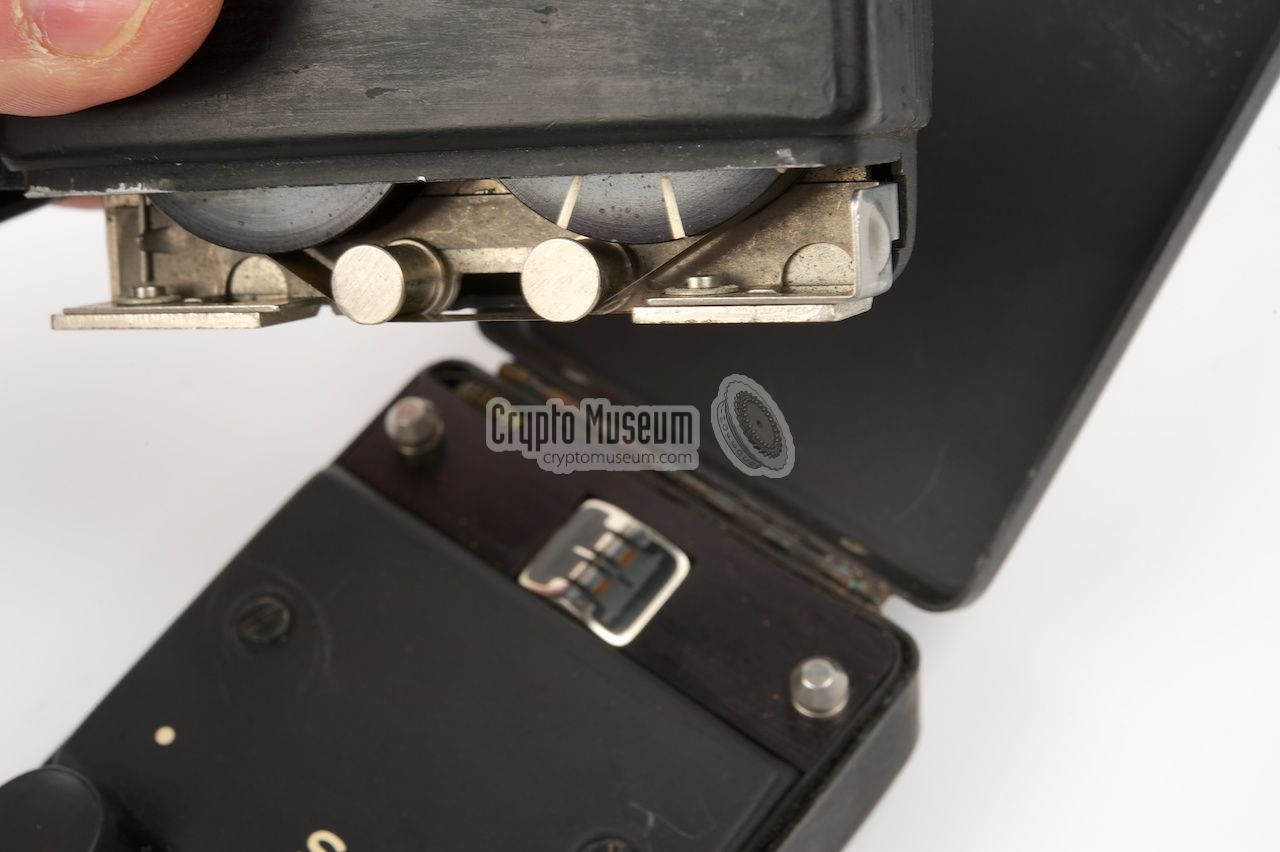
KE-8 was the standard morse keyer of the CK-8 set. It is driven by a spring-loaded
mechanism, or spring-motor, that must be wound-up before each transmission,
with the foldable crank at the top.
It is basically the same device as the KE-8B
supplied with the military AN/GRA-71.
The image on the right shows a KE-8 with its hinged lid open.
A later version uses an electric motor (see below).
|
|
|
The KE/M-8 is basically the motor-driven version of the
KE-8 featured above.
It has the same outer dimensions, but is powered by an external 12V DC
source – typically provided by the radio to which it is connected –
instead of a wind-up clockwork mechanism.
The image on the right shows a typical KE/M-8 as it was found with a
TAR-224 spy radio set. It was introduced by the
CIA in the late 1970s.
|
|
|
|
The military version of the device was commonly painted black, and was
supplied in the water tight contains shown below, which also acts as the
interface between the device and the radio. The other components
are functionally identical to those of the
standard (grey) CIA version.
|
Each items has its own slot – which is read on the inside –
so that the container can easily be checked
for completeness. All items can be removed, with the
exception of the KA-3 keyer adapter, which is an integral part of the case.
The keyer-adapter (KA-3) has two cables: one for connection to the radio,
and one for keyer. They are shown here in their storage position.
The GRA-71 was used in combination with a variety of special forces and
stay-behind radio sets,
including the RS-1 (GRC-109),
the PRC-64A,
the PRC-74A, the RS-59
and the SP-15.
|
|
|
|
Burst encoders like the GRA-71 were very popular with the
American Special Forces (SF) during the Vietnam War, as
they drastically shortened the time needed to occupy the
limited frequency space that was available at the time. The CIA used
burst encoders also to limit the risk of interception and
Direction Finding (DF)
by the enemy. The GRA-71 was used well into the 1970s
when it was replaced by digital systems.
The price of a single GRA-71 unit was US$ 759.14 [2].
|
|
|
Tape cartridge
CA-3B, MA-9
|
|
|
Messages – preferably encrypted – were recorded as
morse code symbols on to
standard magnetic (ferro) audio tape,
similar to the tape used with domestic audio recorders.
Each cartridge holds 12.5 feet of '428' industrial grade recording tape – manufactured by 3M –
which is sufficient for holding 150 five-letter groups (words).
The dots and dashes of the morse code are recorded as a series of pulses
in two individual tracks. When recording, the tape is advanced automatically
by the coder.
|
|
|
|
|
Dot-dash coder
CO-3B, MX-4495
|
|
|
The CO-3B coder was supplied as an alternative to the heavier
CO/B-8 alphabet coder (see below). It had only three buttons:
one for dots, one for dashes and one for spaces, and allowed
any possible morse character to be composed.
This coder required the operator to be familiar with the
morse alphabet
and was often preferred as it was the lighter
of the two. Like the CO/B-8, the CO-3B is a passive device
that does not require an external electrical power source.
Pushing down a button produces just enough electric energy
to store the data onto the tape.
|
|
|
|
|
Alphabet coder
CO/B-8, MX-4496
|
|
|
The CO-8 alphabet coder allows any character of the Latin
alphabet to be recorded onto the tape cartridge in
morse code.
It can be used by operators without knowledge of
morse code.
When operating the lever, a built-in miniature power generator
provides the electric energy to operate the device.
Numbers (0-9) are recorded as letters (A-J or Q-Z).
Spaces can be inserted by pressing the
word-space button.
|
|
|
|
|
Alternative index disk
for CO/B-8
|
|
|
The CO/B-8 coder was supplied with two alphabet discs:
one disc with the letters A-Z in reverse order and an inner
ring (in red) that contained the letters A-Z in the correct
order. The image on the right shows this disc mounted on
the CO/B-8 coder. At the reverse side, this disc contains
the alphabet in reverse order (Z-A).
A spare disc was supplied with the letters (A-Z) in the
correct order, corresponding directly with the morse
characters A-Z. The numbers (0-9) are always sent as
letters (A-J or Q-Z).
|
|
|
|
|
Keyer
KE-8, KE-8B, KY-468
|
|
|
KE-8, also known as KY468, is the actual keyer, and
replaces the morse key of the radio to which it is connected.
It plays back the tape cartridge using an internal
spring-motor, that must be wound-up manually before each transmission.
It can be connected directly to a transistorised transmitter,
via the 7-pin Winchester socket at the rear and is powered directly
by a 12V DC source sypplied by the transmitter.
When using the keyer with a valve-based transmitter, the
KA-3 keyer adapter (see below) should be used.
|
|
|
|
|
Keyer Adapter
KA-3, MX-4498
|
|
|
When using the KE-8 keyer with a valve-based
transmitter, such as the T-784 of the
RS-1 spy set (AN/GRC-109),
the KA-3 should be used as an interface.
It converts the low-voltage signals to the anode voltage of the transmitter.
It is not required for transistorised transmitters.
An R/C timing circuit enables the
oscillator of the T-784 transmitter for the duration of the
transmission. Once the last character has been sent, the oscillator
is disabled after ~ 1 second.
The device also converts the filament voltage of 6.3V into 12V DC for the
KE-8 keyer circuits.
|
|
|
A soft camel hair cleaning bush is supplied to allow the contact
and the mechanical parts to be cleaned regularly.
It can be stowed in a circular slot between the alphabet coder
and the keyer.
The brush itself works like a lipstick; take off the cover and rotate
the shaft to reveal the brush. Rotate backwards to retract the brush again.
|
|
|
Two manuals were available for the GRA-71:
a small instruction manual – TM 11-5835-224-12 [B],
and a larger Depot Maintenance Manual – TM 11-5835-224-35 [C].
Both manuals are shown in the image on the right,
and are available for download below.
➤ Instruction manual
➤ Maintenance manual
|
|
|
Below is the circuit diagram of the CO-3 and CO-8 coders. At the left is
the miniature signal generator (G1). In the CO-3 it is driven by pressing
the dash and dot buttons. The same buttons also operate the
two switches (S1 and S2), which in turn feed the signal from the generator
(G1) to the recording heads (H1a and H1b). The signal is then recorded as
a pulse onto the tape.
The circuit diagram of the CO-8 coder is identical, but the generator (G1)
is operated by the U-shaped lever, and the switches (S1 and S2) are operated
by a coded disc inside the device. The circuit diagram of the keyer can be
found on the last page of the maintenance manual [C].
|
The KE-8 keyer has a 7-pin
Winchester M-series socket [1] at the rear,
allowing the unit to be connected directly to a transistorized (solid-state)
transmitter. The transmitter needs to supply 12V DC for the electronic circuits
inside the Keyer. The pin-out of the socket is as follows:
Note that the SIGNAL lines are galvanically isolated from the 12V circuitry.
In most cases, a purpose-built cable will be needed between the
Keyer and the transmitter.
When used in combination with a valve-based transmitter, such as the
T-784 of the RS-1 spy set (AN/GRC-109),
The Keyer Adapter (KA-3)
(part of the GRA-71 container) is used as an interface.
A fixed cable on the KA-3 (marked TRANS) has an M10P connector at the end,
with this pinout:
|
| |
J1 - Transmitter socket (M10S)
|
The 6.3V filament power from the transmitter (AC or DC) is supplied by
the transmitter on pins H (6.3V) and J (GND) of J1. This voltage is converted
by the KA-3 into 12V DC that is available on pins H (+12V) and C (-12V)
of J2. Pins C and F of J1 are both connected to the screen grid of the PA
valve of the transmitter, which is keyed via the cathode of the PA valve
using the signal at pin B. Pin A provides a timed signal to the cathode of
the oscillator valve, keeping the oscillator ON whilst sending a burst
message. The HT voltage (B+) is received from the transmitter on pin E.
|
When the KE-8 keyer was used in combination with the
QRC-222 radio set,
it could be connected directly to the transceiver, without the need
to connect the KA-3 keyer adapter. This is possible because the
RS-8 (QRC-222) supplies +12V DC through the cable, shown in the
diagram below.
➤ More about the QRC-222 spy radio set
|
|
The burst encoder/keyer kit described on this page is known under the
following names:
|
CK-8 CIA designator GRA/71 Military designator AN/GRA-71 Military designator CO-CA-KE Coder, Cartridge, Keyer (CIA designator) NSN 5820-00-056-6856 Military designator
|
- CIA, Trip Report - Magnetic Coder/Keyer, CK-8
The Files - RD-151, T.O. 1, 31 December 1958. 1
- CIA, Trip Report - Coder/Keyer, CK-8
The Files - RD-151, T.O. 1, 31 March 1959. 1
- CIA, Minutes, Eqipment Board 4 May 1960
CK-8 demonstration, 10 May 1960. 1
- CIA, Monthly Report, 1 September 1961 - 30 September 1961
Research and Development Branch Engineering Staff. September 1961. 1
- CIA, Equipment Board Minutes 7-62
Unit cost, July 1962. 1
- CIA, KE-8 keyers
Memorandum, 5 September 1962. 1
- CIA, Telecon Report - Keying Circuitry
The Files - Contract RD-151, Task Order 1, 14 April 1959. 1
- CIA, Handout concerning the Equipment Board meeting of 6 March 1973
2 March 1973. 1
- CIA, Minutes of the Equipment Board Meeting of 6 March 1973
9 March 1973. 1
|
-
Declassified (sanitised) by CIA.
|
-
Declassified (sanitised) by CIA.
-
Supersedes TM 11-5835-224-45, 15 February 1967,
and TM 11-5835-224-45P, 24 June 1966.
|
-
Supersedes TM 11-5835-224-45, 15 February 1967,
and TM 11-5835-224-45P, 24 June 1966.
|
|
|
|
Any links shown in red are currently unavailable.
If you like the information on this website, why not make a donation?
© Crypto Museum. Created: Monday 03 August 2009. Last changed: Thursday, 08 February 2024 - 10:07 CET.
|
|

|
|
|
|