|
|
|
|
|

|
Receivers, direction finders, TSCM, etc.
This page shows some equipment that was used during or after WWII to
find clandestine radio stations and intercept enemy radio traffic.
Much of this equipment uses
Morse Code
for the transmission of data.
Click any of the images below for a full description of each device.
Please note that the list is by no means complete. If you have any
further information to offer, or better: if you have any surplus
equipment available for the Crypto Museum collection,
please contact us.
Also note that the title 'Intercept equipment' doesn't fully cover
the nature of this section,
but we just couldn't find a better one. This chapter also includes
equipment to locate clandestine radio stations, intercept spy
communication (spy sets and
surveillance radios) and find
listening devices (bugs).
A common name for the latter is
Technical Surveillance and Counter-Measures (TSCM) [1].
➤ Index of intercept equipment
|
|
|
Non-linear junction detectors
|
|
|
|
|
Wired intercept equipment
|
|
|
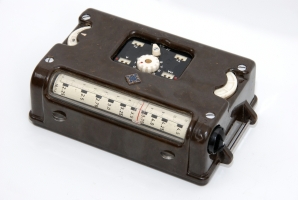
This small receiver was used during WWII to locate clandestine
transmitters, mainly operated by German agents in and around London.
The unit is housed in a Bakelite enclosure and its lid acts as the
frequency range 'plug-in' as well as the direction-sensitive antenna.
The receiver is commonly known as the GPO-receiver, but its official
name was Tester WL-53400. It was only built in small quantities.
➤ More information
|
|
|
BC-792 – also known as SCR-504 – was a portable covert direction finder,
developed in 1943 and used by the OSS (the predecessor of the CIA) for
finding clandestine transmitters operated by spies during World War II.
The device is concealed as a regular leather travel suitcase, and was also
used during the early part of the Cold War in various European countries.
➤ More information
|
|
|
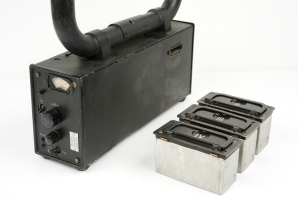
The Gürtelpeiler was probably the first body-worn intercept receiver.
It was used during WWII by the German secret services to locate
clandestine transmitters operating in countries occupied by the Germans.
The valve-based receiver can be concealed under the operator's clothing
with a loop antenna around the neck.
➤ More information
|
|
|
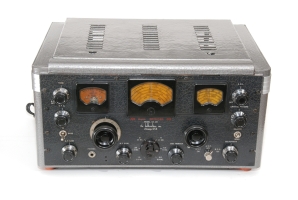
The National HRO was a valve-based (tube) shortwave
general coverage communications receiver,
manufactured by the National Radio Company
(National) in Malden (Massachusetts, USA) from 1935 onwards.
The receiver was intended for military and amateur use and became
very popular for intercept work during WWII.
Different versions of the radio were in production until the 1950s.
➤ More information
|
|
|
The AR-88 was a valve-based shortwave general coverage communications receiver,
developed and built by the Radio Corporation of America (RCA) in the
early 1940s.
Although the receiver was initially intended as the successor
to the AR-77 amateur receiver, the outbreak of WWII made it evolve into
a professional high-end military-grade intercept receiver
for which cost was no object.
➤ More information
|
|
|
The SX-28 and the later SX-28A were AM/CW communication receivers,
developed and built by Hallicrafters Inc. in Chicago (USA) in 1940,
a few years before the US got involved in WWII.
It is one of the most popular receivers every built by Hallicrafters,
and was used heavily for intercept work during the war.
The receiver is also known as Super Skyrider.
➤ More information
|
|
|
SSR-201 was an aperiodic or non-selective receiver, developed during
WWII for use by the OSS,
the forerunner of the CIA.
It was used for
finding clandestine radio stations, operated by – mainly German –
spies in the US and in the UK.
After the war, the device was also used by the Radio Monitoring Services
of several European countries.
➤ More information
|
|
|
During the Cold War, the USSR (Russia) developed a series of highly portable
intercept receivers that were deployed in most Warsaw Pact countries.
Such receivers where generally carried around the operator's waist, hidden
under his clothing.
They also developed stationary and mobile intercept radios and other
direction finding equipment.
➤ More information
|
|
|
This German-built portable direction finding receiver was used
in the Netherlands in the early 60s to track down clandestine
radio stations and foreign secret agents. The receiver is housed
in a wooden case, so that the internal window-antenna can be
used. It is operated by a trigger-switch hidden under the carrying
handle.
➤ More information
|
|
|
The PE-484 was a body-wearable miniature direction finder (Kleinstpeilemfänger)
introduced around 1958 by Telefunken in Germany.
It could be hidden inconspicuously under the operator's clothing
and was intended for tracking down clandestine radio stations.
In some countries, the PE-484 was used until the early 1980s.
➤ More information
|
|
|
This is a rare short-wave direction finder built in Chechoslowakia
around 1948.
It comes with four plug-in modules that can be inserted at the bottom
of the unit. Each plug-in unit covers a specific frequency range.
It was used by the Czech Secret Police to track down clandestine (spy)
radio stations during the Cold War.
➤ More information
|
|
|
|
|
FBA Peiler
Nahfeldausforschungsgerät
|
|
|
This small hand-held direction finder that covers 3 to 145 MHz,
was built by the Austrian Radio Monitoring Service of the ÖPT in 1963,
especially for unobtrusively searching for clandestine radio stations,
such as Cold War spy transmitters.
The receiver is fully transistorized and comes with 15 frequency plug-in
units, nicely packed in a sturdy metal carrying case.
➤ More information
|
|
|
Mason was a manufacturer of TSCM equipment in the USA.
Between 1960 and 1990, Mason developed a wide range
of modular portable bug-finding receivers, including the
so-called Mini Probe Receivers.
Mason equipment was widely used by government organisations
world-wide and the latest models are still in use today.
➤ More information
|
|
|
Micro-Tel
was an electronics company based in Hunt Valley
(Baltimore, US), specialized in developing an building
precision surveillance receivers for the US Goverment,
the Department of Defense (DoD), and various other agencies.
Starting in the 1960s, the company built a wide range of high-end
surveillance receivers and complementary equipment. Today, they are
known as Cobham Defense Electronics SIGINT.
➤ More information
|
|
|
Scanlock is a series of automatic bug-tracing receivers,
developed and marketed by Audiotel in the UK.
Audiotel have been developing and
manufacturing TSCM equipment since the late 1970s
and they are still in business today.
➤ More information
|
|
|
COMPUSCAN was an add-on to the
Scanlock Mark VB bug tracer
(shown above). It allowed a target area to be compared to
a safe zone several miles away. Any differences were then
identified as possible suspected signals.
➤ More information
|
|
|
Research Electronics International (REI) is a US manufacturer of
a wide range of TSCM equipment, ranging from simplug bug detectors
to fully computer controlled correlation receivers and spectrum
analyzers.
➤ More information
|
|
|
This valve-based surveillance receiver was developed by the CIA
in 1958 and covers 50 - 200 MHz. It was used for monitoring and
for the reception of covert listening devices (bugs).
The receiver is based on the military R-744,
which as a similar front panel.
➤ More information
|
|
|
The SRR-8 was a countermeasures receiver, developed by the
CIA between 1961 and 1963. It covers 30-1000 MHz in FM/AM and PM,
and was suitable for stationary as well as mobile use.
➤ More information
|
|
|
The SR-209 (CIA designator: SRR-23) was a high-end surveillance
receiver, developed in the mid-1960s by ACL in Gaithersburg (Maryland, USA).
It is suitable for frequencies between 2 MHz and 12 GHZ, divided over several
bands, each of which required a separate plug-in tuner.
The receiver is suitable for AM, FM, CW and Pulse, and has three IF
bandwidths, selectable from a wide range of IF-plug-ins.
➤ More information
|
|
|
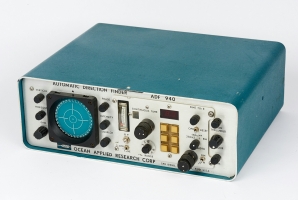
The American company OAR built a wide range of radio direction finders
that were intended as a navigational aid aboard ships. Special versions,
the so-called 9xx-range, were made for locating clandestine radio stations
(pirates).
The image on the right shows the ADF-940 which has a built-in 40-channel
scanner for the 27 MHz citizens band (CB).
➤ More information
|
|
|
Kolibrie (hummingbird) was a car phone intercept receiver
developed by the Police Signals Service in The Netherlands
in the early 1990s. It was intended for intercepting
criminal conversations on the early analogue car phone networks.
➤ More information
|
|
|
Another item that was very popular with the Dutch police was
the CR-3000/C frequency counter with built-in optical and
acoustical field-strength indicator.
It was used for quickly finding the frequencies
that were used by criminals for hand-held communication
and for tracking devices.
➤ More information
|
|
|
In the 1980s and 1990s, Schlumberger GmbH developed a series of
high performance digital programmable precision receivers,
under the name Minilock. The receivers were used by many agencies
for intercepting, measuring and fingerprinting radio signals.
➤ More information
|
|
|
The EB-100 is a small portable surveillance receiver build in the 1980s by
Rohde & Schwarz in Munich (Germany).
It was intended for a variety of jobs, including frequency monitoring,
radio surveillance, radio intercept, EMC measurements and direction finding.
Due to its small size and wide frequency range, it is extremely useful for
bug tracing. EB-100 is also known as MINIPORT.
➤ More information
|
|
|
The EB-200 is the successor to the EB-100. It is a portable receiver
that covers all frequencies between 10 kHz and 3 GHz, with a wide
variety of modulation types: AM, FM, CW, LSB, USB, Pulse and I/Q.
It is one of the first receivers that has
a fully digital IF-stage with DSP technology.
The radio was intended for monitoring of the frequency spectrum and
for locating sources of transmission, including
covert listening devices.
➤ More information
|
|
|
Bodrog was a series of wideband VHF and UHF receivers, developed and built
in Czechoslovakia,
especially for the reception of FM radio bugs.
The version shown here is the A-variant that was used for the VHF-H band.
It was supplied with a mains PSU and a removable battery pack.
➤ More information
|
|
|
The FSH-3 is a portable spectrum analyzer developed by
Rohde & Schwarz
in Munich (Germany).
It covers all frequencies between 100 kHz and 3 GHz and
is suitable for HF measurements as well as for bug tracing.
➤ More information
|
|
|
Delta-V is a small hand-held differential RF detector that allows easy
bug detection in a room, in a car or on a person, without in-depth
knownledge and expertise. The device is powered by an internal 9V battery.
Although the first version of Delta-V dates back to 1989, it has been
updated and enhanced several times since, and is still available from
the manufacturer today (2013).
➤ More information
|
|
|
The TCM-03 was a device for detecting bugs on the mains power cables
and on the (analogue) telephone lines. It was introduced in 1989
and was succeeded by the TCM-03 Mark II in 1992.
The TCM-03 was sold until 2013.
➤ More information
|
|
|
During the days of the Cold War, the secret service of the
former DDR (East Germany), also known as the Stasi, used this receiver
to monitor domestic and foreign radio traffic.
➤ More information
|
|
|
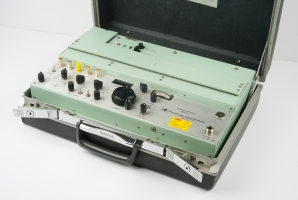
Orchidea-2 was a device that was able to find a covert listening device (bug)
that was connected to a wire line, such the power network, remote door openers,
telephone lines and TV cabling.
The device is usually carried in an unobtrusive Samonite-style briefcase,
together with a set of ancillaries, and has a built-in oscilloscope.
➤ More information
|
|
|
Osobnjak was a range of high-end countermeasures receivers,
developed by the Soviets for protection against
resonant cavity microphones,
a special kind of passive covert listening devices (bugs) that were
activated by a strong RF signal.
As the Soviets were the first to employ resonant cavity microphones,
they knew that sooner or later their Western counterparts would use
the same technology against them.
➤ More information
|
|
|
|
|
|
Any links shown in red are currently unavailable.
If you like the information on this website, why not make a donation?
© Crypto Museum. Created: Monday 03 August 2009. Last changed: Saturday, 18 April 2026 - 14:17 CET.
|
|

|
|
|