|
|
|
|
|

|
|
USSR Cold War KGB GRU R-350M →
Russian spy radio set (Eagle)
The R-350 was a Russian spy radio set
that was developed in the former USSR
around 1955 as the successor to the
post-war Electron (or 'Elektron') radio set.
The Electron had an output power of 50W and was suitable for ranges up to
3000 km. It was one of the first true spy radios that used a
burst encoder in order to minimize the risk of
interception and direction finding
by the enemy. The R-350 used the
same burst encoder.
The R-350 was developed by the KGB Research Institute,
probably in Kuchino (near Moscow) [1].
It was succeeded in 1957 by the R-350M.
|
Compared to the Electron, the R-350 was more robust and was therefore
much more suitable for use by the Russian Armed Forces. It was used by
Special Forces, the GRU,
for reconnaissance at the battle front and behind
enemy lines. It was available with Russian text on its front panel, but also
in English, especially for its foreign users.
The image on the right shows a typical R-350 radio set
with English front panel. It can be recognized
by the rectangular filter blocks used for the transmitter. Only one filter
can be installed in the transmitter at any time. The remaining 7 filters
are stored inside the case lid.
The R-350 is extremely service-friendly.
All valves (tubes) - except for the TX power valve - are accessible
directly from the front panel and can be extracted by pulling the
black knob on top. Spare valves are stored inside the top lid.
A spare TX power valve is also supplied, but that requires the
TX module to be removed first.
The R-350 was designed as a self-contained mid-range transceiver with an
HF output power of approx. 6W. The base of the unit consists of
a transmitter (right),
a receiver (left) and
a power supply (behind the other two).
At present, any knowledge about the power supply is missing.
|
|
|
|
The R-350 was the first Russian spy radio to be put into mass production
and for a long time it was the most popular radio set, until it was
replaced around 1957 by the improved R-350M.
The R-350M became even more popular than the R-350, as it was
also supplied to other countries of the Warsaw Pact, such as the
DDR (East-Germany). The original R-350 (shown here) is extremely rare.
In the mid-1960s, the R-350 and the R-350M were
replaced by the R-354 (Schmel).
|
- R-350
This is the basic model that can be recognised by its rectangular filter
units. One of these filters is inserted into the transmitter.
The remaining filter units are stored in the top of the lid.
This version is described on this page.
Radio sets of this type are extremely rare.
- R-350M
This is a slightly modified version of the R-350. It was introduced around
1959 and can be recognised by its cylindrical filter units.
Radio sets of this type are also very rare, but not are rare as the
earlier R-350 model as they were also deployed in the DDR (East-Germany).
➤ More information
|
|
Below are some audio samples of the R-350M, recorded by karsten Hansky in
Germany [3] in June 2014. The radio was connected to a dummy load and an
ELAD FDM-S1 was used to receive and record the signal. Further sound
processing was done with Audacity.
|
|
The R-350 is wired in such a way, that the transmitter and receiver are easily
removable. Once the bolts
at the edges of the front panel are removed, the module can be lifted out.
It is connected to the rest of the radio by means of a connector that mates
with a socket inside the case. The radio consists of the following functional
blocks:
|
|
The first two blocks are truly modular. The receiver (RX) is located at
the front left, while the transmitter (TX) is mounted on the right.
The transmitter can be removed by releasing the 4 bolts at the corners of
the front panel. The transmitter is connected to a socket that is fixed
to the receiver. Once the transmitter is removed, the receiver can be
removed in the same manner.
|
The image on the right shows the transmitter (block 1)
once it is removed from the case. The interior
is constructed in the usual manner for the era. The two 'standard'
valves are both recessed by means of an aluminium 'beaker' with
a socket at the bottom. They can be accessed from the front panel.
The power amplifier valve can only be
accessed from the rear. If it is broken, the transmitter needs to
be removed from the case. A spare power valve is stored inside the
top lid of the case.
|
|
|
The receiver is a two-stage super-heterodine design,
built with 2ZH27L valves (2Ж27Л).
The LF output is about 4mW, which is suitable to drive
a standard Russian 150 ohn headset, which is connected
at the top left.
The image on the right shows a typical receiver once it is
removed from the case. The connector at the right is the
receptacle for the transmitter.
|
|
|
|
There are still many questions about this radio. From all R-350 radios we've
seen so far, the power supply has been missing. This means that we do not know
whether this radio had a built-in power supply or an external one.
We are also looking for the original manual of the R-350. If you have any
information about this radio, please contact us.
|
The image on the right shows a set of 6 wire terminals that are used
to feed the various voltages to the radio. It is possible that an external
power supply was connected here.
It is far more likely though,
that a power converter (probably with a vibrator) was built inside the
emply space below the power terminals.
However,no evidence has been found so far to support this theory.
|
|
|
|
Most of the accessories are storied inside the top lid. With a standard
unit, the following extras are usually supplied:
|
- Additional filter units (7)
- Spare valves
- Spare transmitter valve
- Work light
- Message puncher (burst encoder)
- Morse key with burst transmitter
- Wire antenna
- 35 mm photo film (inside container)
|
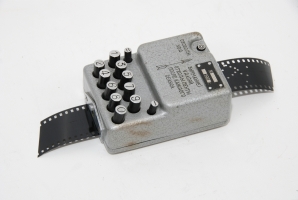
Each message is first translated into a series of numbers. This is usually
done with some kind of cipher system, such as a simple matrix or the
unbreakable One Time Pad (OTP).
The numerical message is then stored on a a standard 35 mm photo film
by punching a series of holes in it, using the device shown here.
➤ More information
|
|
|
The R-350 is supplied with an external morse key with integrated burst
transmitter. Photo film with the punched numerical message can be fed
into a narrow slot at the front of the morse key.
A small crank is then used to feed the film through
the transmitter at a constant speed.
➤ More information
|
|
|
|
|
|
Any links shown in red are currently unavailable.
If you like the information on this website, why not make a donation?
© Crypto Museum. Created: Tuesday 03 November 2009. Last changed: Monday, 11 March 2024 - 21:25 CET.
|
 |

|
|
|