|
|
|
|
|

|
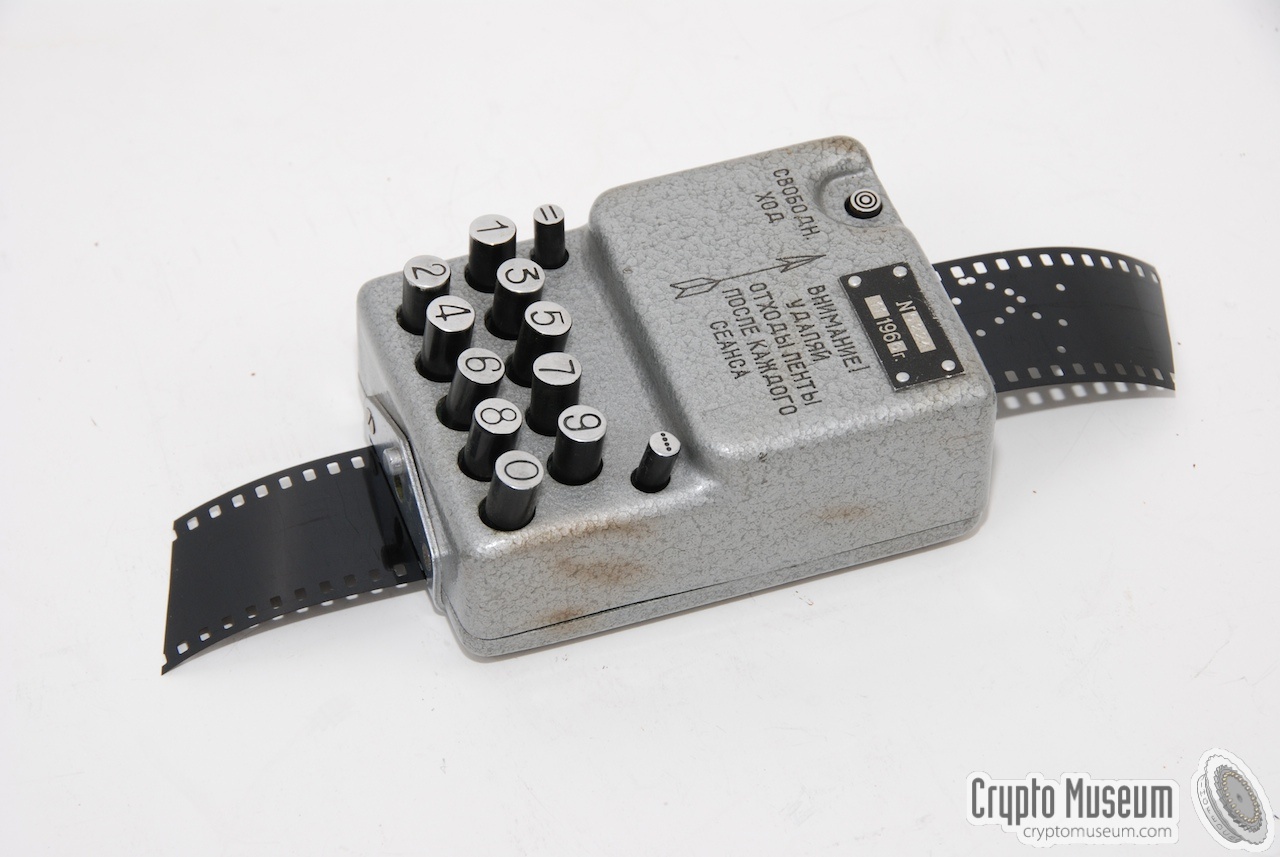
The device shown here is the actual burst transmitter, which should normally
be attached to the side
of the radio set. A small two-pin plug is used to
connect it to the morse key input of the transmitter.
It combines three functions.
At the front of the device is a small (black) morse key, which can be used
to send messages directly in morse code.
For this, the operator must - of course - be trained in morse code first. Sending messages directly in morse
code was not general practice and was only used as a safety backup measure.
|
|
|
If the operator was not capable of sending messages in morse code, he could
use an 'electric pen', stored inside the device, to send numbers in morse
by sliding the pen
through one of 10 'slots' on top of the device.
Inside the slots, the morse pattern for each number (0-9) was layed out in
copper. All the operator had to do, was to slide the pen through the
appropriate slot with a constant speed. Again, this method would only be
used in case of emergency.
|
In normal use, the numerical message would be stored onto photo film
first, using a separate punching device. The Russians used standard
35 mm film rolls, as this was commonly available around the world
and would not attract attention when bought abroad by an agent.
The film would be entered into a slot of the puncher and the operator only
had to press the appropriate buttons on top of the device. Each number was
represented by a single hole in the film and the film was automatically
advanced by one step on each key press.
|
|
|
Once the message was complete, the film was entered into a similar slot
at the front of the morse key. Once the connection with headquarters
was established, the operator would use a small hand crank to
advance the film
at a regular speed through the encoder (see the images below).
One has to bear in mind that all messages were converted into a series
of numbers first, using some kind of cipher method. This is called a
pre-coded message. Various manually operated cipher systems
(hand methods)
were deployed to encipher a message,
ranging from simple matrix operations
to truely unbreakable One Time Pads (OTP).
The latter was the preferred method for spies and agents operating abroad,
often used in combination with the so-called Number Stations, endless
sequences of random numbers spoken by an 'automated' woman.
|
|
|
|
Any links shown in red are currently unavailable.
If you like the information on this website, why not make a donation?
© Crypto Museum. Created: Tuesday 03 November 2009. Last changed: Sunday, 15 May 2022 - 11:23 CET.
|
 |

|
|
|