|
|
|
|
|

|
|
Beacons Micromill BND
The M7142 is housed in a yellow enclosure that is milled from a solid piece
of aluminium. It has two open dipole antennas that are fitted with
LEMO connectors. At the front panel are two LED-bars that indicate the signal
strength and the direction to the beacon. An earphone can be connected for
obtaining an acoustic indication.
The device was typically used by the police 1 for locating a tracking beacon
that had been fitted under a suspect's car, or by an intelligence or
law enforcement agency for following a VIP or a case officer, and
responding to a distress signal.
|
|
|
|
Although its is currently unclear when the device was first made,
we assume that this was around 1985, based on the choice of components.
The device shown here, is the Rev. 'C' version. Based on date codes on
the components, it was manufactured in or after 1995. Manufacturer
Micromill was taken over by Cobham in 2001,
and became part of Domo Tactical Communications (DTC) in 2016. In 2018,
the beacon tracking business was transferred to
MetOcean Telematics in Canada [1],
which has since released a similar handheld direction finder, known
as Novatech DF-500N.
|
-
In German, a more generic term is 'BOS', which stands for
Behörden und Organisationen mit Sicherheitsaufgaben
(Authorities and Organisations with Security Tasks).
This includes the reguar police (Bundespolizei).
|
The image below provides a quick overview of the features of the M7142,
which is seen here from the top left. The device is housed in a yellow
enclosure that is milled from a solid block of aluminium. At the bottom
is a removable panel that gives access to the battery compartment.
The two T-shaped open dipole antennas must be connected to the two
2-pin LEMO sockets at the top.
The device is switched ON by turning the brightness control clockwise.
The brightness must be adjusted until the LED bars are clearly visible.
The M7142 is now ready for use. As soon as a signal from a compatible
transmitter is picked up, the LED bars show the signal strength and the
direction (left/right). If necessary, an earphone can be connected to
the 4-pin Hirose socket at the right.
It provides an acoustic indication
of which the volume can be set with the VOL-knob.
|
At the heart of the system is the M7142 direction finding receiver.
It operates on a single crystal-controlled channel in the VHF-H band,
and has a built-in RSSI signal strength detector. Furthermore, it has
a switched twin-input antenna input, allowing the direction to a transmitter
(left/right) to be determined. For acoustic feedback, it has a built-in audio
amplifier.
The device was typically used in the vicinity of a (covert) transmitter,
for example for the last 100 metres, or for locating a person in distress.
|
|
|
The M7142 came with two shortened open-dipole antennas, in the form of
helical antennas mounted in a T-shaped construction, as shown in the image
on the right. At the base of the 'T' is a 2-pin LEMO connector
that mates with the socket(s) at the narrow top end
of the receiver.
The use of two spaced antennas allows the direction to a transmitter
to be determined, based on Time Difference of Arrival (TDoA).
|
|
|
The M7142 receiver is powered by an internal standard 9V block battery
(6RL61). When using an Alkaline battery, it should be sufficient for at
least 8 hours of uninterrupted usage.
The battery compartment is located at the bottom end of the receiver.
It is covered by a lid that is held in place by two large knurled bolts.
After loosening the bolts, the cover can be removed, as shown in the image
on the right.
|
|
|
If an acoustig feedback is needed, for example to listen to the nature of
the transmission, or to determine whether the correct transmitter is
being intercepted, it is possible to connect a pair of headphones or an
earpiece to the 4-pin Hirose connector
at the right side of the device.
The image on the right shows a suitable earpiece that is used with our
M7142 receiver.
|
|
|
The interior of the M7142 can be accessed by removing the four black screws
from the front, after which the
front panel can be taken off.
The first PCB that becomes visible is the
indicator board with the
two LED bars. It is fixated with a single screw. After removing this screw,
it can be lifted from the interior. This reveals the receiver and detector PCBs, both of which
are fitted to the case bottom. The largest PCB holds the
detector and AF amplifier. It also holds the volume and brightness
controls. There are four 3-pin headers on which the
indicator PCB should
be fitted.
Aside the detector PCB is a smaller board that holds the receiver.
Inside the narrow section at the top
of the enclosure is a small PCB that holds an
electronic selector with two PIN-diodes.
It alternates between the two antennas, so that only one receiver
is needed. Due to the
difference in Time-of-Arrival (ToA) between the two antennas, the
phase between the two signals will also be different. This difference
is then used to drive the left/right LED bar on the front panel.
The signal strength line from the receiver (RSSI) is used to drive
the near/far LED bar at the front panel.
|
|
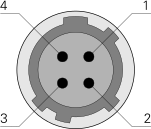
At the right side of the device is a recessed 4-pin Hirose socket for
connection of a pair of headphones or an earpiece. Only the leftmost two
contacts of this connector are used. Below is the pin-out of the socket
when looking into the chassis part.
|
- n.c.
- n.c.
LS1 Earphone (1) LS2 Earphone (2)
|
|
|
In order to discriminate the direction to the transmitter,
the M7142 needs two antennas: one at the left and one at the right.
Each of these antennas is a T-shaped open dipole, consisting of two
¼λ helical antennas with a perpendicular boom at the centre,
terminating in a 2-pin LEMO plug.
|
- Upper dipole arm (¼λ helical antenna)
- Lower dipole arm (¼λ helical antenna)
|
|
-
168.360 MHz was officially assigned to the German
Border Protection Service (BGS)
as channel 41, but is known to have been used by other services as well,
as a BOS inter-services channel.
|
135 Crypto Museum, Netherlands
|
- Brochure(s)
- Operating instructions
- Technical documentation (circuit diagrams, etc.)
Earphone - Storage case
|
|
|
|
Any links shown in red are currently unavailable.
If you like the information on this website, why not make a donation?
© Crypto Museum. Created: Friday 19 December 2025. Last changed: Wednesday, 07 January 2026 - 22:45 CET.
|
 |

|
|
|