|
|
|
|
|

|
|
SF EMU Tadiran
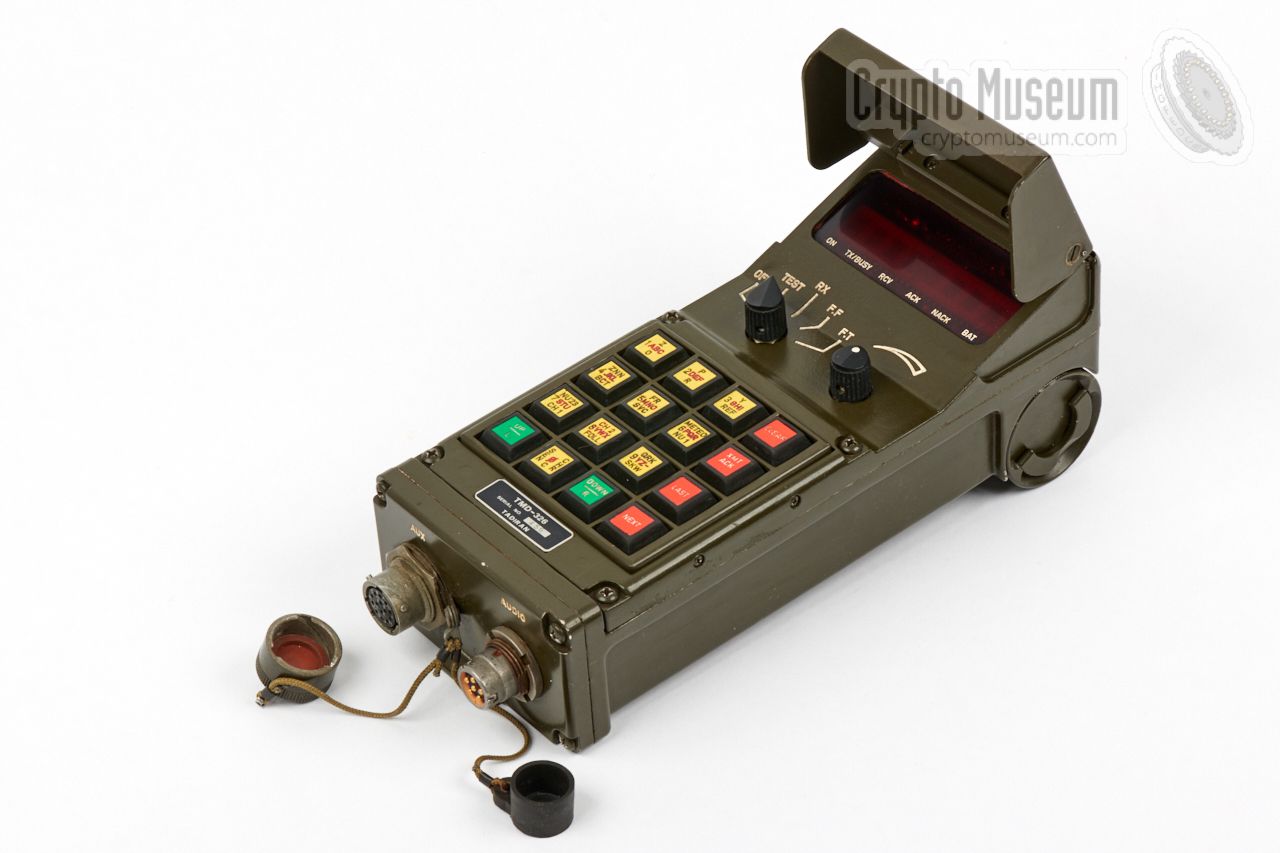
The device can send messages at a speed of 75, 150 or 600 baud, and was
inteded for use by air observers, reconaissance units,
special forces (SF) and forward artillery.
It measures 210 x 105 x 52 mm and weighs 1.67 kg, battery included.
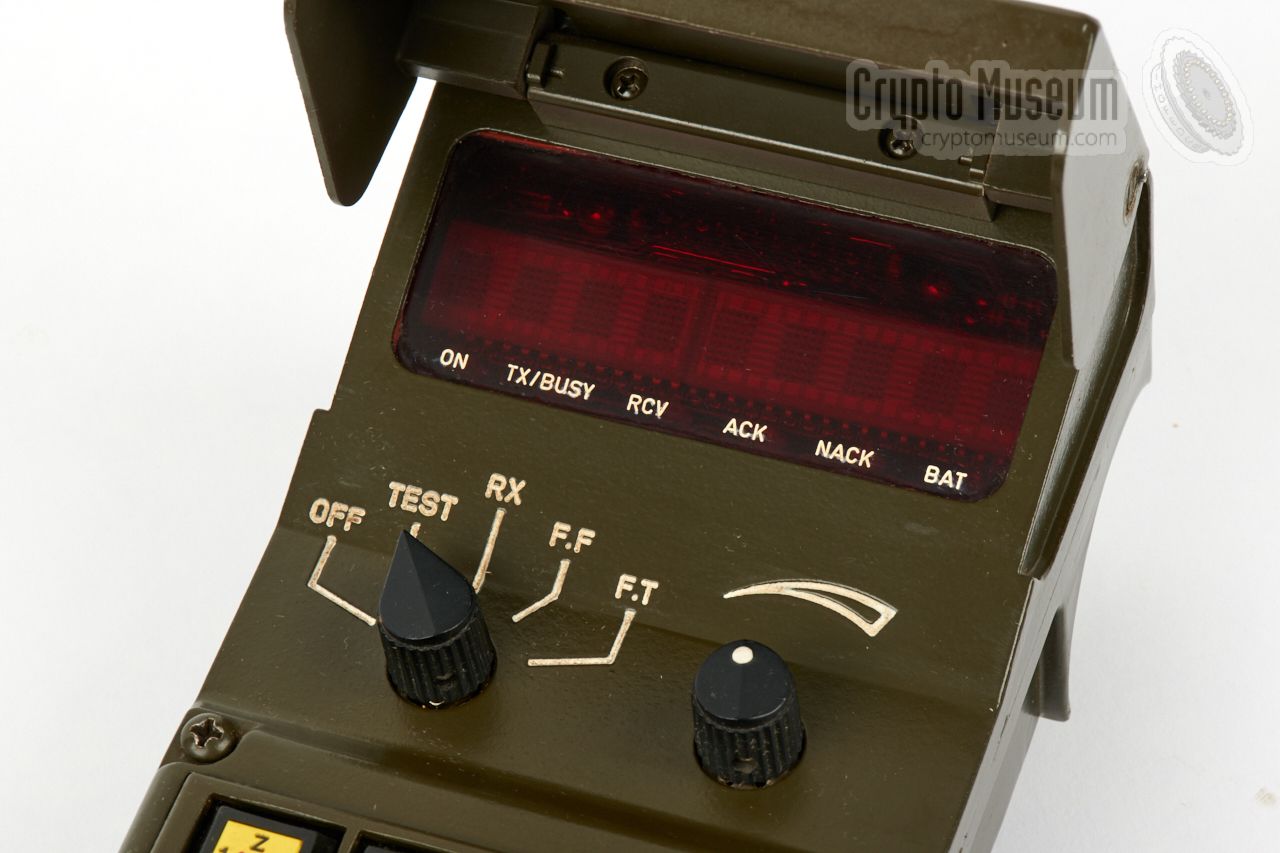
The unit is housed in a military green enclosure with connections at the
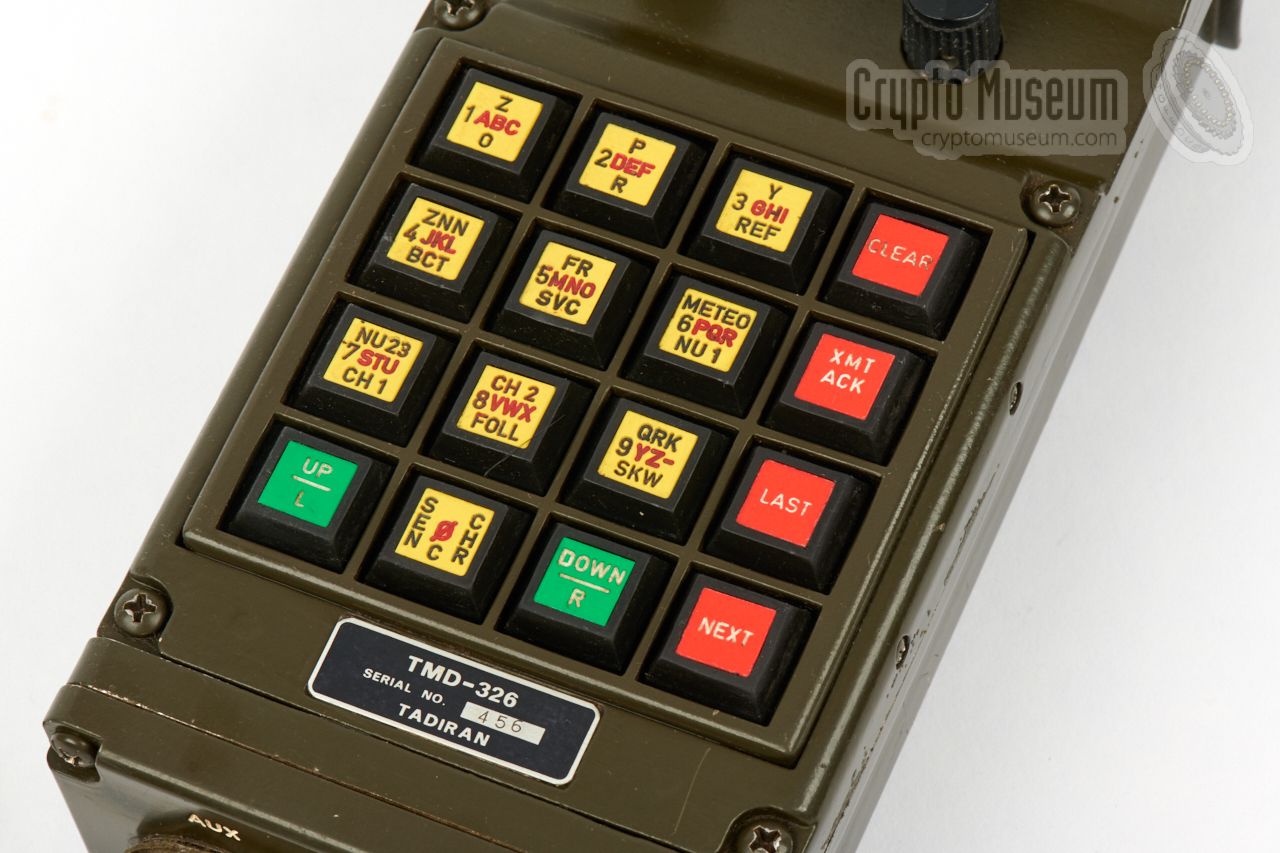
front and controls at the top. Operation is via a rotary
selector, a brightness knob and a 16-button keypad.
Towards the rear is a red 9-digit alphanumeric LED display
with a hinged cover to shield it from bright sunlight.
A protective pouch is available separately.
|
|
|
|
TMD-326 was commonly used with a manpack radio like the
AN/PRC-77,
or a vehicle set such as the AN/VRC-47 (RT-524), in which case it was connected
to the spare U-229 socket
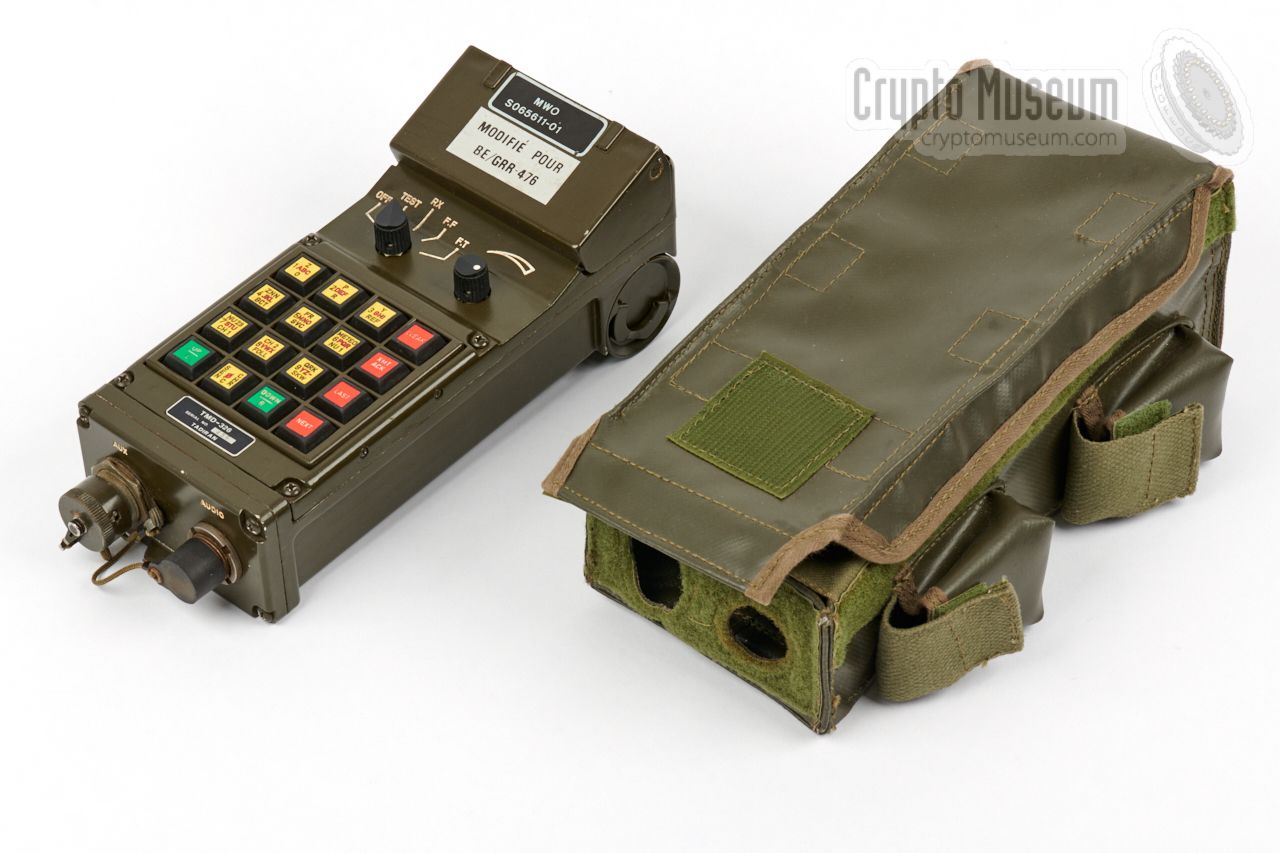
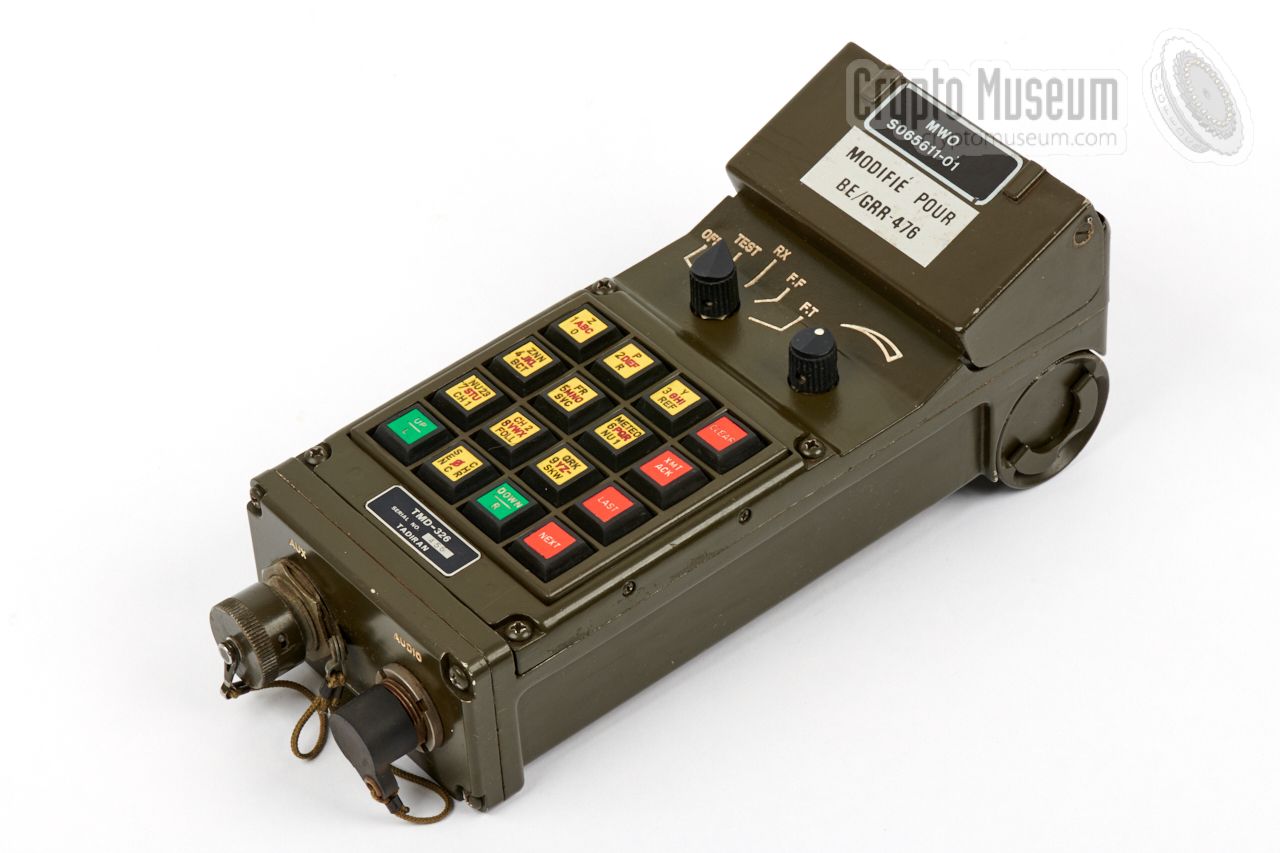
(re-transmit) of the radio. It can also be modified for other types of
radio sets, such as the BE/GRR-476.
|
PLEASE HELP —
We are currently looking for the pinout of the AUX connector
of this device. We are also looking for suitable batteries.
If you can help, or if you have other information about this device,
please contact us.
The image below give an overview of the controls and connections of the
TMD-326. The device is house in a metal enclosure and is usually powered
by an internal 7.2 V rechargeable NiCd battery. Alternatively it can
be powered by an external power supply unit (PSU), which can be connected
to the AUX socket. The device is connected to a radio set
via the US/NATO U-229 AUDIO connector.
The desired mode of operation is selected with the MODE-knob, which also
acts as the ON/OFF switch. Please refer to the manual [A] for a detailed
description of each mode. Input is via the 16-button keypad at the lower
half of the top panel. The yellow buttons (1-9) are the Message keys.
Below them are three Shift keys. The four buttons at the right are the
Control keys. The output is produced on a 9-position alphanumeric
LED display. The lid shields it against bright sunlight.
|
The TMD-326 was used with several HF radio sets, of which the
AN/PRC-77 is arguably the most well-known
one. For the Belgian Army, the device was modified for use with other
radio sets, including the BE/GRR-476 (indicated on the label)
and the BE/PRC-600 shown in the image below.
The image above shows a soldier of the Belgian Special Forces (ESR)
in an underground hideout, with a TMD-326 in front of him [1]. It is used here
in combination with the BE/PRC-600 HF Radio placed at the left.
Also visible in this image are the external batteries for the radio
(visible to the left of the radio) and the handset (on top of the radio).
Click the image to enlarge.
|
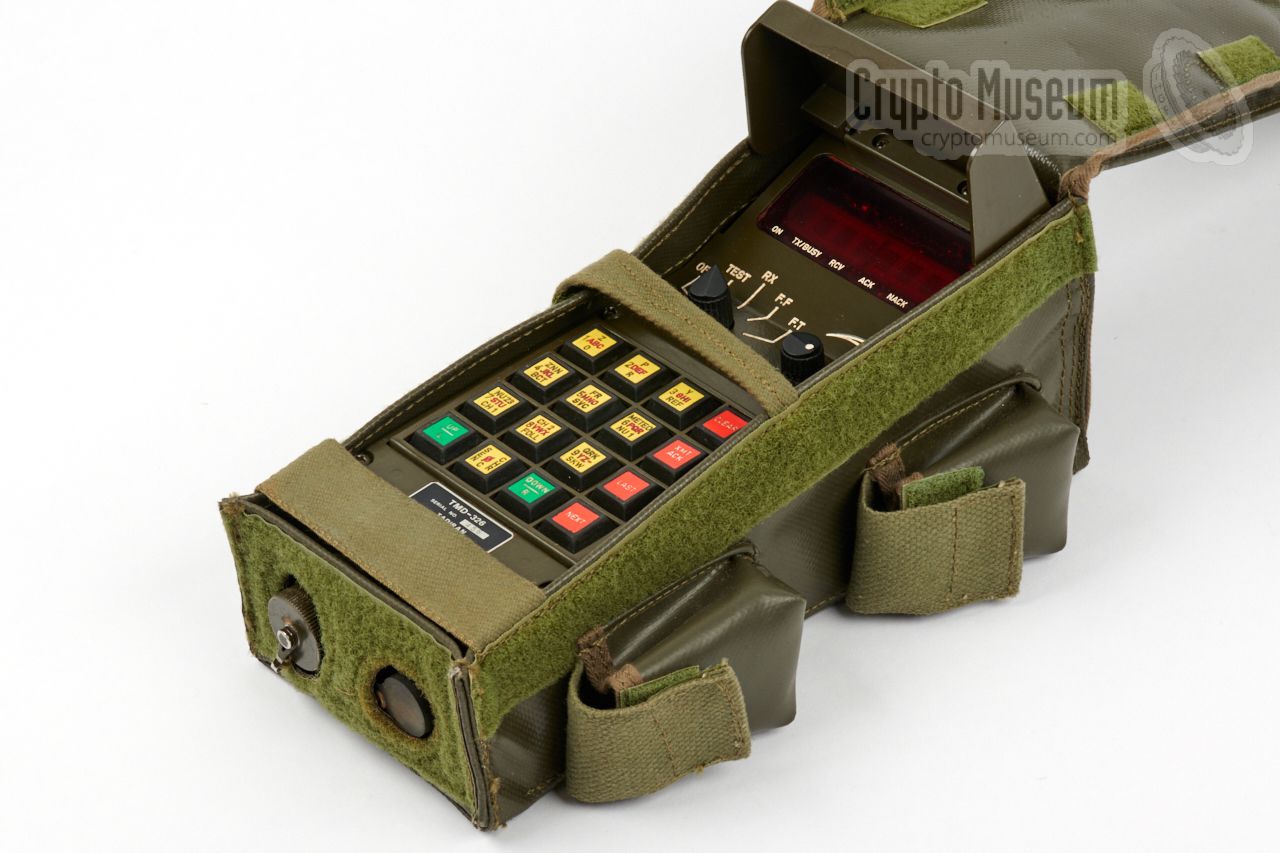
The TMD-326 can be fitted inside the green carrying pouch shown in the
image on the right. It can be attached to a soldier's webbing and protects
the keyboard and display.
The pouch has a flap at the top that covers the controls, and is held in
place with Velcro strips.
|
|
|
This is the actual DMED device, which is fully self-contained.
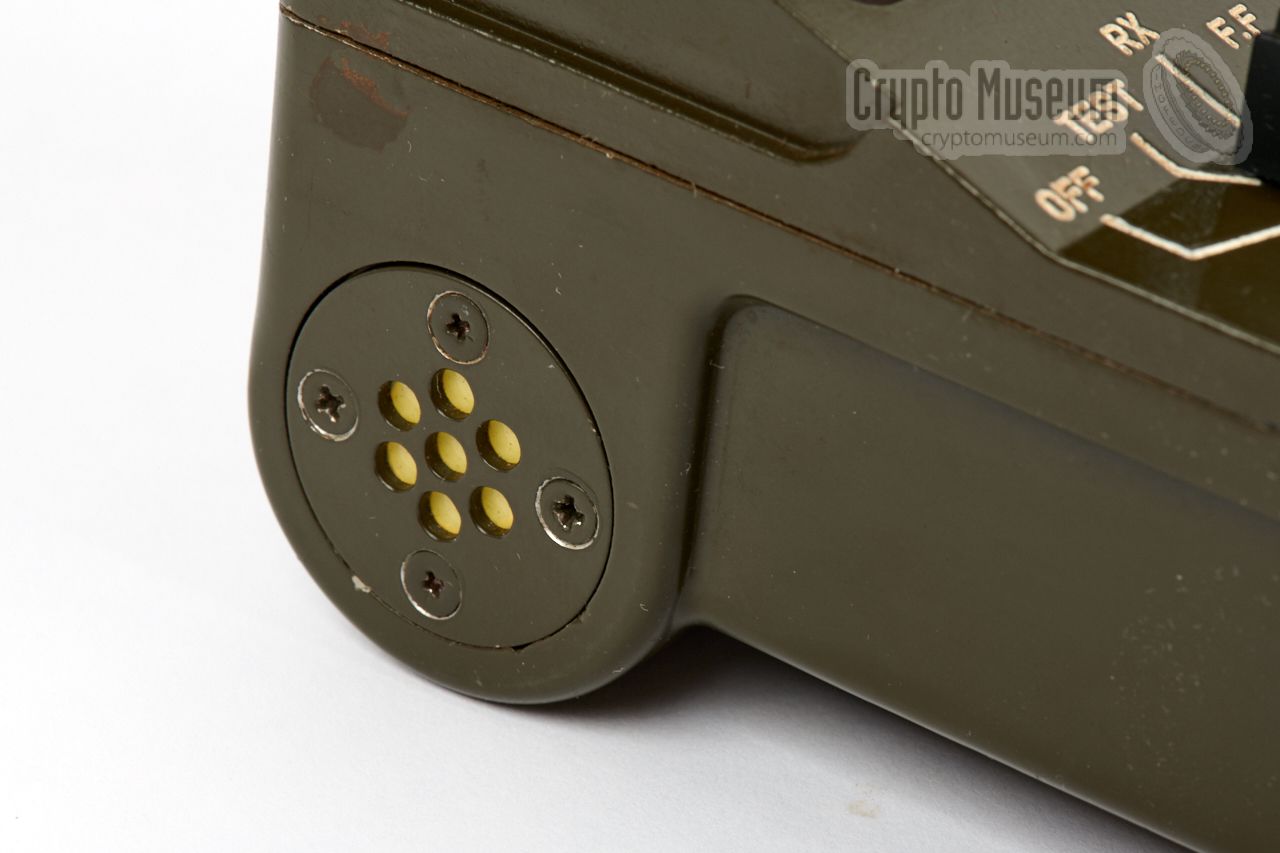
It is powered by an internal 7.2V NiCd battery that is installed
at the right side, just below the display.
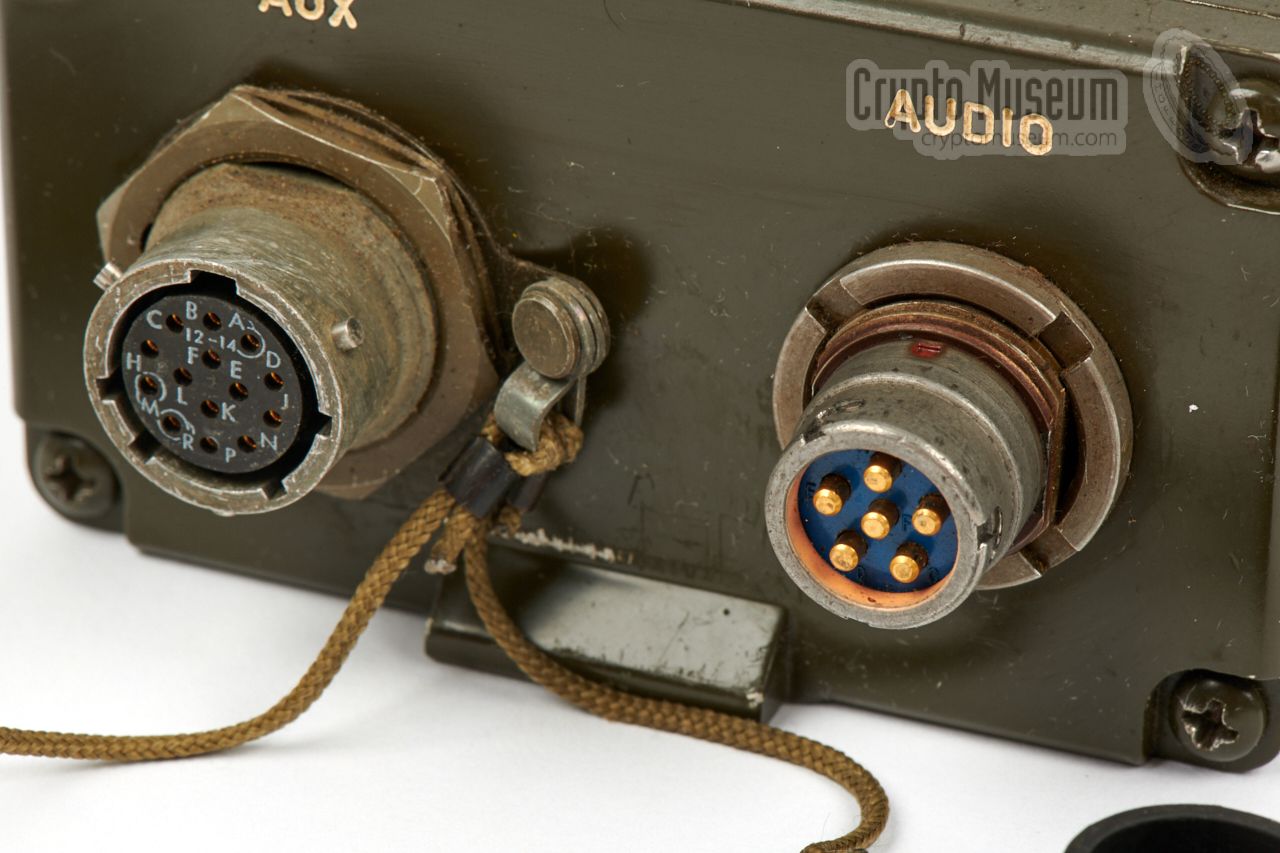
At the front is an U-229 socket – for connection to a radio set –
and a 14-pin female socket for connection of auxiliary equipment,
such as the IB-326 interface box.
|
|
|
|
Messages from the TMD-326 can be printed directly on a
teleprinter (telex)
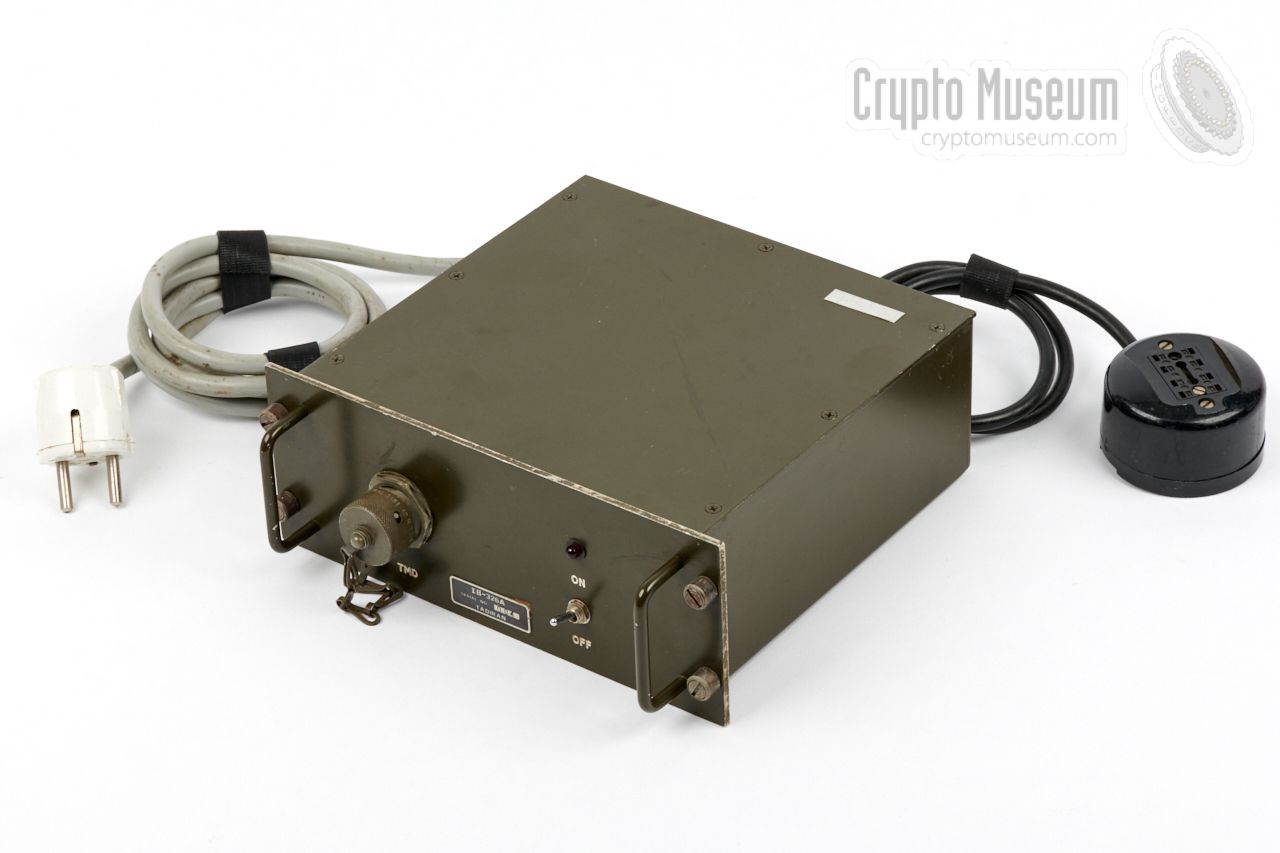
by using the IB-326 interface box shown in the image on the right.
The box is connected to the AUX socket of the TMD-326 by means
of a CX-326C cable, whilst the
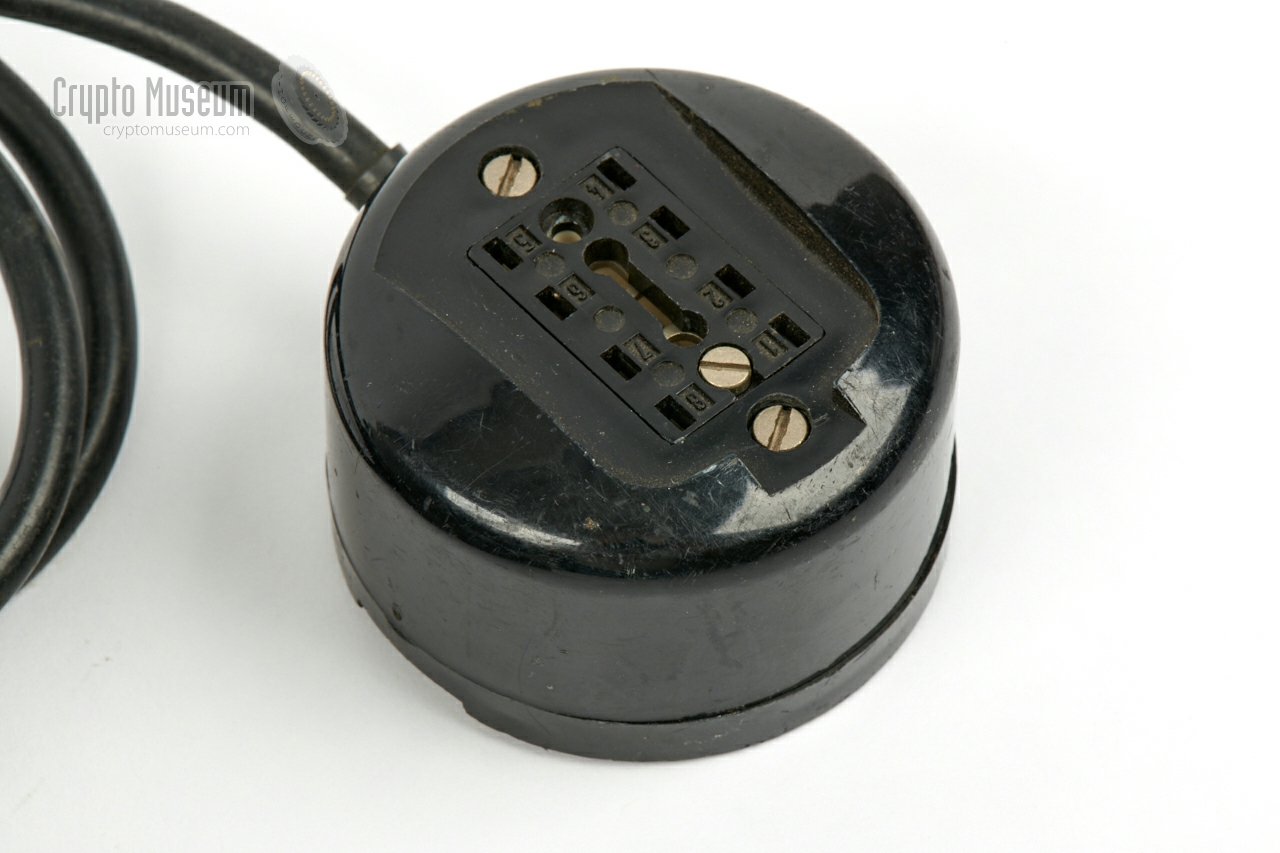
teleprinter should be connected to the
ADo-8 socket
at the end of the black cable.
|
|
|
The TMD-326 must be connected to a radio set by means of the
CX-326/A cable. One end of this cable has a U-229 connector
that mates with the AUDIO socket at the front of the device.
The other end has a connector that matches the AUDIO socket
on the radio. I most cases, this will also be a U-229 connector.
The original CX-326/C cable is missing from our collection.
|
|
|
The leftmost connector at the front of the TMD-326 is marked
AUX. It can be used for connection of a variety of devices,
including an external power supply unit (TMD-328), a printer
(TMD-330) or an interface box (IB-326). The latter allows a
regular teleprinter (telex) to be used as a printer.
When used with the IB-326 interface box, the CX-326/C cable
must be used to connect it to the TMD-326.
The original AUX-cable is missing from the device in our collection.
|
|
|
In the field, the device should be powered by a 6T-133
NiCd battery. This is a circular 7.2V rechargeable battery
that must be installed behind the knurled screw-on cap
at the right side of the device, just under the display.
The original battery is missing from the device in our collection.
|
|
|
|
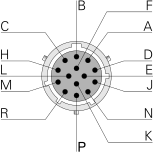
The right connector at the front of the device is a standard
US/NATO U-229 for connection to a radio set.
The built-in modem transmits the message via a regular voice grade channel,
using the audio in and out lines of the radio.
Below is pinout when looking into the connector of the radio.
|
GND Common ground SPK Audio out PTT Transmit contact MIC Audio in ? ? ? ?
|
|
|
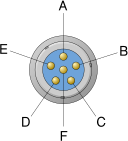
The AUX connector is used for the connection of an external power
supply unit (PSU), a printer or an interface box. The latter allows
a regular teleprinter (telex) to be used as a printer.
Below is the pinout when looking into the connector.
The pinout of this connector is currently unknown.
|
- ?
- ?
- ?
- ?
- ?
- ?
- ?
- ?
- ?
- ?
- ?
- ?
- ?
- ?
|
|
Device Burst message terminal Purpose High speed message transmission over HF radio Model TMD-326 Manufacturer Tadiran Year 1979 ~ Country Israel User Belgian Army (BE/GRR-476) Message Up to 16 nine-character groups (sentences) Waveform Frequency Shift Keying (FSK) using internal modem Baudrate 75, 150 and 600 baud (bits per second) Bit error 5·10-4 at 12dB S/N Audio out 1.4 mV into 150Ω load Audio in 0.1 to 3V from radio set Display 9-digit alphanumeric Power 7.2V DC NiCd battery Current 420 mA in operations (100 mA with display off) Temperature -40°C to +55°C Dimensions 210 x 1-5 x 52 mm Weight 1.67 kg with battery
|
6T-133 Rechargeable 7.2V NiCd battery TMD-330 Printer CW-326 Carrying pouch IB-326 Interface Box TMD-328 Power Supply Unit CX-326/A Audio cable to radio set (U-229) CX-326/C Auxiliary cable for interface box IB-326 CX-326/D Auxiliar cable for power supply unit TMD-328
|
|
|
|
Any links shown in red are currently unavailable.
If you like the information on this website, why not make a donation?
© Crypto Museum. Created: Sunday 16 June 2019. Last changed: Monday, 08 June 2026 - 12:17 CET.
|
 |

|
|
|







![Belgian Special Forces (ESR) using a TMD-626 from an underground hideout. No date. Photograph kindly provided by Arthur Daubercy [1].](img/BE_ESR_TMD326.jpg)