|
|
|
|
|

|
|
← R11-PA DF USSR KGB Stasi Filin →
Soyka covers a frequency range of 0.7-30 MHz, which is
wider than its valve-based predecessor R11-PA, which covers
(2.1-25 MHz). It is also smaller, but has the disadvantage that
it needs a different plug-in coil for each frequency band.
The image on the right shows the bare Soyka receiver, with its
top panel clearly visible.
It has a curved shape, to allow it to be carried on the chest,
hidden under the operator's clothing. The device was supplied in
a small suitcase, together with a range of plug-in coils,
wire antennas and other accessories. It is externally powered by 9V.
|
|
|
|
All switches are at the front, whilst the connections and the
tuning dials are at the top, all within reach of the operator.
The device is fitted to the body with a leather belt that hooks
into the recessed fittings at the four corners. The frequency
is adjusted with a knurled ring
around the (illuminated)
plug-in coil, and can be fine-tuned with a
recessed knob. The wire antennas
are usually carried in the trousers, in the sleeves of the coat
or at the operator's back. In 1970, Soyka was complemented
by a range of Filin direction finders
which are suitable for higher frequencies.
|
-
СОЙКА (Latin: SOYKA) is the Russian word for jay. At the time,
covert equipment like this was usually named after a bird.
The radio is also known as СОВА (Latin: SOVA), which means owl.
|
The diagram below gives an overview of the controls and connections on
the body of the receiver, as seen from the operator's perspective,
with the frequency dial at the top. All connections are identical.
At the left are the sockets for a 9V battery (9В),
a recorder (МАГН.)
and a speaker (ТЛФ).
At the center is the plug-in coil, which also acts as the frequency dial.
It can be illuminated by pressing a button at the right.
The knurled ring around the coil is for adjusting the frequency, which can be
fine-tuned with a recessed knob to its right.
At the far right is the MODE selector.
To the right of the frequency dial are two antenna sockets, that allow
three types of antennas to be connected. The leftmost socket is used for
an omni-directional reference antenna that can be used for interception of
agent-to-agent communication or to search for a (clandestine) station.
For direction finding, the rightmost socket is used. It accepts a
directional body-worn loop-antenna, or a V-antenna
consisting of two wires that are hidden in the sleeves of the operator's
coat.
In normal operation, the V-antenna is used as a dipole and a slide switch
just below the fine tuning knob (marked o - ∞) can be used to select
the required antenna radiation pattern. When set to ∞ it is suitable
for direction finding and can be used to find the minimum signal strength.
When in close proximity of a transmitter, the built-in HF pre-amplifier
can be bypassed with the Near/Far switch. When direction-finding, the
sensitivity of the receiver can be adjusted with the RG gain knob,
whilst the receiver's bandwidth can be controlled
with the Wide/Narrow switch.
|
|
The MODE-switch is used to select the required mode of operation:
|
- ТЛГ. 1 (TLG, Telegraphy)
This mode is used when listening to telegraphy signals like
morse codes (CW).
The CW tones are heard through the speaker.
- ТЛФ (TLF, Phone}
This mode is used for the reception of phone signals (AM) that are used for
voice conversations. The demodulated speech is heard through the speaker.
- ТЛГ. 2 (TLG, Telegraphy with Tone)
In this mode an LF signal is injected directly at the antenna input
allowing all types of signal, including silent carriers, to be traced.
A continuous 8 kHz tone is heard through the speaker. The stronger the
signal, the louder the tone.
|
|
Soyka receivers were also used in the former DDR (East-Germany) by the
Ministerium für Staatssicherheit (MfS, Ministry for State Security)
commonly known as the Stasi. It was the main organisation for espionage
in the DDR and was actively involved in tracking down agents.
|
As the typical Russian antenna sockets were in short supply in the DDR,
the socket that was used the most has been replaced by a standard BNC socket.
The antennas for this socket have been modified with BNC plugs accordingly.
The image on the right show a Soyka receiver that was found in the Stasi
headquarters near Berlin, just after the fall of the Berlin Wall in 1989.
Pieces of paper with German translations are taped over the original
Russian texts.
|
|
|
|
The complete set is packed into a small unobtrusive cheap-looking
suitcase, complete with all accessories, plug-in units and
batteries. The case measures just 46 x 30 x 14 cm and is made of
green and yellow leather. In the 1960s and 70s it could be used to travel
around inconspicuously.
|
The image on the right shows a typical Soyka configuration
packed in the original suitcase. It has several pre-shaped 'slots',
each of which holds a rigid board with canvas pockets.
At the far right is the leather belt,
used for carrying the
Soyka on the chest, and the Power Supply Unit.
Inside the case are several brown canvas pockets containing the
accessories and plug-in units. The actual Soyka unit itself is
packed in yet another canvast pocket and is not visible in the
image as it is 'face down' in the rearmost slot.
A special small pocket
is present to allow three spare plug-in
units to be hidden under the clothing whilst operating the
receiver.
Various antennas, such as a loop antenna and a simple wire antenna,
are supplied for a variety of applications.
The loop antenna, hidden in green cloth, can be hidden under the
cloting as well.
|
|
|
|
Soyka was suitable for a wide frequency range (0-30 MHz),
divided over several bands. For each band, a separate plug-in
coil is available. Two special coils are supplied for
non-selective wide-band operation (indicated with a * below).
The following plug-in units were available:
|
- 0.7-1.1 MHz
- 1.1-1.7 MHz
- 1.7-2.6 MHz
- 2.6-4 MHz
- 4-6 MHz
- 6-9 MHz
- 9-13 MHz
- 13-18 MHz
- 18-24 MHz
- 24-30 MHz
- 3-15 MHz *
- 1-30 MHz *
|
|
|
All plug-in units have the same physical
size. They consist of a metal cylinder of approx. 42 mm,
with a diameter of 21 mm. The frequency scale is at the top, whilst
the contacts are at the bottom.
Inside a plug-in unit is a tuned circuit, consisting of a series
of capacitors and coils.
|
The plug-in is held in place by a lock that is operated
with a small handle at its side.
Please note that the
plug-in can only be removed when
the frequency dial is
in a certain position.
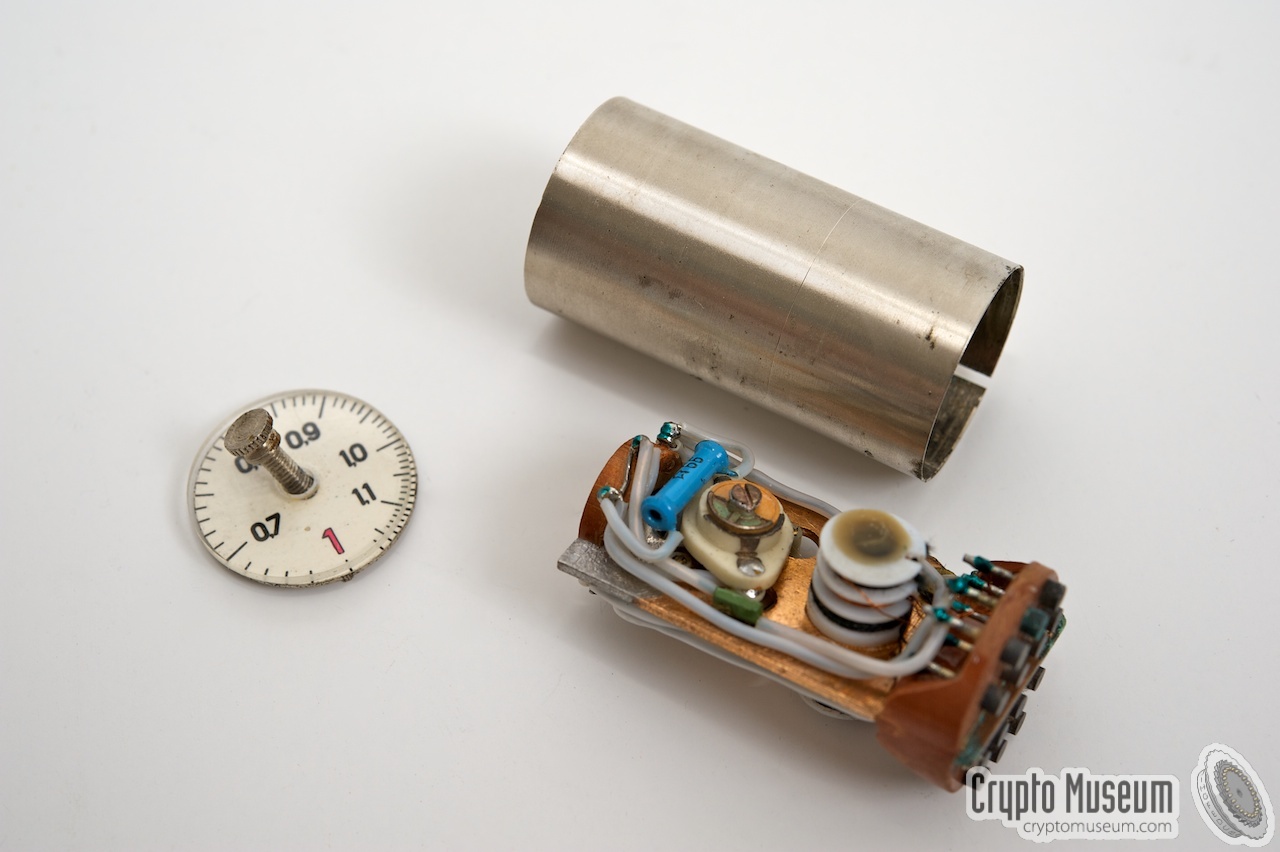
A plug-in unit can easily be opened by removing the rigged
bolt at the top.The frequency scale then comes off and the
unit can be taken out of its protective metal cylinder.
The image on the right shows the interior of plug-in unit #1.
It can be adjusted by inserting the tuned circuit inside
a special cylinder with 4 holes.
This also requires the Soyka receiver itself to be opened.
|
|
|
|
*) The
last two plug-in units
(XI and XII, or 11 and 12) are special.
They can be used to convert the receiver into a wide-band
non-selective receiver, ideal for picking up transmitters operating
on unknown frequencies in the immediate vicinity.
This would also work with transmitters that use Frequency Hopping (FH).
As a result, the receiver loses its sensitivity, which is a desired
side-effect, as broadcasting stations would otherwise interfere with
the reception of the local signal.
|
|
The Soyka main unit is powered by a 9V source, which should be
connected to the leftmost connector on the top panel (9В).
It can be powered by a variety of sources, all of which are
included with the unit. The first possibility is the
PSU
that is supplied with the kit. The same PSU is also used to
charge the NiCd batteries (see below).
|
Alternatively, the unit can be powered with a
cylindrical 9V NiCd pack,
of which two are supplied with the unit.
As the cells of our device had already started leaking, we had to
remove them.
As a last resort, another metal cylinder with a small 9V
block battery can be used, but it lasts only a short period
of time.
For sustained portable use, the unit can best be powered
by two 4.5V flat batteries. A special
battery holder with
a suitable connector is supplied with the set. It is shown
in the image on the right, where two Varta batteries are
used.
|
|
|
|
Unlike other Russian body-wearable direction finders, like
Filin and
Sinitsa, the suitcase of the Soyka does not contain
a checklist.
It is therefore very difficult to identify the correct location
of each item and to determine whether a set is complete or not.
Here is an attempt:
|
- Receiver (main body unit)
- Chest belt
- Plug-in coils 1-12 (probably less with earlier version)
- Speaker
- Wire antenna
- V-antenna
- Loop antenne
- Large battery holder (for 2 x 4.5V)
- 2 x Rechargeable 9V battery (cylinder)
- 2 x Small 9V battery holder (cylinder, not present with earlier version)
- Power supply/battery charger
- Volt meter
- Extra pouch for spare coils (not with earlier version)
|
On the international forums there seems to be some confusion about the name
of this intercept receiver. Although the unit is commonly called Soyka
(Сойка), there are some that suggest that this name was only used by
the KGB and other secret services, while everyone else called it Sova
(Сова). Another possibility is that Sova is an earlier variant of the
later Soyka, probably with a smaller frequency range and fewer plug-in coils.
If you know more, please let us know.
|
-
Document obtained from BStU [4] and kindly supplied
by Detlev Vreisleben [3].
|
- Paul Reuvers and Marc Simons, Soyka portable intercept receiver
Crypto Museum, Investigation August 2011.
- Louis Meulstee, USSR Portable Intercept Receivers
Wireless for the Warrier. Volume 4. September 2004. ISBN 0952063-36-0.
- Detlev Vreisleben, Soyka, technical documentation
Personal correspondence, November 2018.
- Bundesbeauftragte für die Stasi-Unterlagen (BStU) 1
Federal Commissioner for the Stasi-Records.
|
-
Full name: Bundesbeauftragte für die Unterlagen des Staatssicherheitsdienstes
der ehemaligen Deutschen Demokratischen Republik
(DDR) —
Federal Commissioner for the Records of the
State Security Service
of the former German Democratic Republic (GDR) —
officially abbreviated to BStU.
|
|
|
|
Any links shown in red are currently unavailable.
If you like the information on this website, why not make a donation?
© Crypto Museum. Created: Monday 03 August 2009. Last changed: Tuesday, 09 August 2022 - 18:15 CET.
|
 |

|
|
|