|
|
|
|
|

|
|
Motorola USA STU-III Phone 1500 →
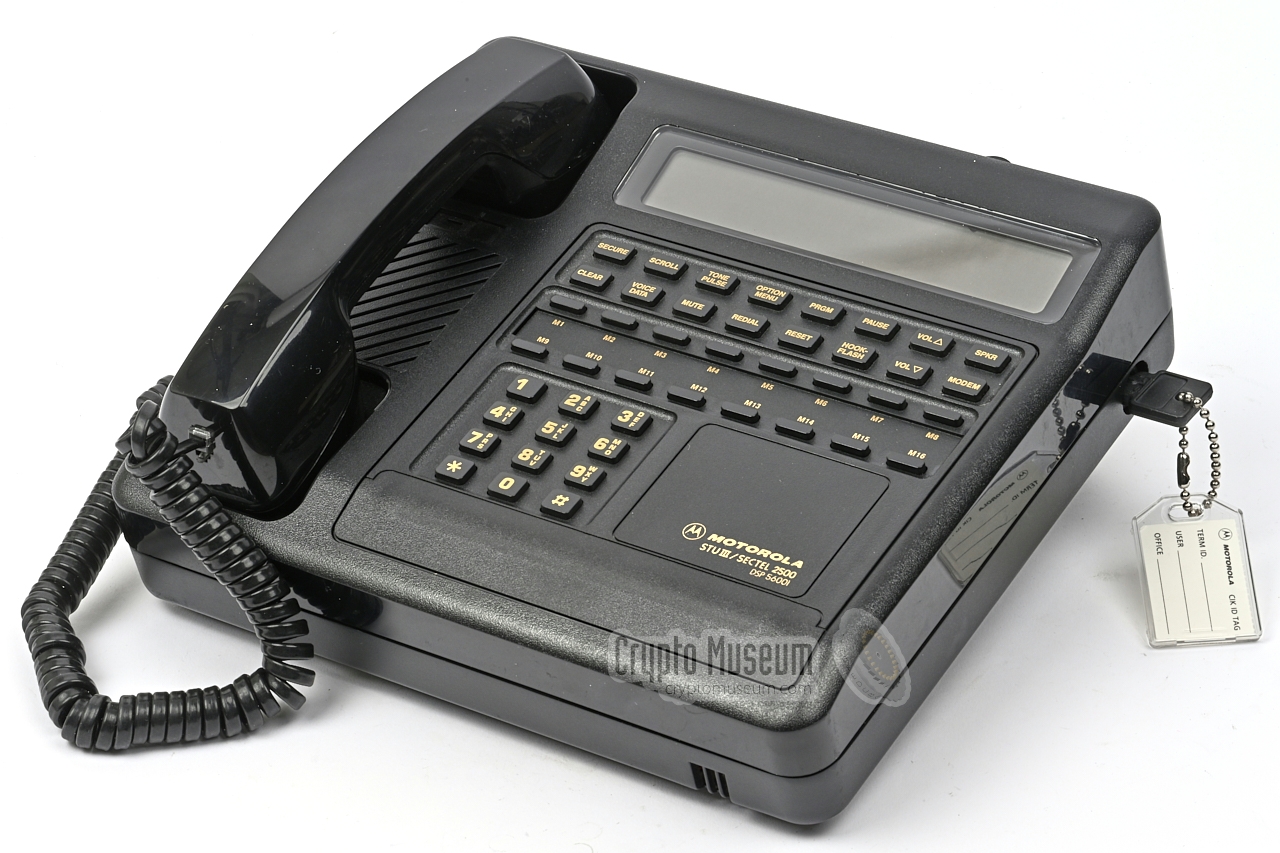
The devices are housed in a black or cream plastic enclosure and are
only marginally bigger than a regular desktop telephone set of the era.
At the left is a cradle with a common handset. To its right, close to
the front edge, is a keypad for dialling the numbers 0-9 plus the '*' and '#'.
Towards the rear is a large Liquid Crystal Display (LCD) with 16 pre-defined
function keys plus another 16 user-definable short-cut buttons.
At the right side, towards the rear of the unit, is a receptacle for the Crypto
Ignition Key (CIK), which is a Datakey
KSD-64 Key Storage Device.
|
|
|
-
And the Canadian Government.
|
|
|
Motorola SECTEL phones on this website
|
|
|
Strictly speaking, STU-II/B and STU-III/R
are not SECTEL products, but since they are based on the same
Motorola hardware development, we are listing them here as well.
|
To suit both the safety requirements of the customers and US Government
regulations, different SECTEL models were manufactured, all based on the same
basic hardware design and enclosure. The firmware and the cryptographic
algorithms are different however. The diagram below shows how they
are positioned. Only the SECTEL 1000 series and
2000 series are STU-III compatible.
Type 1 products use classified (secret) NSA encryption algorithms
and are intended only for use by the US government and some allies,
at the highest level of classification.
Type 2 products use classified algorithms endorsed by the NSA,
and are used for protection of sensitive information between government
agencies. Approval from the US or Canadian Government is required.
Type 3 products use an unclassified, fully public encryption algorithm
that is used for protection of sensitive or company-proprietary information.
Type 3 is also referred to as NIST Standard DES. It is only sold to US
government contractors and approved companies.
The SECTEL 3500 is an example of a Type 3 product, whilst the
SECTEL 2500 can use both Type 2 and Type 3 encryption.
The SECTEL 9600 is the only phone in this family that uses
Type 4 encryption.
It is intended for unclassified, non-sensitive information between
companies. It uses a non-classified, publicly available and fully
published encryption algorithm.
It could be sold to all countries except those that were on the
US proscribed list, but was never a commercial success.
➤ More about NSA encryption products
|
|
|
Presidential communication
|
|
|
|
For a president, communication with his ministers and advisors is paramount.
In the past, the STU-III has proved to be a major
'lifeline' for various presidents whilst travelling through the
country or during overseas visits.
Generally, a couple of STU-III
phones were installed by the US Secret Service,
at any likely or unlikely location that the president
could possibly visit that day.
|
The STU-III has an analogue interface and can be connected
to a POTS telephone wall socket anywhere in the world, allowing secure
conversions over non-secure telephone lines up to the level of TOP SECRET.
For this reason, the later STE
phone still supports analogue connectivity.
The long life-span of the STU-III
is illustrated by the fact that it served four US Presidents:
Ronald Reagan, George H. W. Bush (Sr), Bill Clinton
and George W. Bush (Jr).
Although it not certain, it is possible that the suceeding president,
Barack Obama, also used the STU-III secure telephone.
|
|
|
The STU-III was gradually phased out between the mid 2005 and 2009,
during the tenure of Barack Obama, the 44th US President (2009-2017).
It was replaced by the STE, of which the first versions were
backwards compatible with the STU-III.
➤ More about the STU-III
|
|
|
Any links shown in red are currently unavailable.
If you like the information on this website, why not make a donation?
© Crypto Museum. Created: Sunday 11 July 2010. Last changed: Monday, 16 January 2023 - 13:29 CET.
|
 |

|
|
|
|