|
|
|
|
|

|
|
USSR Rotor Fialka
30 x 30 matrix punched card
To enhance the cryptographic strength of the machine,
Fialka (M-125) has
a card reader at the bottom of the left side. Each day,
a fresh paper card
with a series of punched holes was installed in the drawer
of the card reader.
The functionality of the card reader is similar to the plug board
(German: Steckerbrett) of the Enigma,
but is easier to use and is cryptographically much stronger.
|
Not many original Fialka punched key cards have survived because
— as per protocol —
they were all destroyed immediately after use.
So far, we've only seen one
original key card,
which is shown in the image on the right. Many thanks to
Tom Perera in the USA for donating this card to us [2].
In the image on the right it is clearly visible that the card
was torn from a stack,
as the top part is missing.
The number 23
in the top left corner
refers to the day of the year.
The key cards were changed daily and they were created by the
Soviets for all countries of the Warsaw Pact.
|
|
|
Each country had its own unique stacks of cards, each valid for one month.
The stacks were created by the Russians, for one year in advance
and were supplied in a seal bag. The cards were perforated at the upper and
lower edges. When taking a card from the seal bag, it was ripped off at the
lower edge, whilst the upper edge was used to align the card with the
two index pins in the reader.
The number of the card (i.e. day of the year) was printed along the upper
edge of the card and was visible through a cut-out in the seal bag.
Each day, the Fialka operator took a card (with the number
corresponding to the day) from the seal bag (see below)
and placed it in the reader.
The cards were so thin that they could only be used once.
Opening the drawer of the card reader a second or third time, was likely
to damage the card. This was deliberately done to ensure that a card would
not be used again.
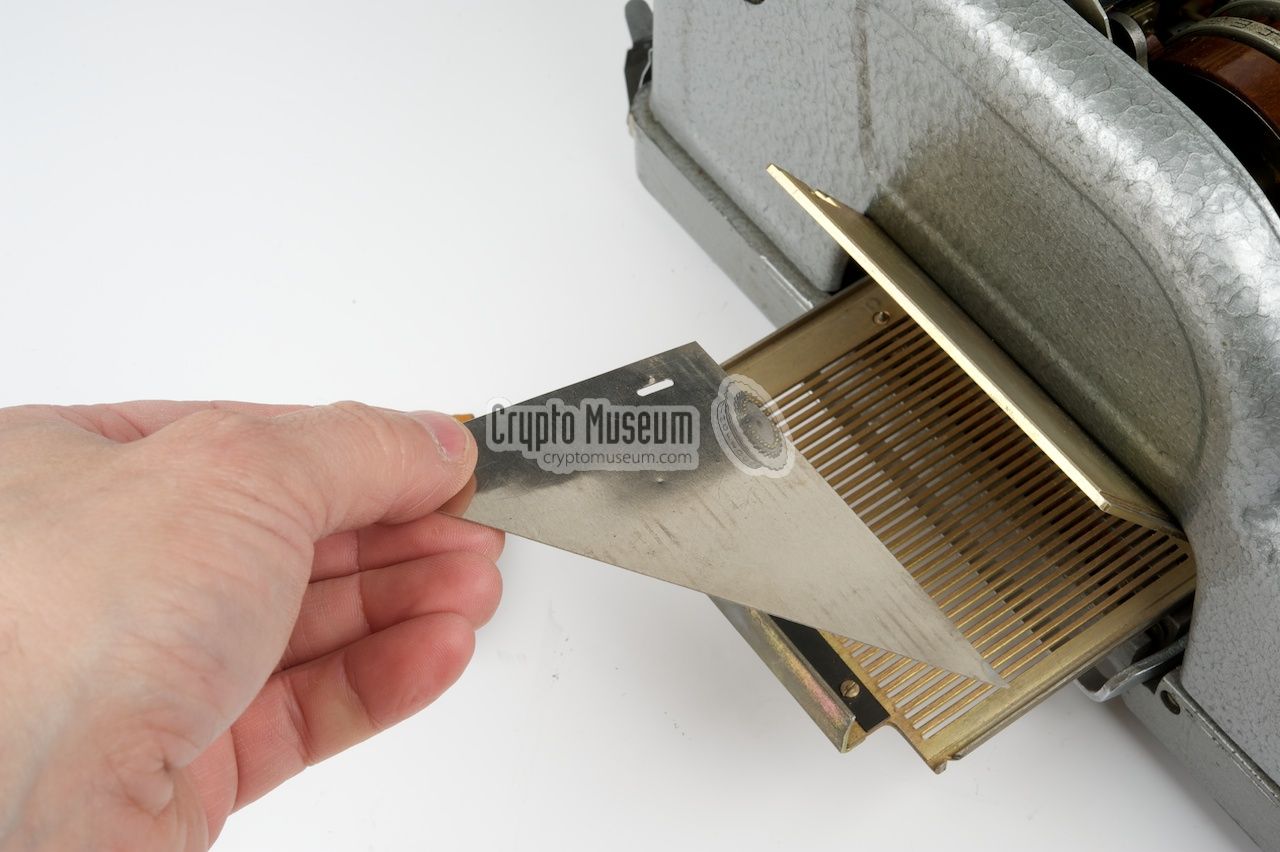
In situations where no key card was needed, a
metal triangle was used instead.
It forces the identity matrix to be used and is similar to an Enigma
plug board with no cables.
Reproduction key cards are available from two sources, both of
which are listed below.
|
|
Most Fialka machines
found on the surplus market today, are supplied with a
metal triangle
in the card reader. Basically, this triangle eliminates the card reader
by forcing the identity matrix, or diagonal, to be used.
This means that A is translated to A,
B becomes B, C becomes C, etc.
The use of the triangle is comparable to removing all patch cables
from the Enigma's Steckerbrett.
|
As per protocol, the key card was removed at the end of the day (or session)
and replaced by the metal triangle.
The original key card was then destroyed.
This way, no useful intelligence was left behind in the machine.
The metal triangle was also used for eliminating the card reader from the
equation when servicing the machine.
It is also possible that the triangle was used for lower grade messages
for which a less secure key was sufficient, for example for messages with tactical or logistic content,
but no evidence has been found to date to support
this theory.
|
|
|
In 2007 Günter Hütter in Austria created a series of replica
key cards that can be ordered directly from him. The cards are punched with a
purpose-built puncher and are sold in sets of two.
They work perfectly well with every Fialka we have tried.
We should like to thank Günter for sharing the results of his experiments
and for confirming that the dimensions given below are correct.
|
|
|
Another successful attempt to create high quality reproduction key cards
was mounted by Mark Sims in 2014. His key cards are fully laser-cut and
contain every detail that can observed on the original.
These cards can be ordered directly from Mark Sims, who can be contacted
at his e-mail address
holrum@hotmail.com
[4].
|
|
|
Below is a drawing of a key card with all holes punched. In case you want
to create your own key cards, you may want to use
this drawing as a mask
and punch out the required holes: one for each row/column combination.
Click the image to open it as a 1:1 PDF file,
or download it below.
|
Below are the dimensions of the
metal test triangle that is normally present
in the card reader of a Fialka, when the machine is unused.
If this triangle is missing from your machine, you may be able
use these dimensions to create a reproduction. Click the image
to download it as a 1:1 PDF.
The Russian word ВЕРХ, engraved along the upper edge,
means TOP (this side up).
|
Below is a drawing of a
key card with serial number 14, just as an example.
As you can see, there is precisely one hole for each row/column combination.
If you want to create your own Fialka key cards, you may want to download
and print this one. Click the image to download it as a
1:1 PDF.
|
In case the metal test triangle is missing from your Fialka machine,
and you are not able to make a proper reproduction of it, you may want to
use the identity matrix key card shown below.
It contains a diagonal of holes and is the equivalent of the metal triangle
(A→A, B→B, C→C, etc.).
|

|
|
Universal key cards (836KB PDF file)
|
|
This is a single page that contains four blank universal key cards.
Print this page at actual size (100%) and cut the four cards apart.
Next create the alignment holes and the actual key holes.
|
|
|
|
|
Sample key card # 014 (65KB PDF file)
|
|
This file is similar to the one above, but rather than showing all
possible hole locations, it prints the holes for the sample key card
number 014 that is featured as an example in the German Fialka Manual.
|
|
|
|
|
Metal test triangle (12KB PDF file)
|
|
The metal test triangle should be present with your Fialka.
It should be used when no key card is present in the card reader.
If the triangle is missing, you might want to download this file
and print it on sturdy paper (e.g. 150 or 200 grams).
|
|
|
|
|
|
|
|
Any links shown in red are currently unavailable.
If you like the information on this website, why not make a donation?
© Crypto Museum. Created: Saturday 31 May 2014. Last changed: Monday, 10 April 2023 - 09:07 CET.
|
 |

|
|
|




![Seal bag containing the key cards and the wheels settings for one month [3]](img/sealbag.png)