|
|
|
|
|

|
Homing beacon voice identifier
- not in collection
SKG-1 was a voice-based identifier
(German: Sprachkennungsgeber), developed in 1943
by Dr. Karl Daniel of Tefi-Apparatebau Dr. Daniel KG
in Porz (Germany) for use by the German Airforce
(Luftwaffe) during WWII.
The device was based on the Tefifon and
added a spoken message with the name
of the base station as modulation to the carrier, or tractor beam,
of a homing beacon.
|
During WWII, the German Luftwaffe used VHF homing beacons to guide
their Stuka 1 airplanes home after a strike on, say, London.
Each beacon was modulated with its ID
in morse code, so that pilots could easily
find the correct homing beam.
By 1943 however, it had become clear that these morse codes
could easily be faked by the British, causing the planes to be guided
elsewhere. 2 It was therefore decided to replace the morse code by a
female voice – alternated with a 1000 Hz tone – that read the codename of the
station; typically a female name like Erna or Veronica.
|
|
|
|
The Luftwaffe then commissioned Dr. Karl Daniel to develop a system
that was able to produce a short – continiously repeating – sound sample.
Daniel based the system on his so-called Tefifon, a system for background
music that had an endless tape (with up to 4 hours of music), much like
an 8-track system, using a 8 mm plastic (celluloid) film into which a single groove
is cut in depth.
|
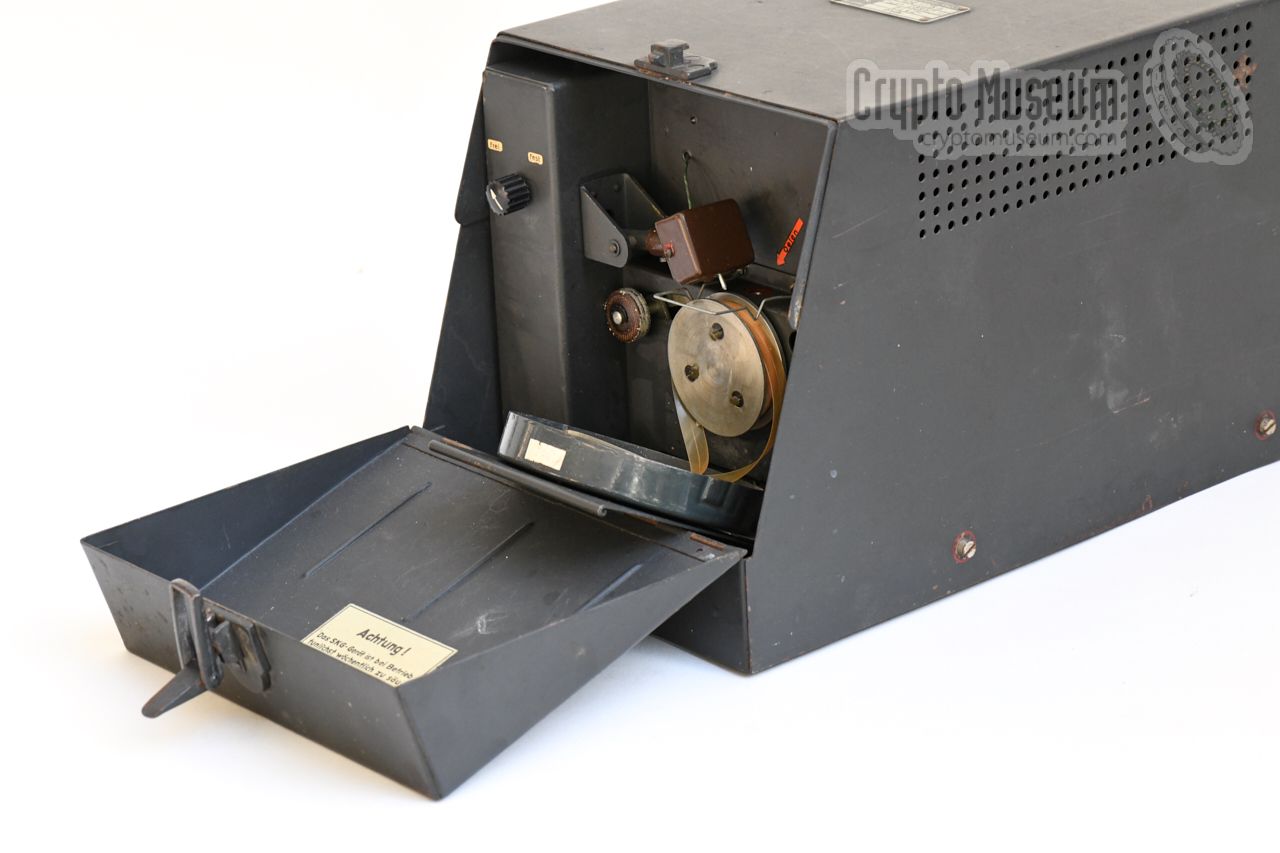
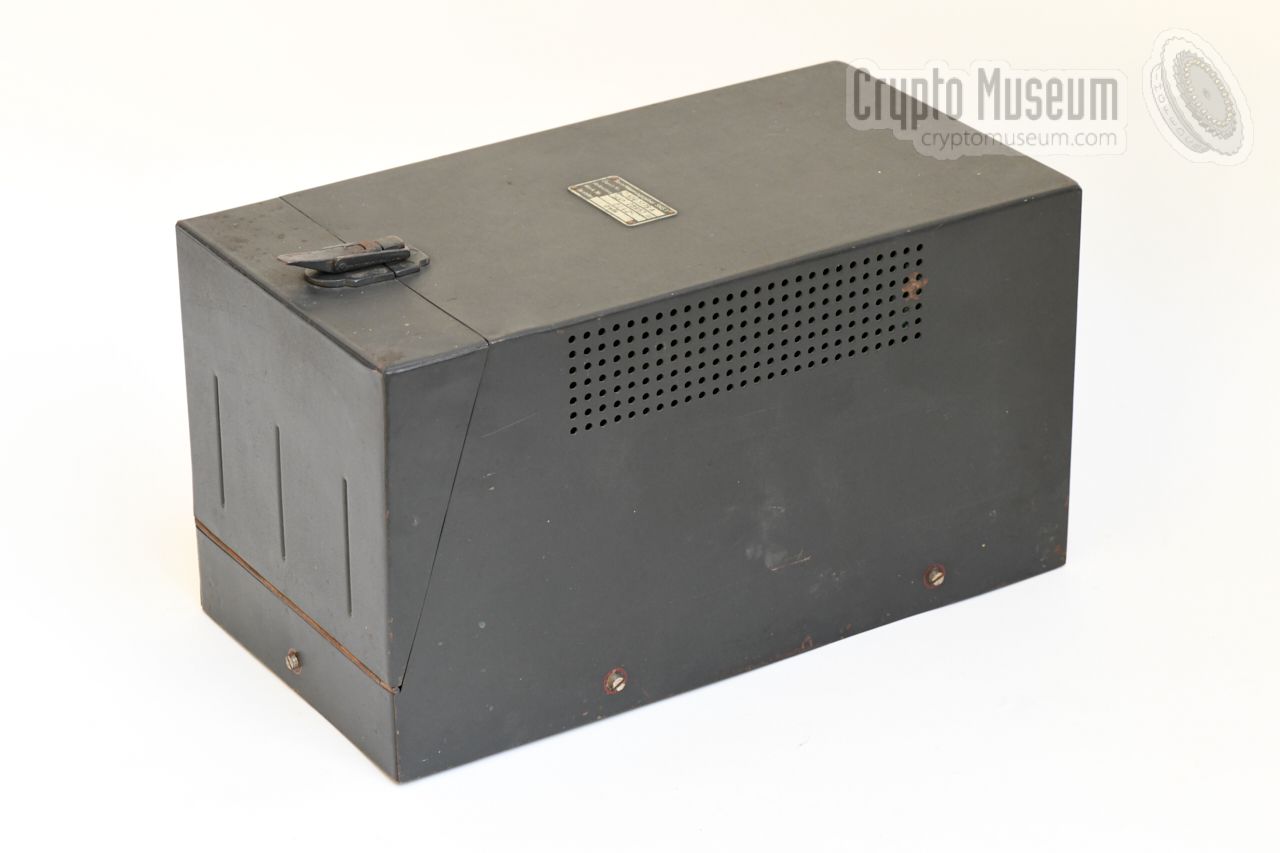
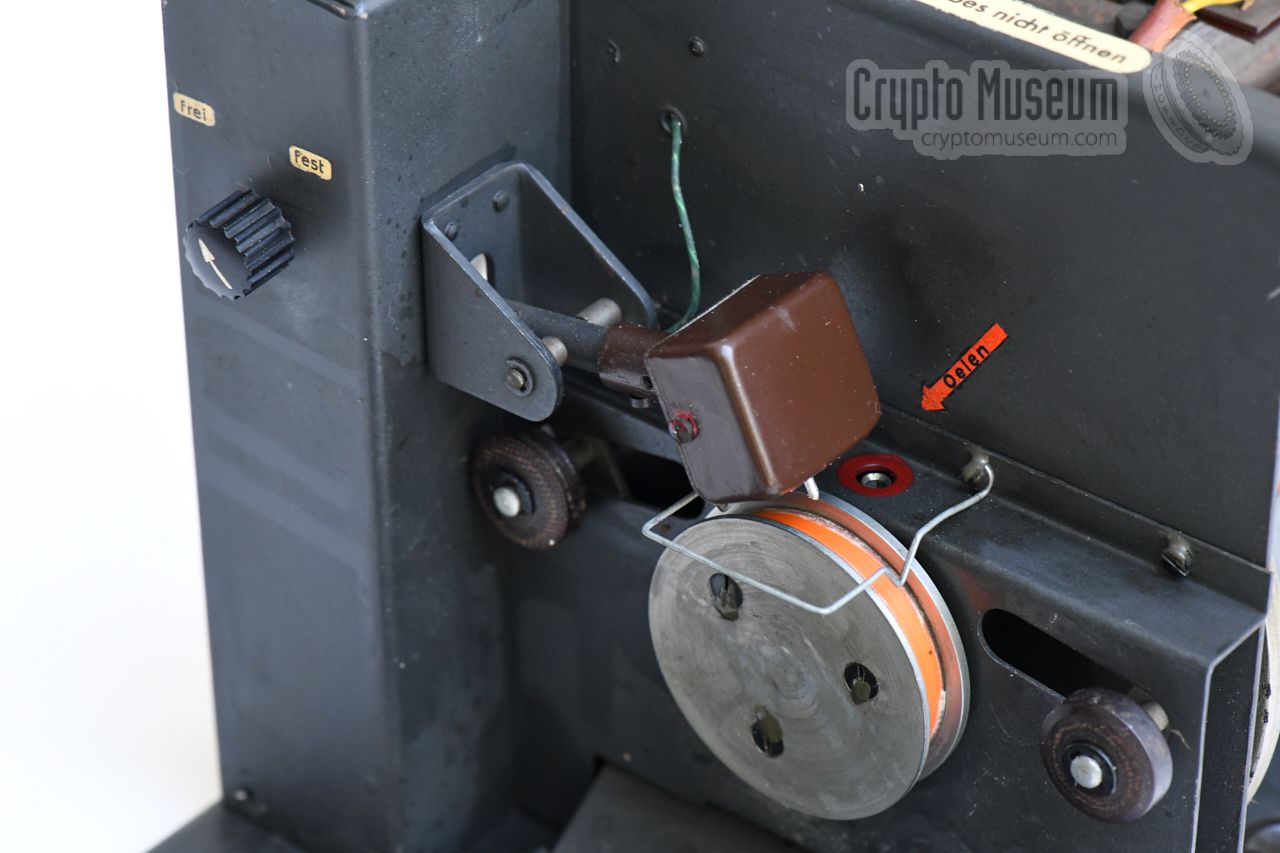
The device is housed in a grey metal enclosure that measures 350 × 190 × 185 mm,
and has a hinged front panel that is held in place with a spring-lock at the
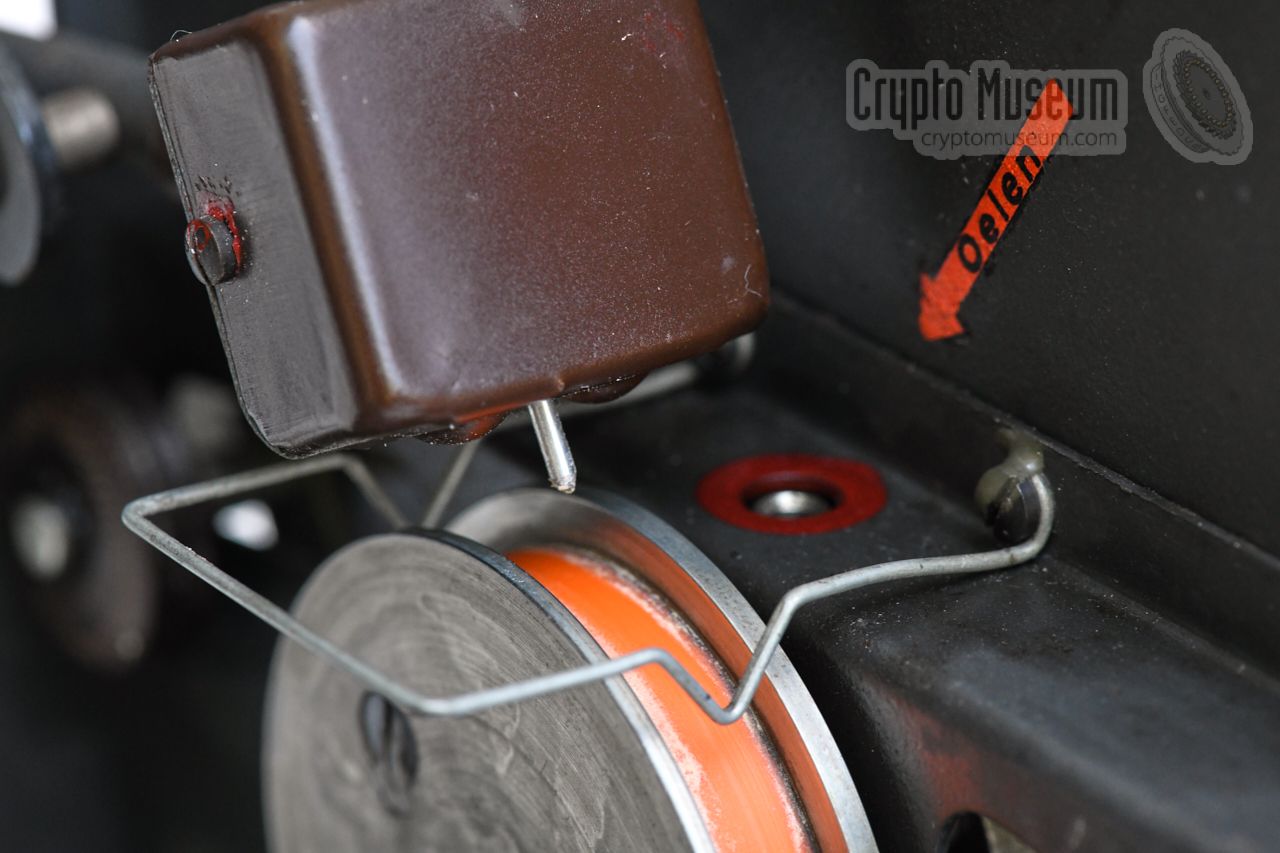
top. Behind this panel is a pulley that accepts a special cartridge, plus an
electromagnetic pickup head, as shown here.
The cartridge (not shown here) contains a endless piece of
8 mm film, onto which the sound is recorded into a groove,
much like a phonograph record. 3
The device is first described in 1995 by Herbert Jüttemann in his book
Das Tefifon [5].
It is that particular device that is featured here [1].
|
|
|
|
The device is also mentioned briefly by Fritz Trenkle in his book of 1987 —
Die deutschen Funkfürungsverfahren bis 1945 — although
he erroneously describes it as using magnetic tape [4].
A good description of the device is also given by Werner Baus, based
on an interview he had with Dr. Daniel in 1977 [7]. In his article,
the device is called SKG-10, but this probably
incorrect
[1].
|
|
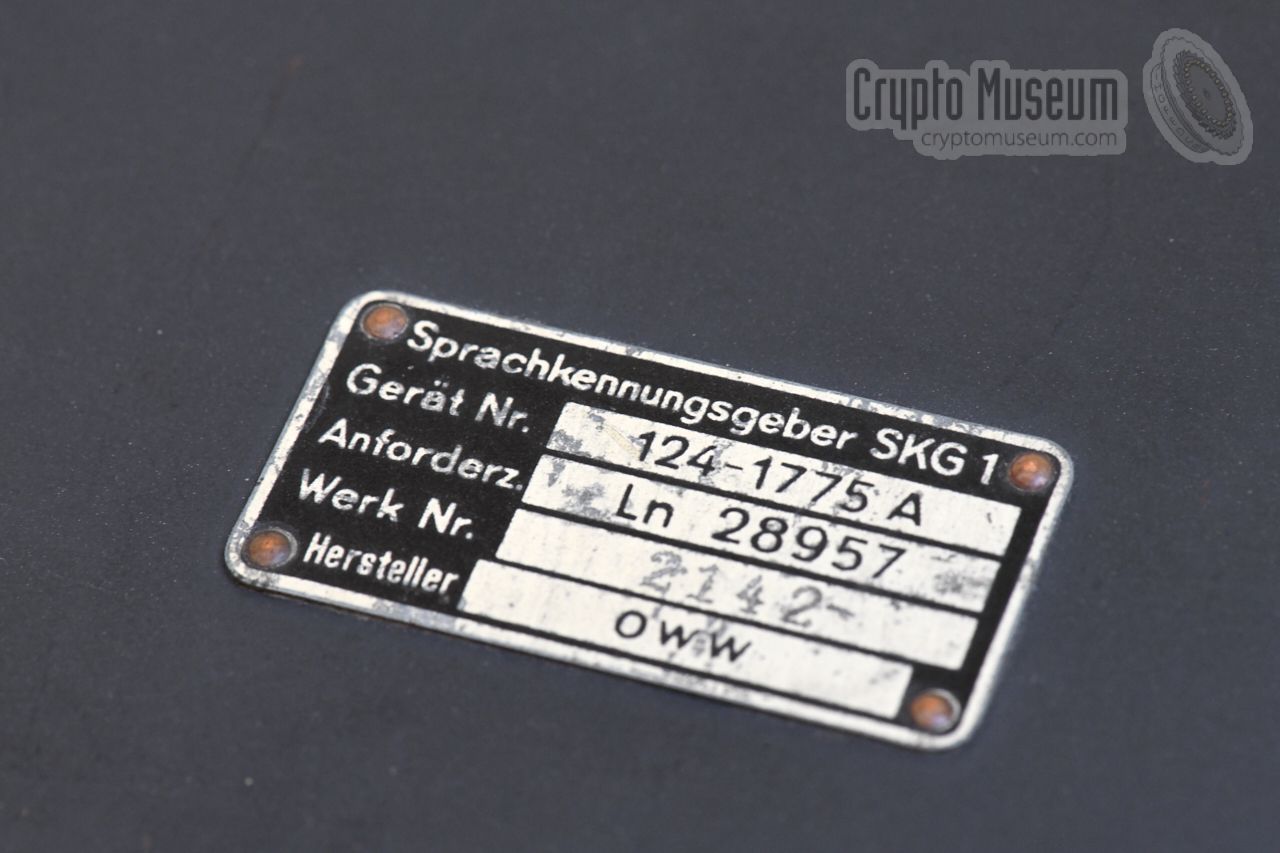
According to the serial number tag,
the SKG-1 was also known by its part number
124-1775A and by the order number Ln 28957.
It is estimated that the SKG-1 was first produced in 1943.
It is currently unknown how many devices were made, but it is possible
that the one show above is the only surviving one. It is in the collection of
Austrian collector Günter Hütter [1] and has meanwhile been restored to full
operating condition with help from the Crypto Museum curators.
|
-
Stuka, short for Sturzkampfflugzeug (dive bomber), was the nickname of
the Junkers Ju 87. ➤ Wikipedia
-
It is known that the Russians did the same with German Luftwaffe strikes
on Russian territory [8].
-
On a phonograph record that information is contained in the sideways
displacement of the groove, whereas on Tefifon (and hence the SKG-1)
the information is contained in the depth of the groove.
|
|
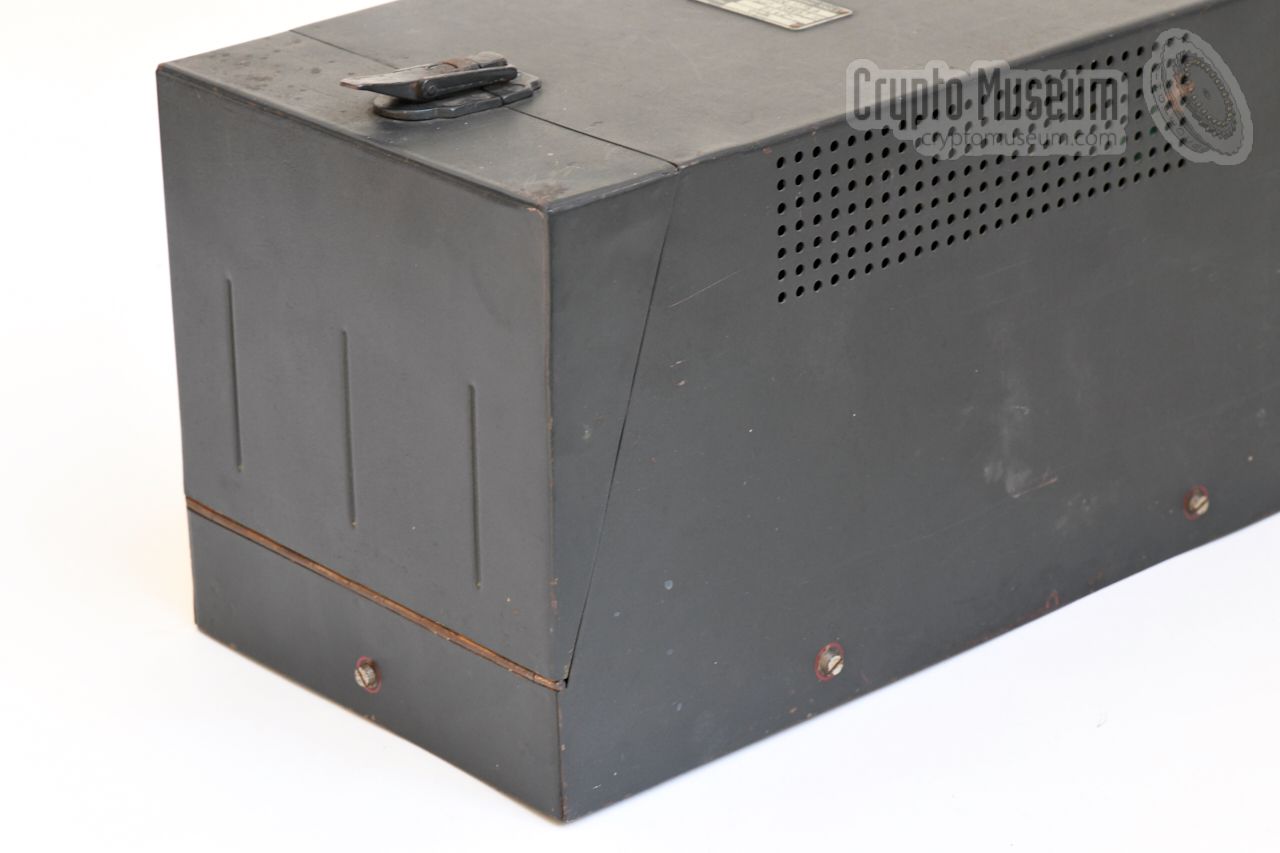
The SKG-1 is housed in a lightweight rectangular grey metal enclosure with a
hinged front cover that is held in place by a spring-lock at the top. The
interior is covered by a perforated U-shaped metal cover that is held in place
by four screws; two towards the bottom of either side panel.
|
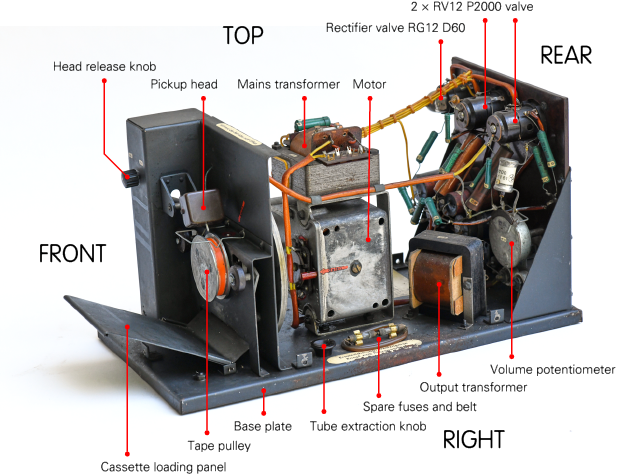
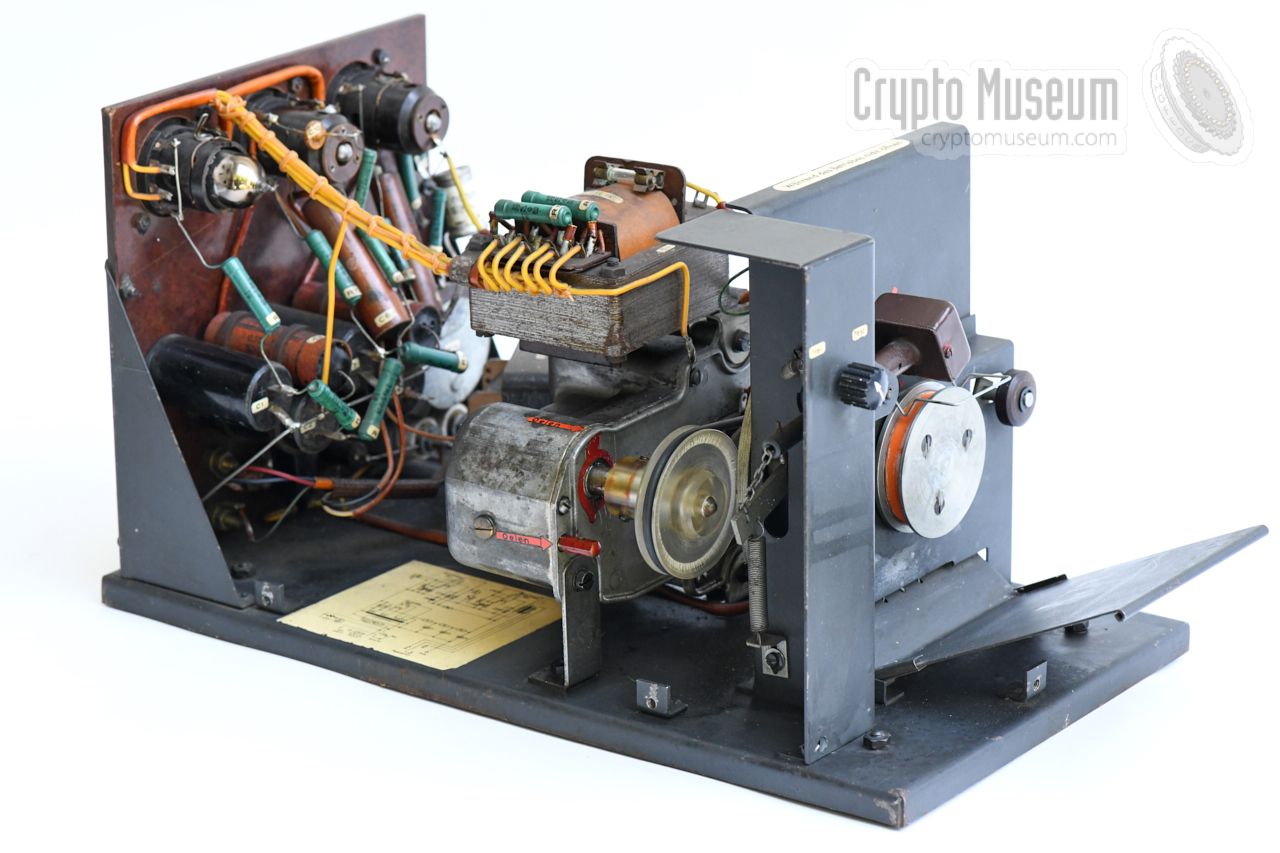
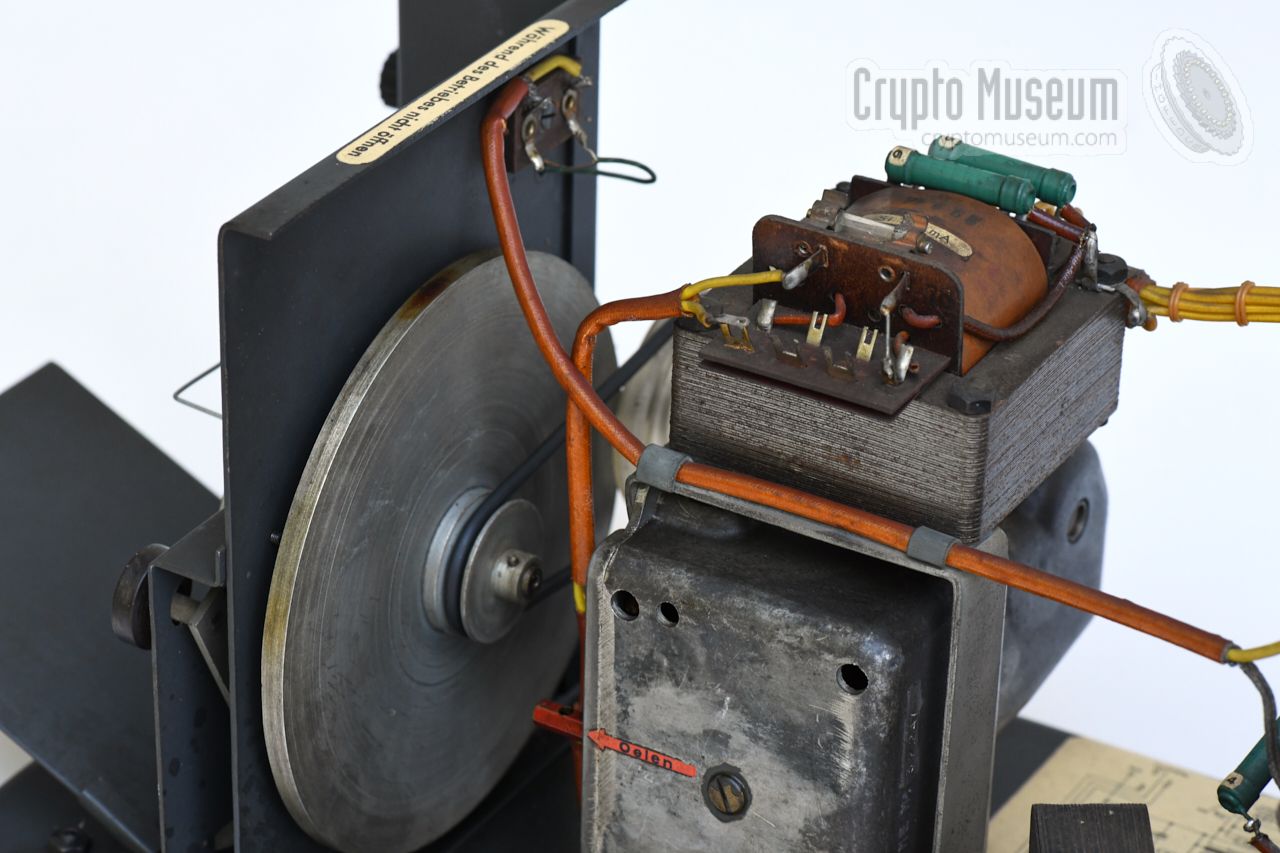
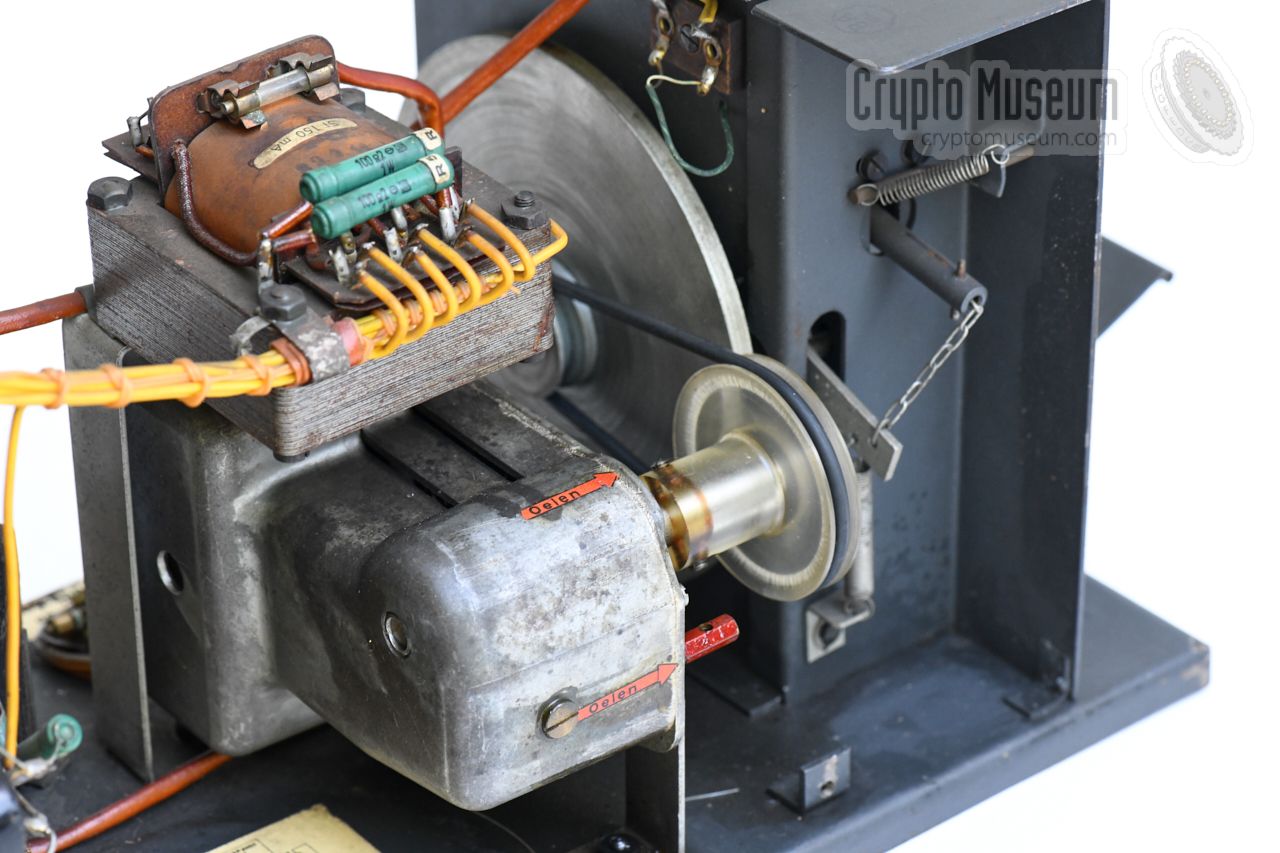
After removing the four screws, the U-shaped top panel can be removed and the
interior is exposed, as shown in the image on the right. At the centre of the
device is the motor that drives the tape pully at the front panel. On top of
the motor is the small 220V AC mains transformer.
By means of a rubber belt, the motor drives a large flywheel that is mounted
on the same axis as the tape pulley at the front panel. When a sound film
is played, the needle of the electromagnetic pickup head transforms the
variations in groove-depth into a small electric current.
|
|
|
|
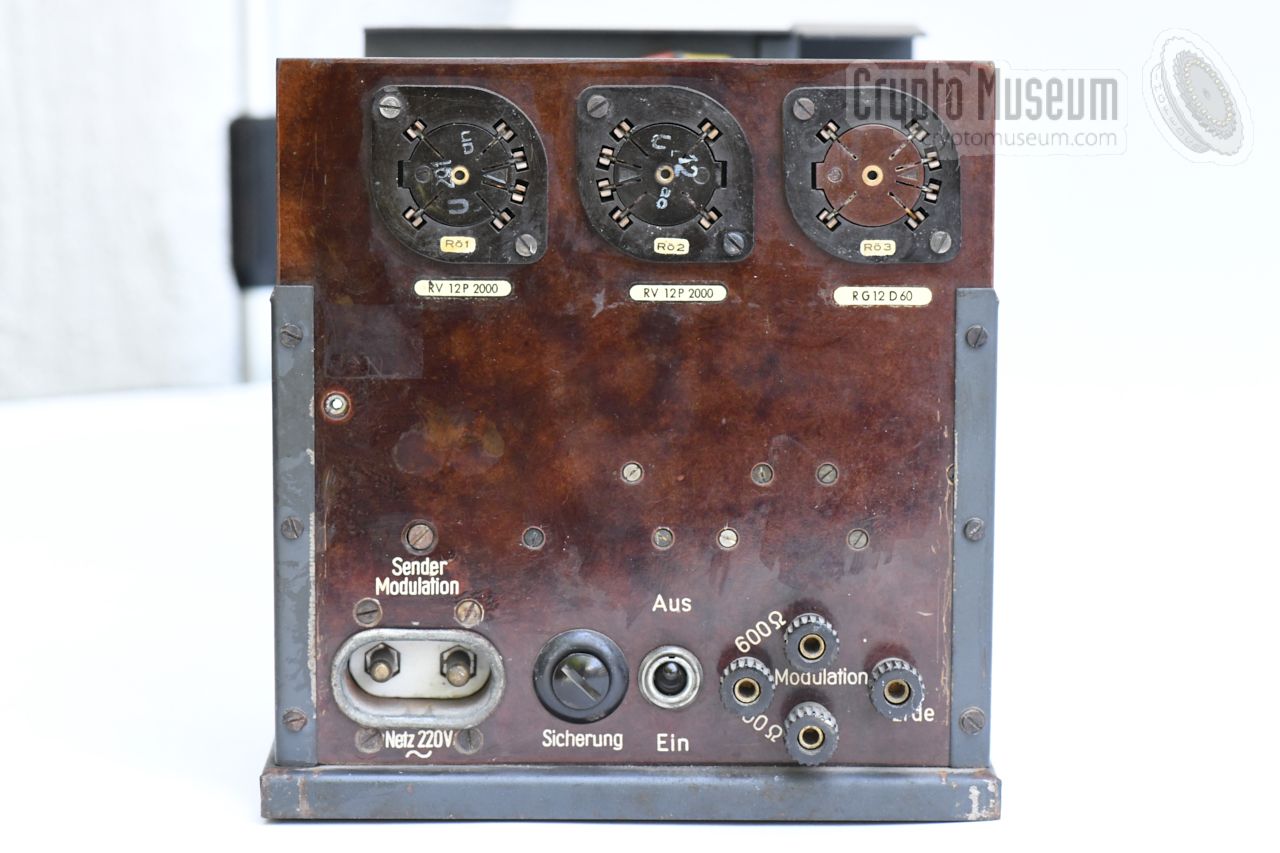
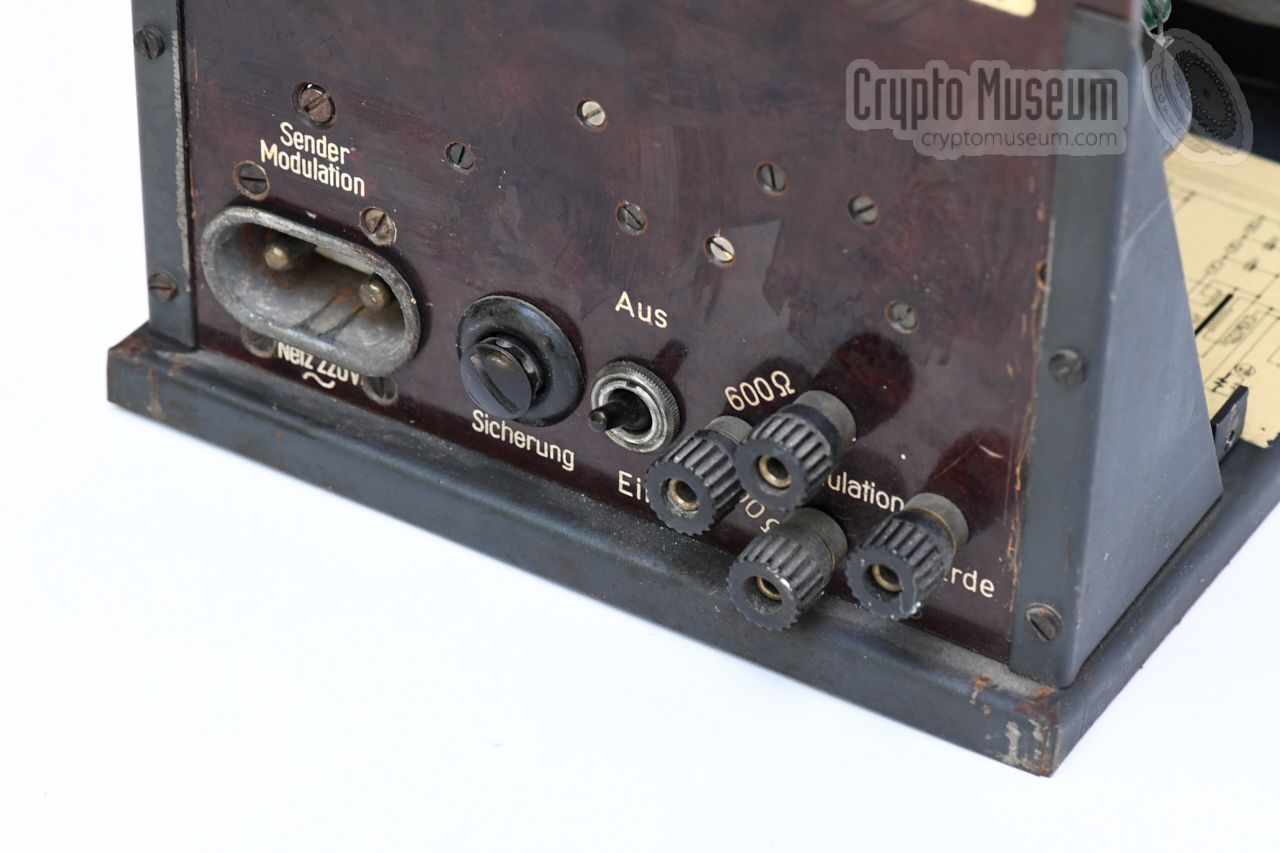
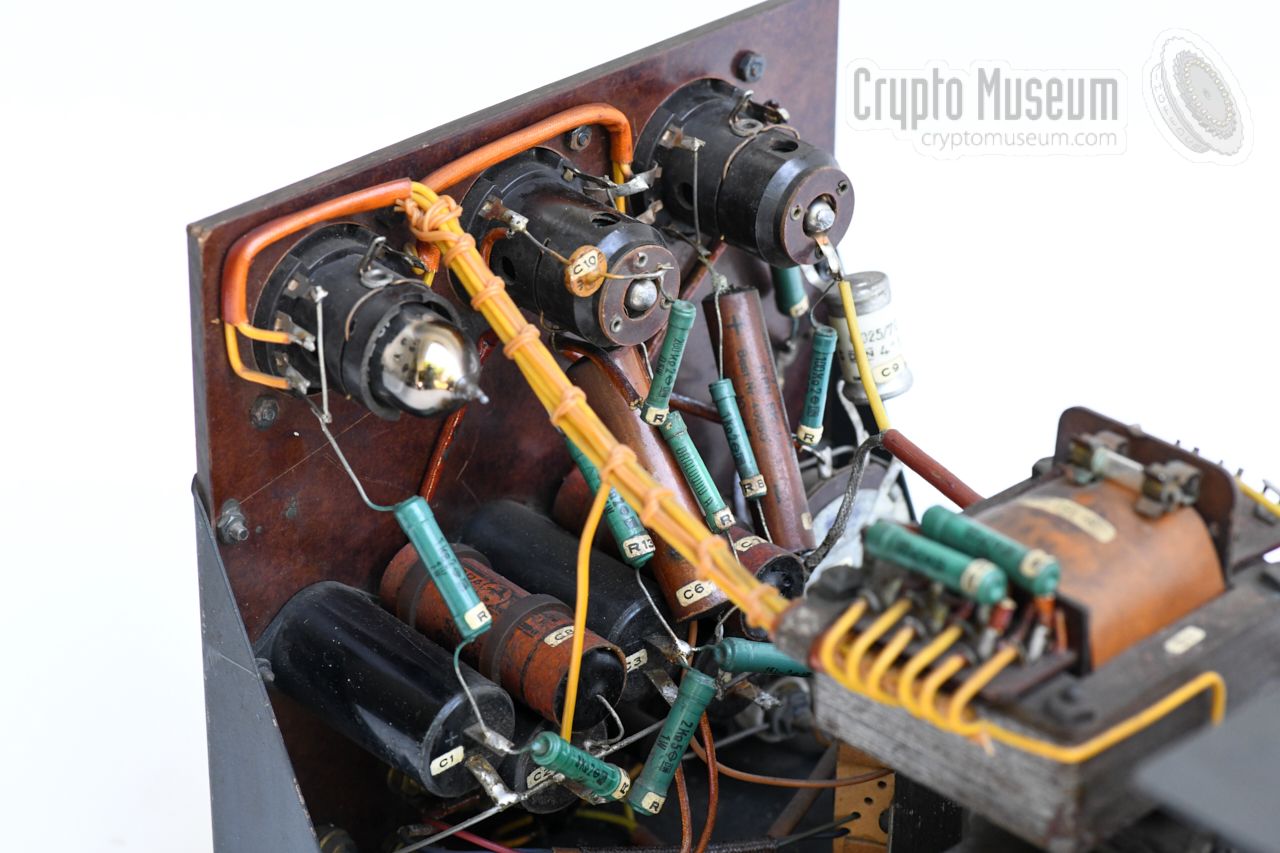
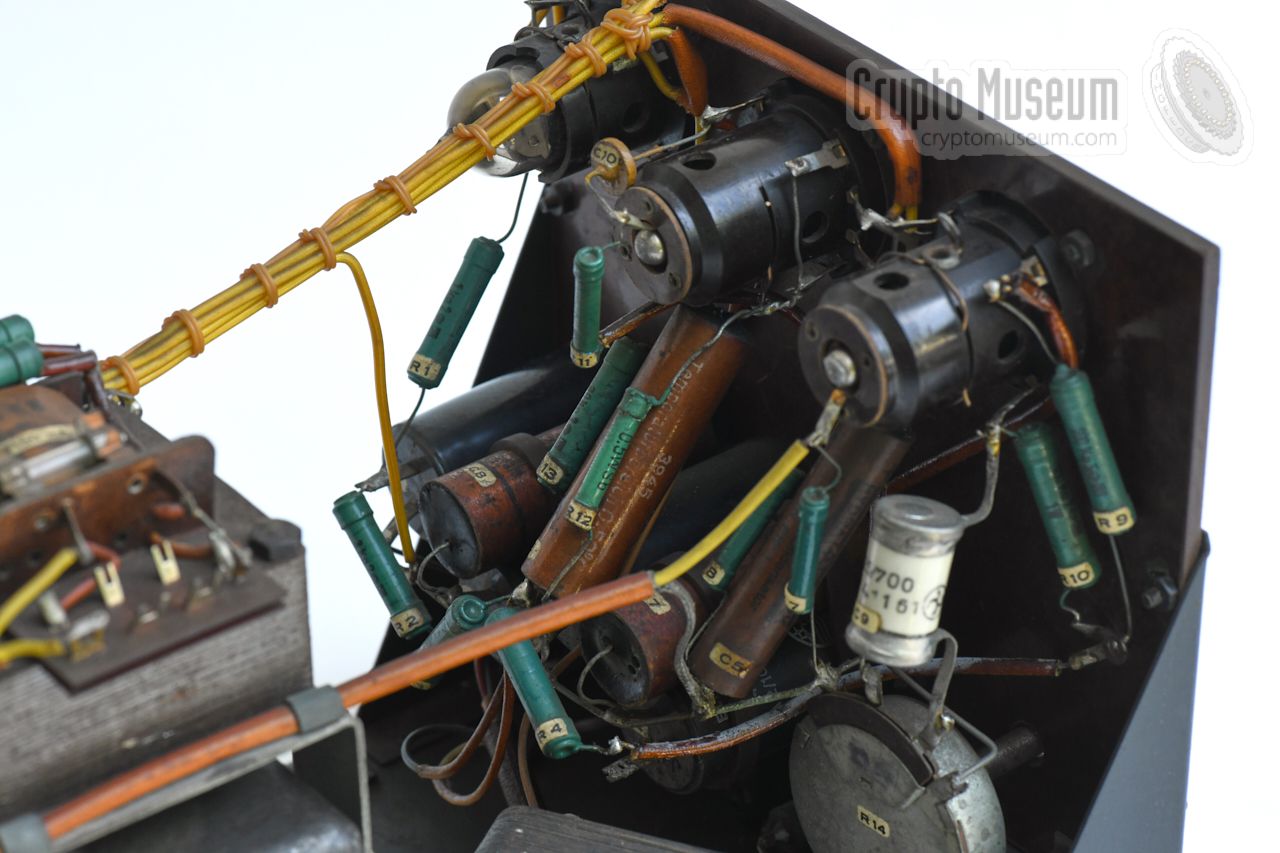
The current is passed — via a shielded cable — to the 2-stage audio amplifier
which is mounted to the rear panel, along with the HT voltage rectifier. The
amplifier is rather straightforward and is built with two RV12-P2000 valves,
that are inserted into their sockets from the rear, allowing them to be replaced
without opening the case.
The amplifier is shown in the image above.
|
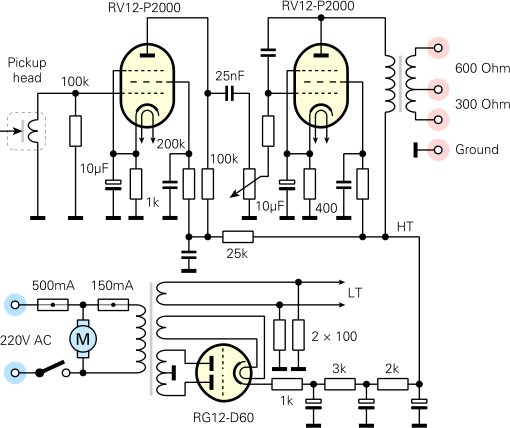
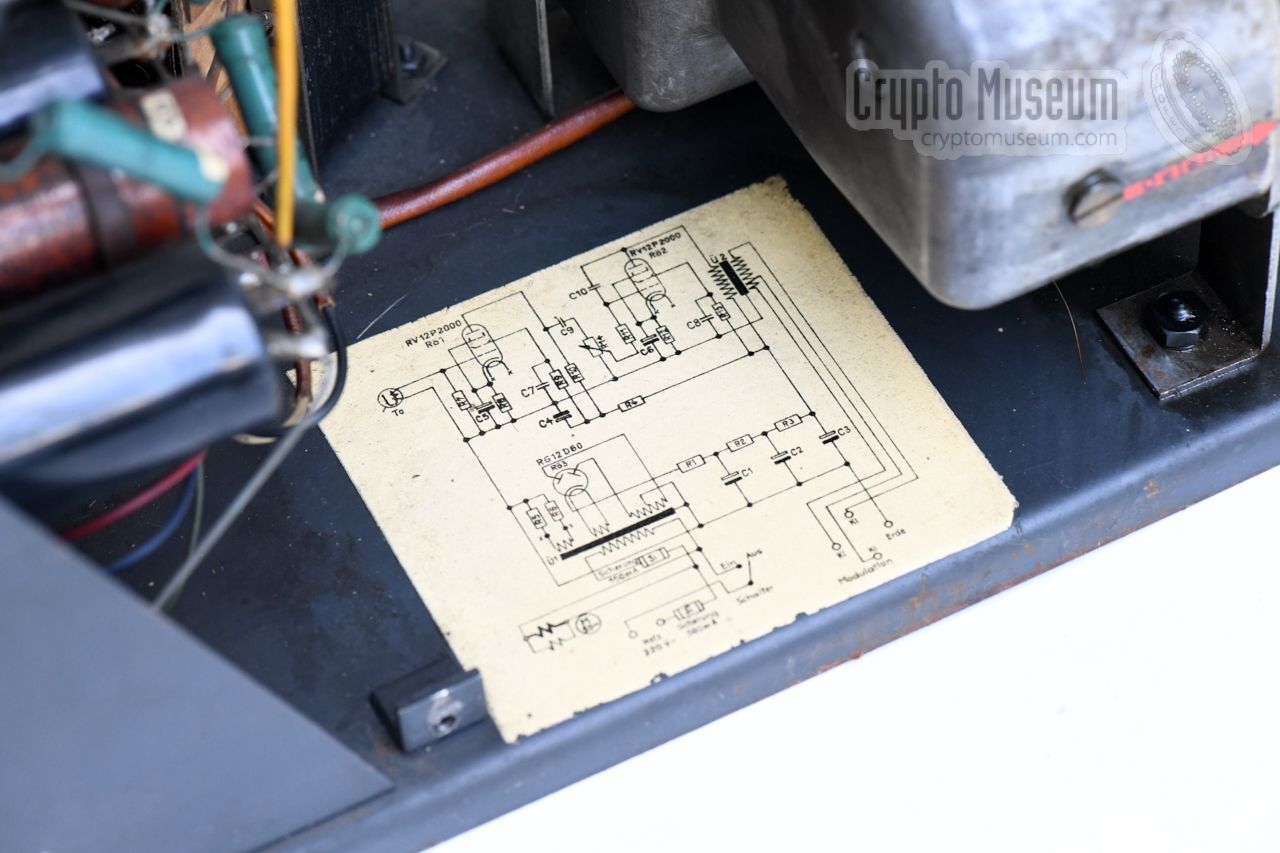
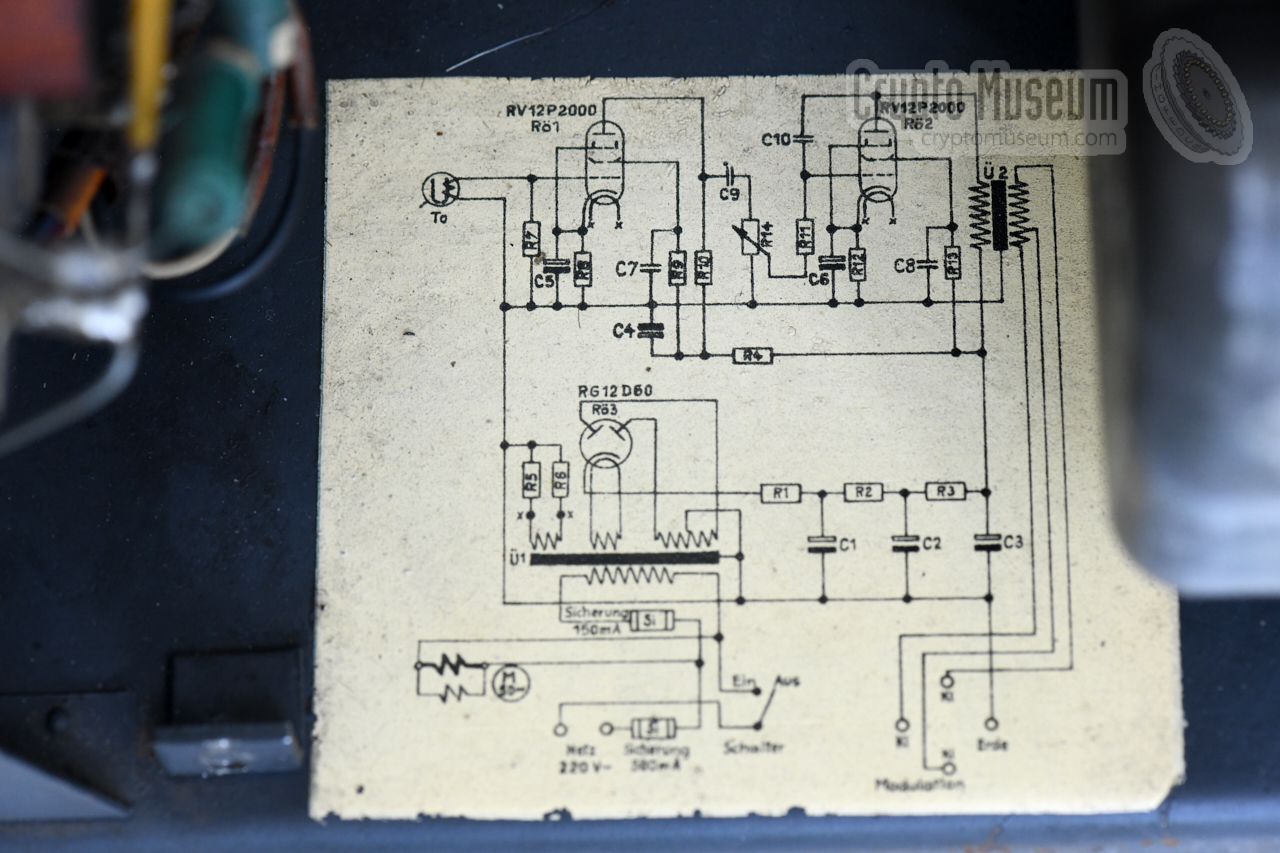
The circuit diagram
is printed at the bottom and is also reproduced here.
At the bottom is the 220V AC mains transformer, which produces the LT and HT
voltages for the filaments and the anodes respectively, for the two RV12-P2000
amplifier valves at the top. At the left is the pickup head that is driven by a
needle that follows the groove in the recorded 8 mm plastic film (tape).
The weak signal from the pickup head is first amplified in the first RV12-P2000,
and then to line level in the second PR12-P2000. The output of the 2nd stage is
available from the transformer at the top right, which offers a line impedance
of 300 or 600 Ohms, available at the rear panel.
|
|
The SKG-1 shown on this page was rediscovered by Austrian collector Günter
Hütter in 2019, and is probably the only surviving one. Although the device
was more than 75 years old when it was rediscovered, it was still in working
condition. Nevertheless it exhibited a disturbing 50 Hz hum and some distortion
when it was switched on, indicating that some of the parts had worn out.
|
In order to do a quick first test, modern components were fitted in parallel
to the existing (worn-out) parts, and the leads of some other parts where cut.
The footage above shows the result of our efforts. It was recorded on 24 June
2019 in Austria. At the bottom left is Marc's hand holding the Tefifon film
cartridge in the proper position. The voice Erna can be heared in the
background.
|
Tefi-Apparatebau Dr. Daniel KG, commonly abbreviated Tefi,
was an electronics company, established in 1936 by Dr. Karl Daniel [2].
He was the inventor of the Tefifon, a tape-based audio recording format
that used celluloid film with a depth-modulated groove [3], similar to
phonographic records. The Tefifon allowed up to 4 hours of music to be
recorded onto an endless tape — held in a special cartridge — and was
used for a number of years in restaurants and dancings as (background)
music system. As such, it is similar to the magnetic-tape-based 8-track format.
During WWII, Dr. Daniel and his company could not escape the German war machine,
and were asked to develop a voice-based system for identification of the
German airports, so that pilots could easily lock onto the correct tractor
beam that would guide them home after an air raid.
It resulted in the SKG-1. During the war, Tefi was known under manufacturing code oww.
Before and during the war, Tefi successfully marketed a variety of products,
but due to the fact that most artists preferred to release their titles on
phonograph records, Tefi's musical offering was limited to relatively unknown
artists. After the war, Tefi released a number of integrated and stand-alone
products – even a stereo version in 1961 – but could not compete with the
phonograph record, and eventally lost the battle.
The company closed down in 1965, after which the
product line and the rights to the name were taken over by the Neckermann
mail-order company.
|
- Günter Hütter, SKG-1 with serial number 2142
Crypto Museum. Austria, June 2019.
- Wikipedia (Germany), Karl Daniel
Retrieved June 2019.
- Wikipedia, Tefifon
Retrieved June 2019.
➤ German
- Fritz Trenkle, Die deutschen Funkfürungsverfahren bis 1945
ISBN 3-7785-1647-7. Heidelberg, 1987. p. 76, 105.
- Herbert Jüttemann, Das Tefifon
ISBN 3-931651-00-2. 1995. pp. 66-68.
- Radio Museum, Sprachkennungsgeber 124-1775A (Ln 28957)
Retrieved June 2019 (German).
- Werner Baus, Ein Tag bei Dr. Daniel in Porz/Rhein !!!
16 November 1973 (German).
- Radiomusem-Bocket, Tefi-Apparatebau
Retrieved June 2019 (German).
|
|
|
|
Any links shown in red are currently unavailable.
If you like the information on this website, why not make a donation?
© Crypto Museum. Created: Wednesday 26 June 2019. Last changed: Sunday, 17 May 2026 - 08:13 CET.
|
 |

|
|
|