|
|
|
|
|

|
|
OTT Siemens D → ← T-43
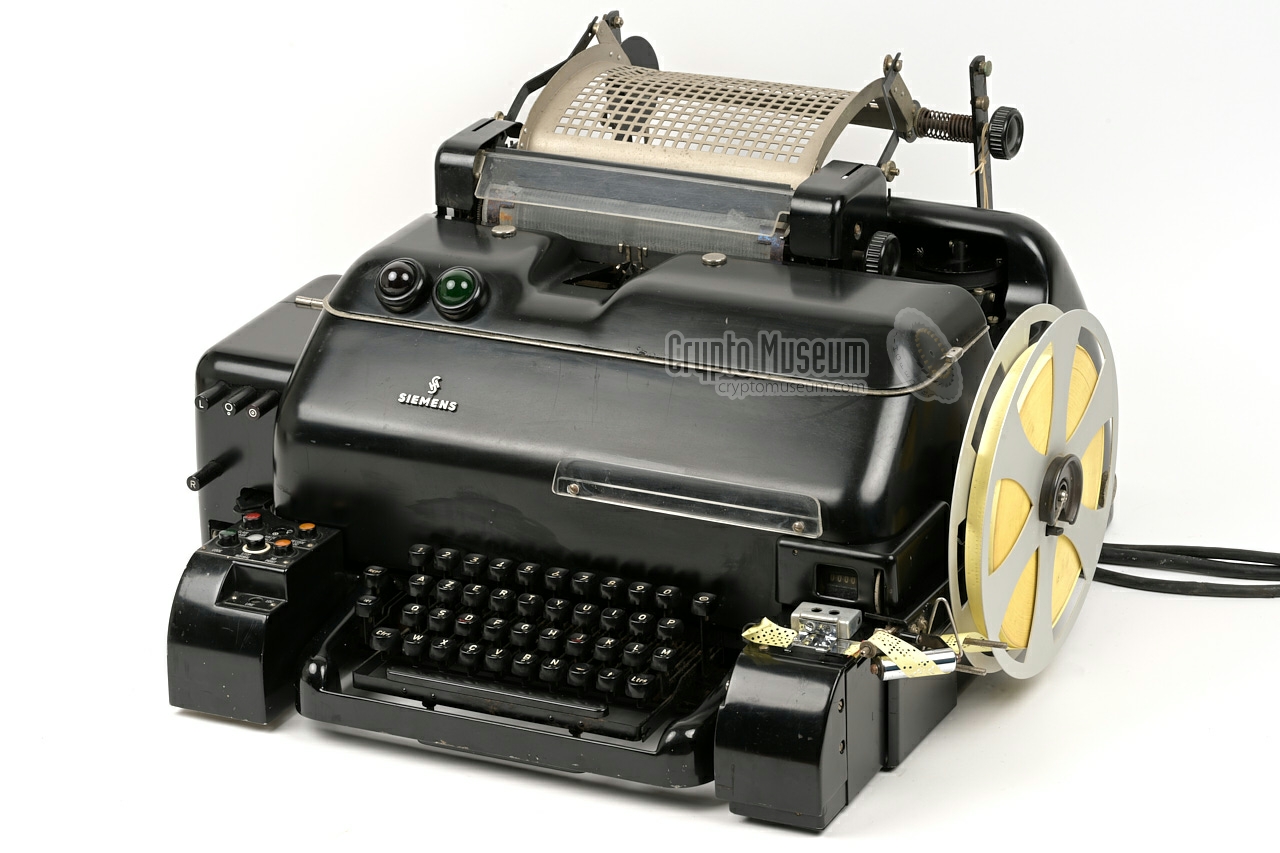
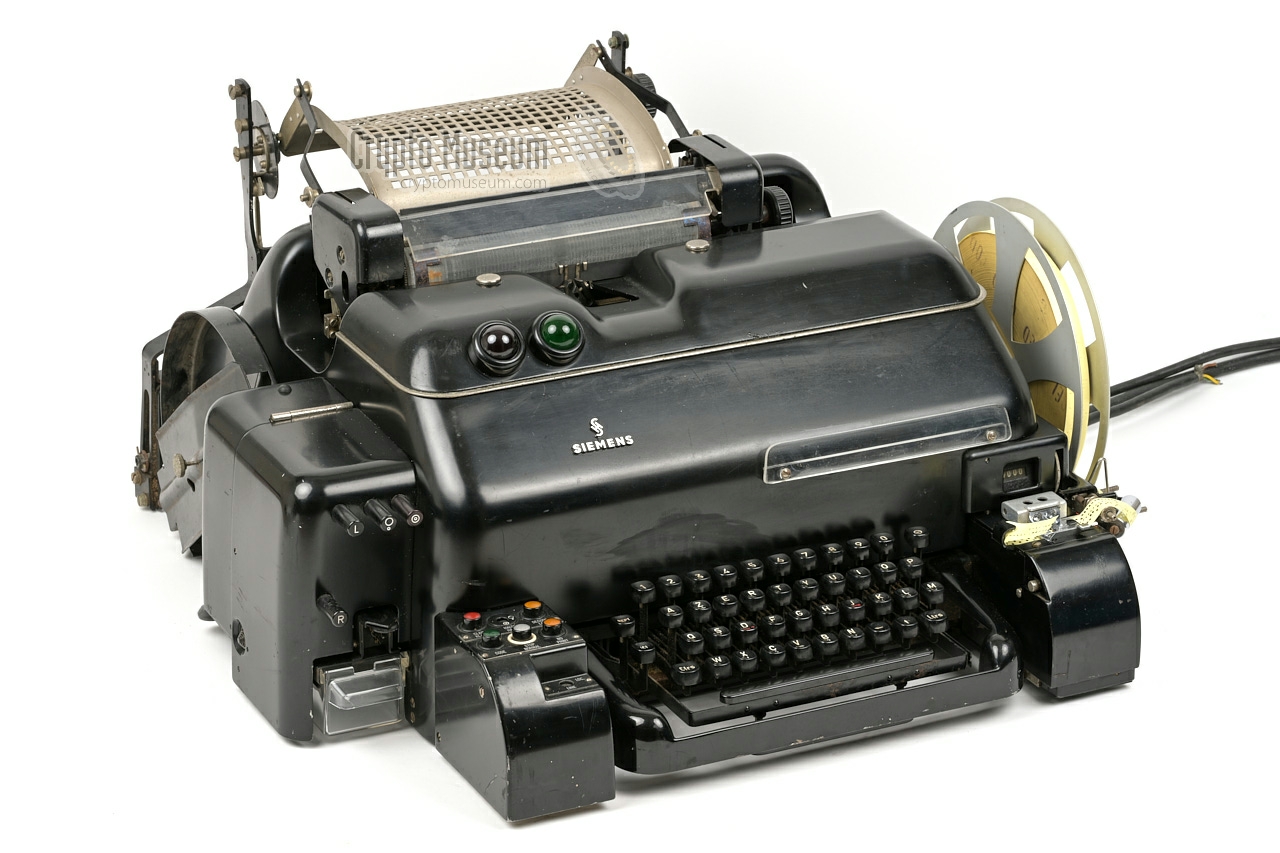
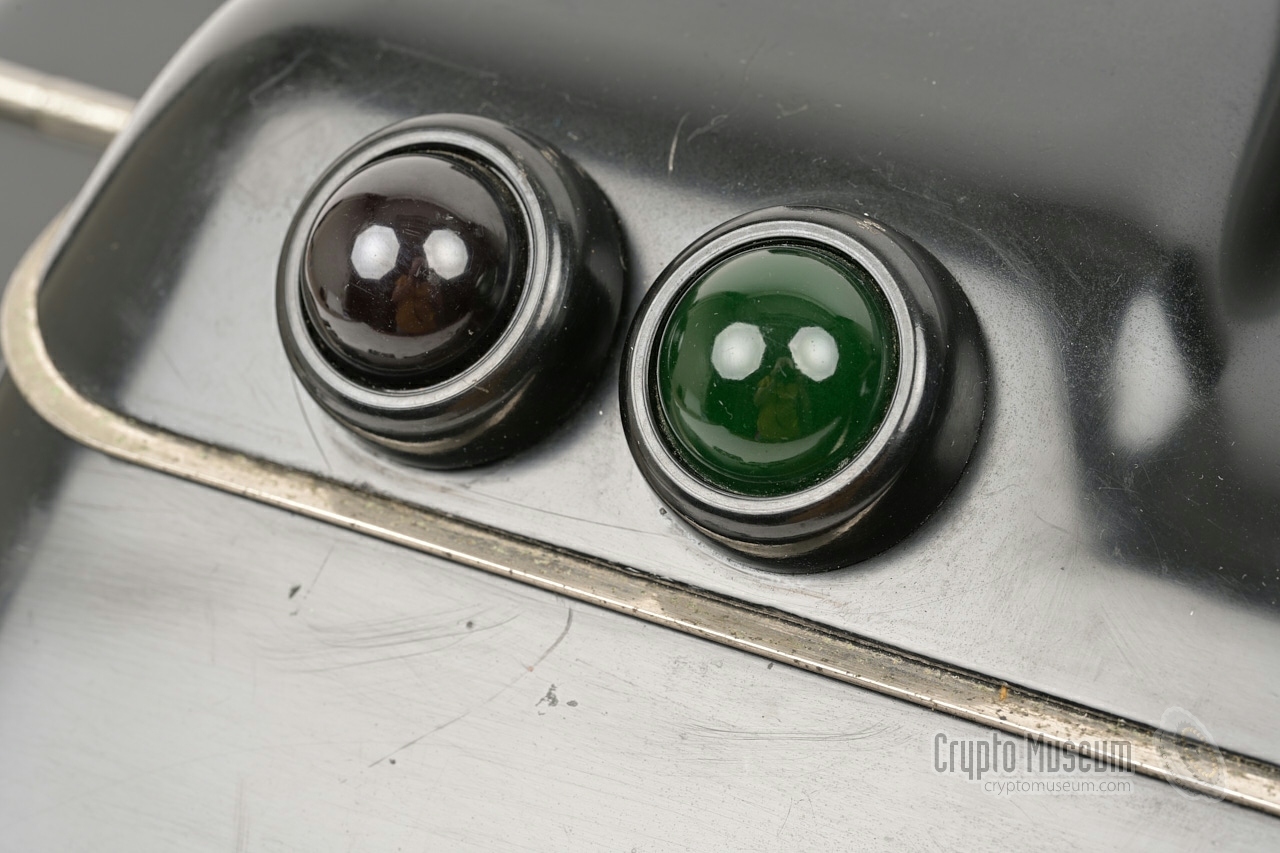
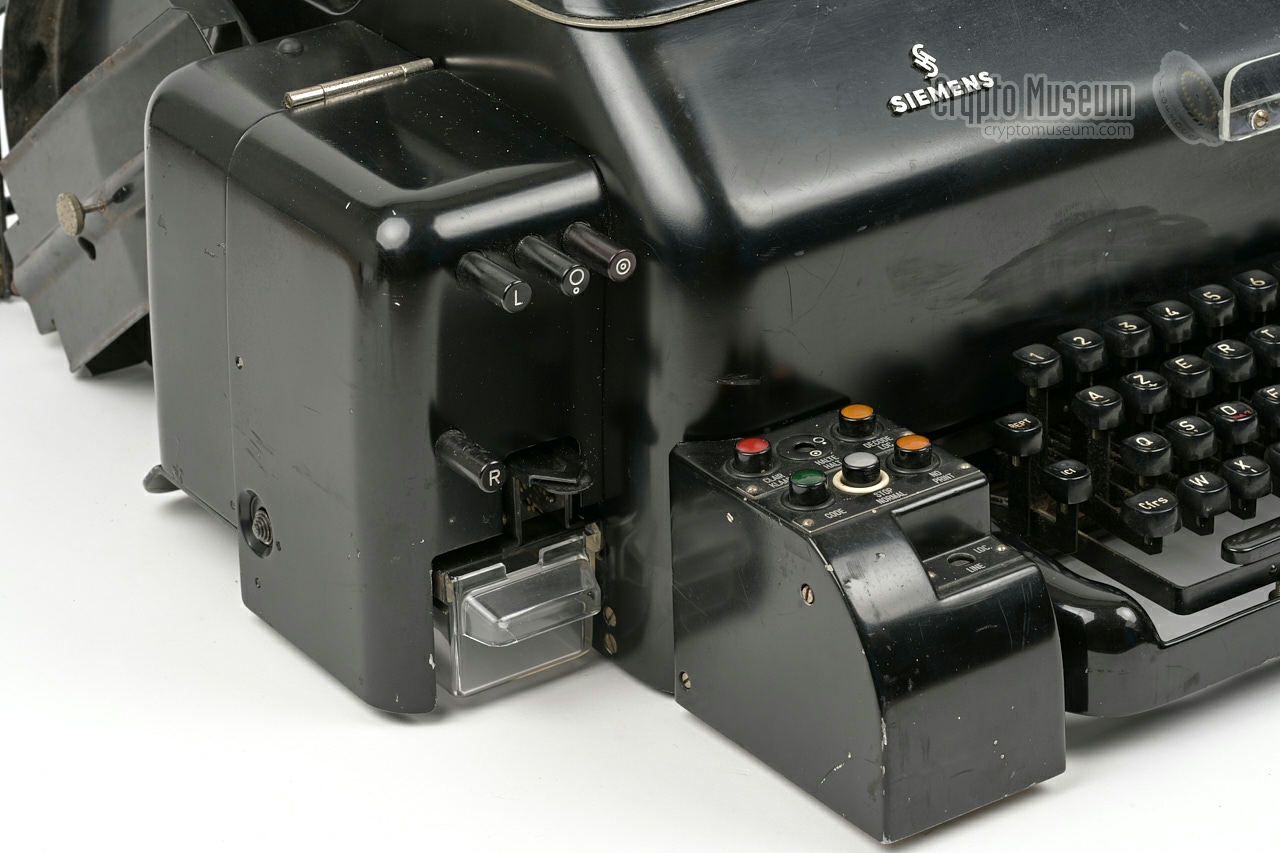
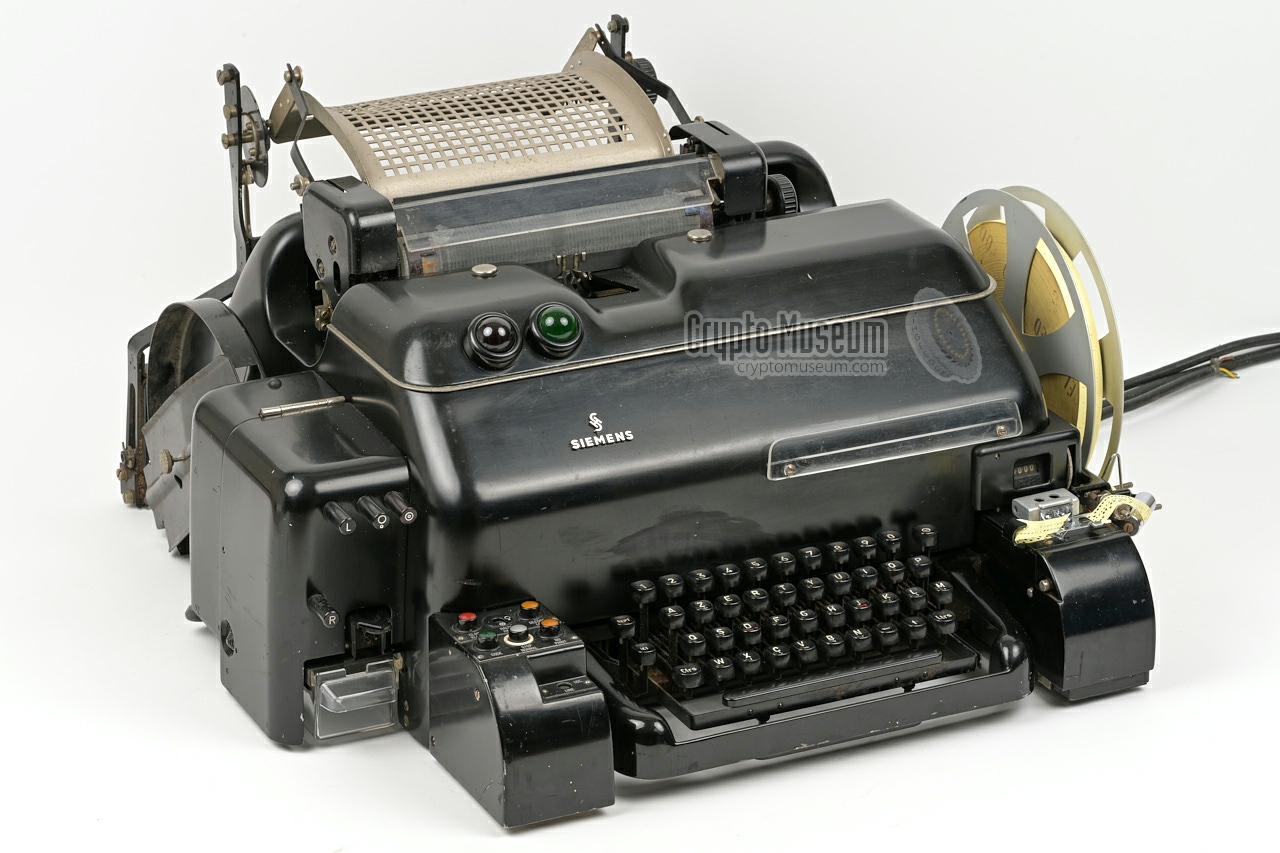
The device can be recognised by the large red and green lamps on the front
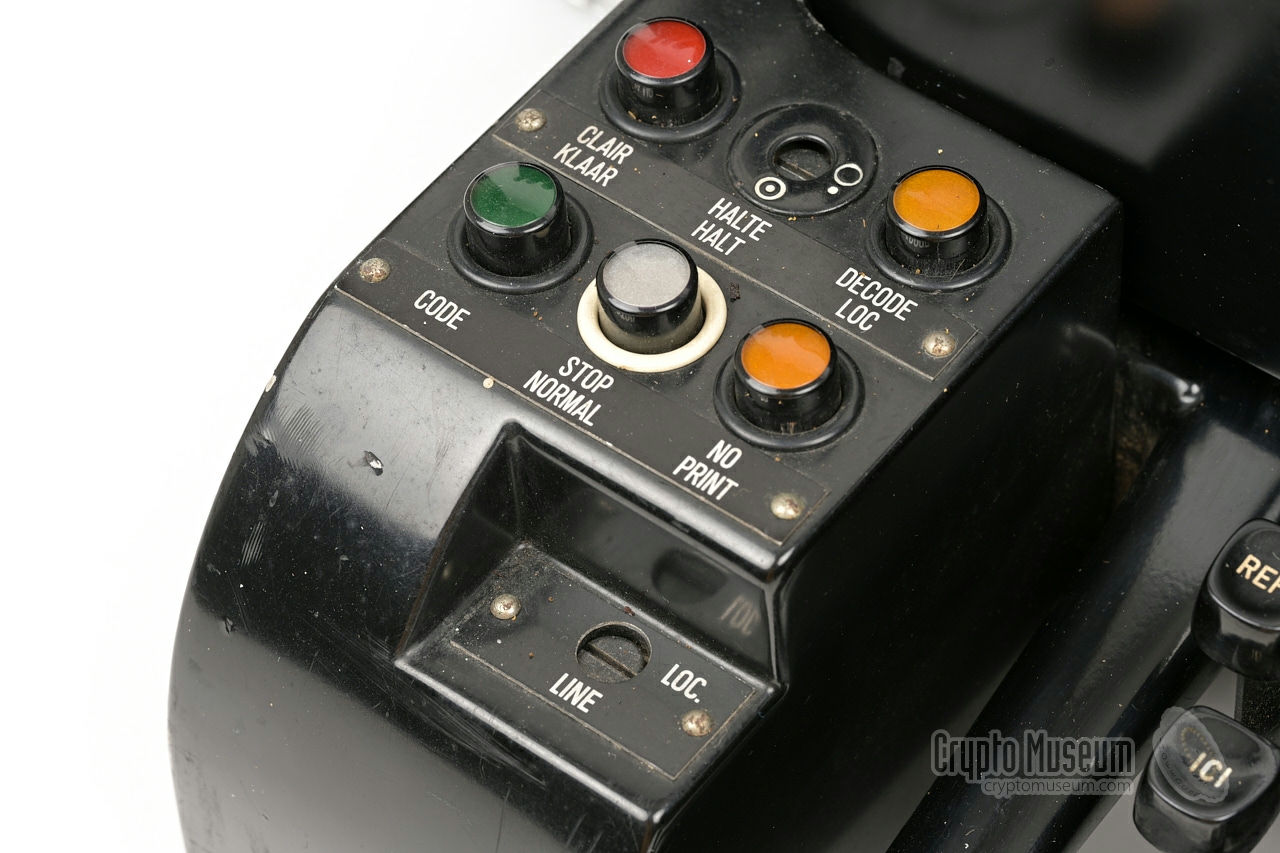
cover, just in front of the platen, and an extra control panel to the left
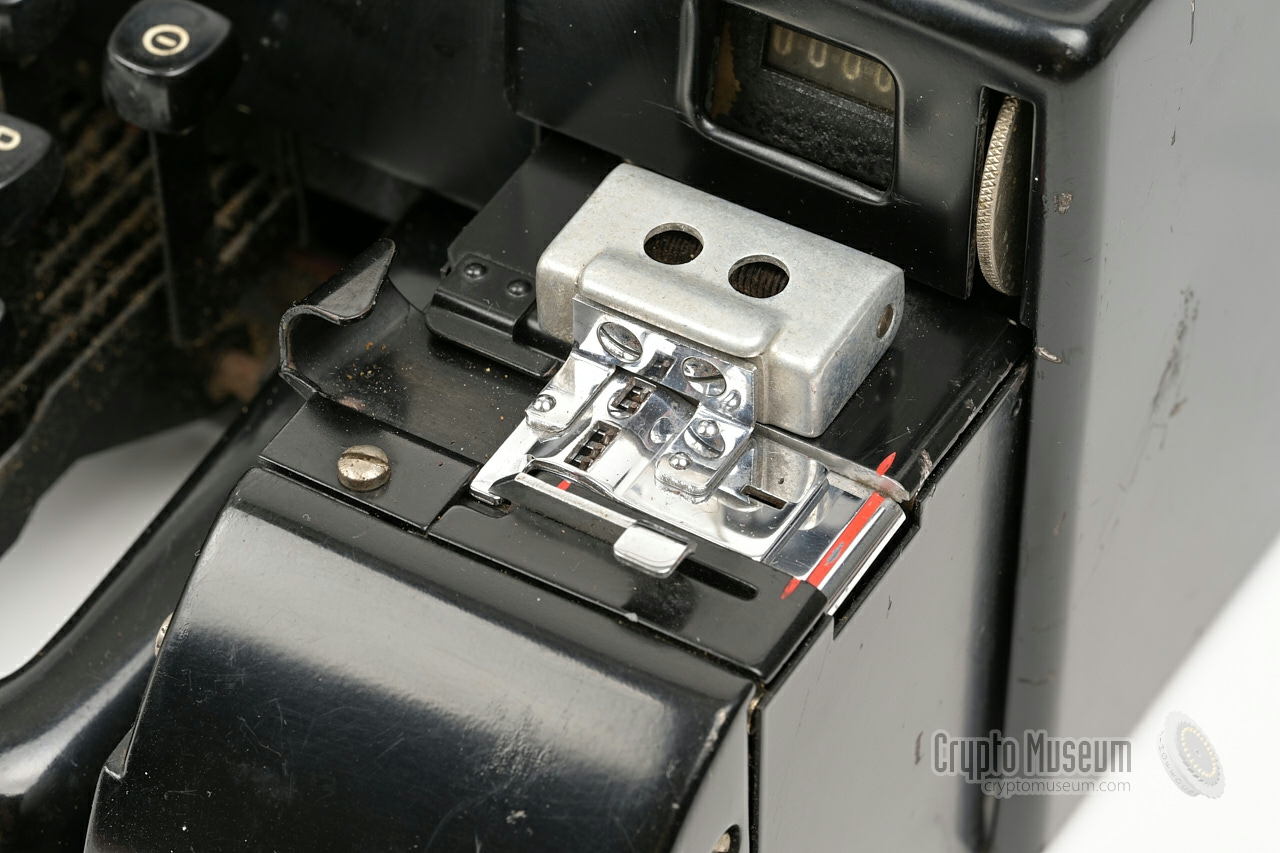
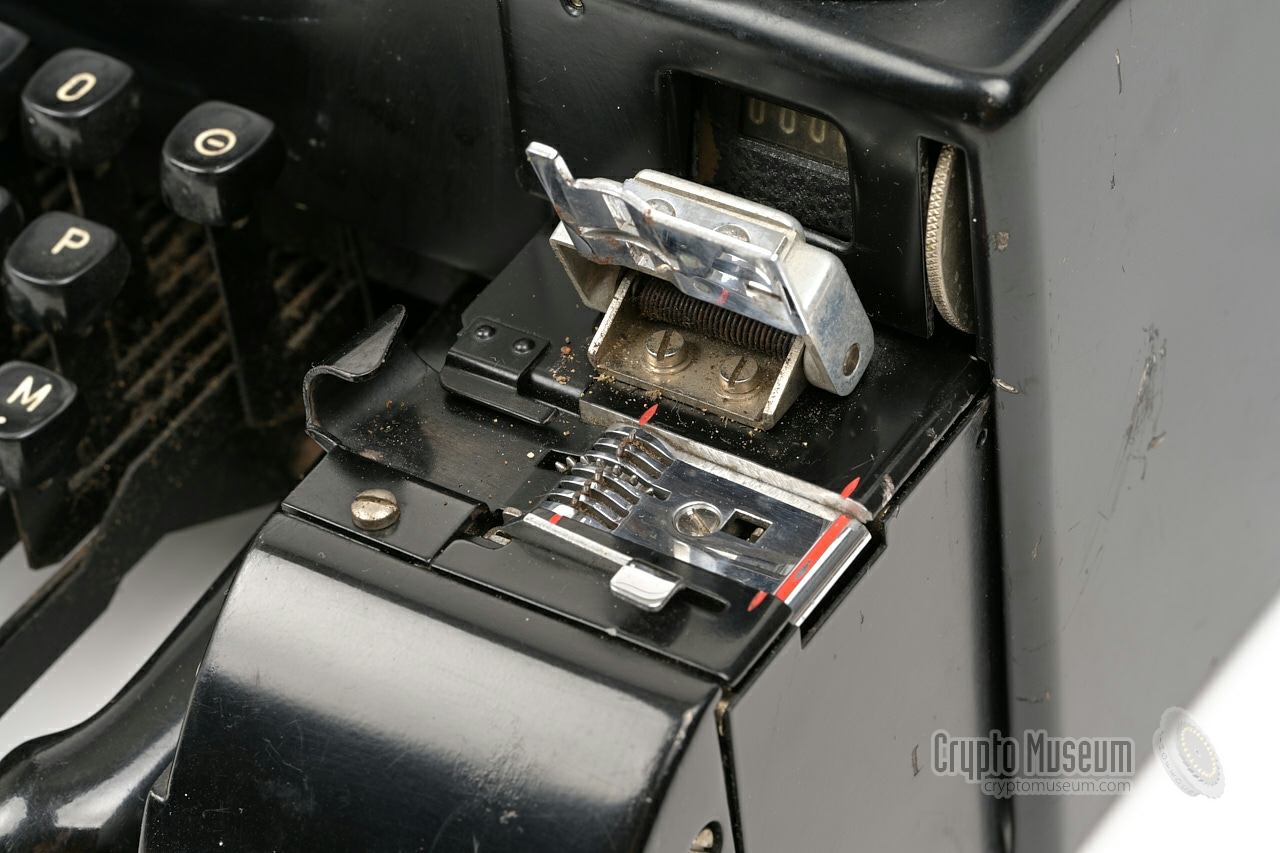
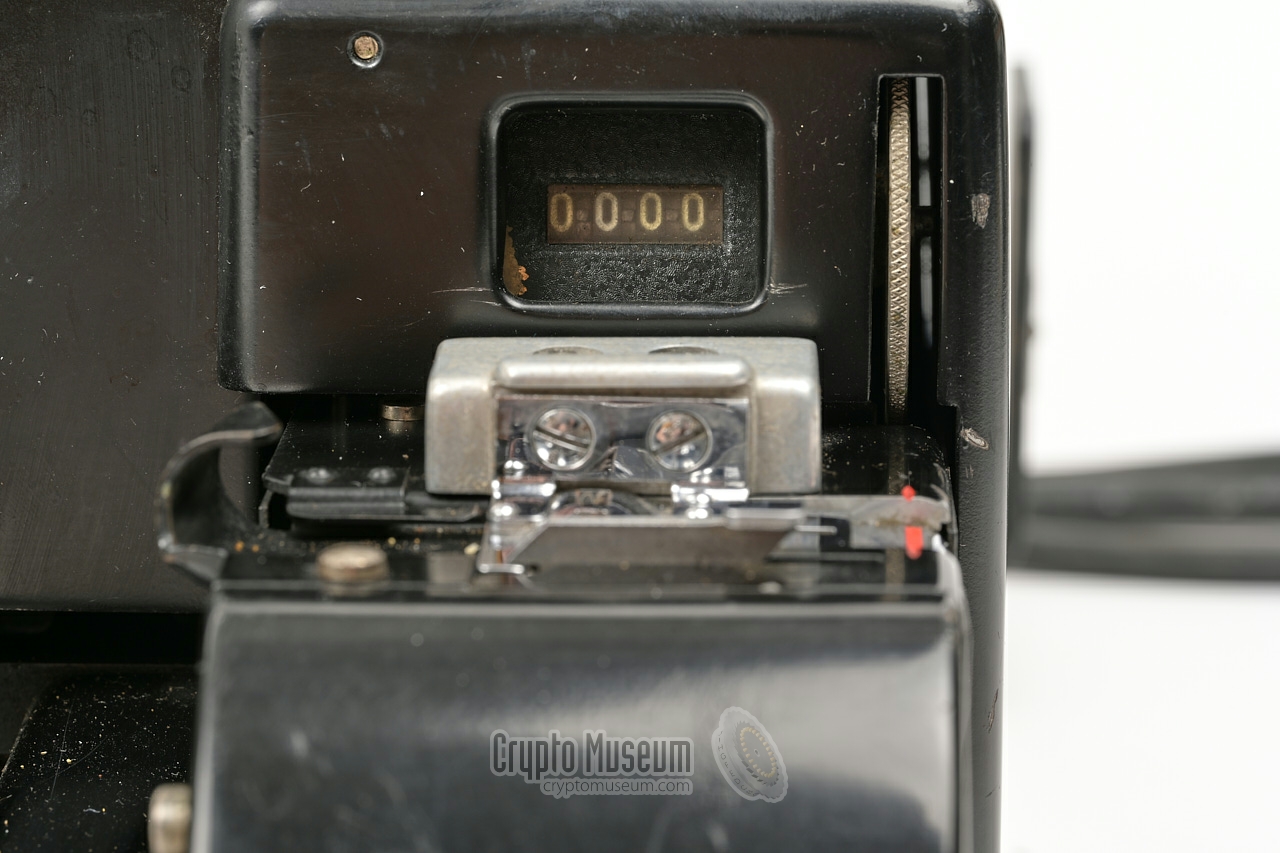
of the keyboard. The device had an internal tape puncher (at the left)
and a tape reader (at the right). The latter was used for entering
plaintext messages instead of via the keyboard.
The T-37i uses the principle of the co-called Vernam Cipher.
It had to be used in combination with an external
T.send.61 tape reader (T-61)
that held the random keytape. It was connected to one of the three
fixed cables of the T-37i.
|
|
|
The T-37i CA was introduced in 1956, and was approved for use by NATO
at all levels of confidentiality in 1960 [5].
In 1965 TEMPEST problems were encountered. Measurements had shown that
information could leak out via the power line, allowing an adversary
to reconstruct (part of) the plaintext. After adding a power line filter [6] the device was re-approved for NATO-use [7].
In 1957, the T-37i CA was succeeded by the external
Schlüsselgerät D (cipher machine D), which could be used in
combination with any ITA-2 compatible
teletypewriter.
Nevertheless, the T-37i CA was kept in production for many years,
and remained in service well beyond 1980.
|
-
The letters 'CA' stand for Cryptographic Application and are not
printed on the ID plate.
-
T-37h SZ, also written as T-37/HSZ, is (nearly) identical to the
T-37/ICA. The letters 'SZ' stand for Schlüssel-Zusatz (Cryptographic
Extension). The service documentation for the T-37/HSZ is also applicable
to the T-37/ICA [I].
|
The image below provides a quick overview of the features of the T-37i CA.
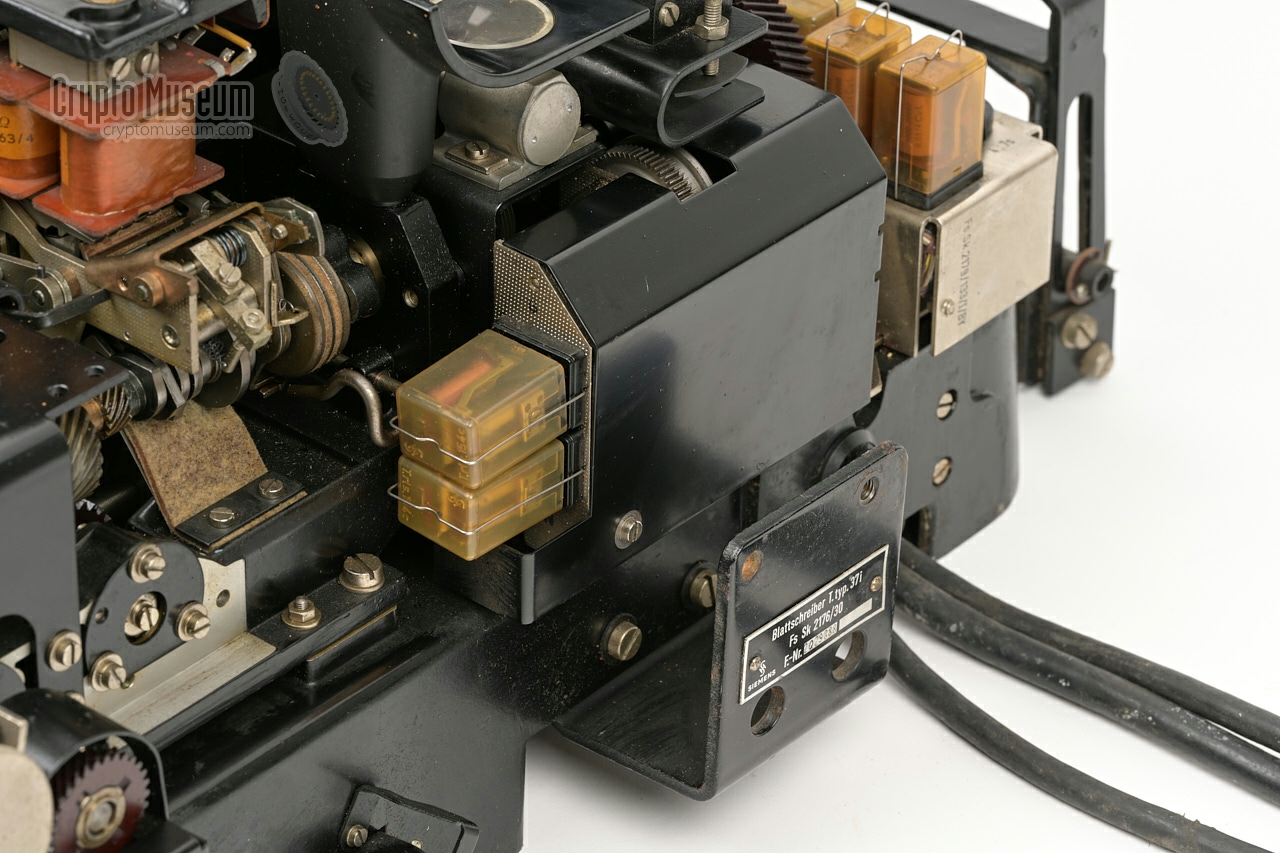
It should be noted that on its name plates, the device is identified as T37i.
The 'CA' suffix is implicit as the device has two large lamps – a red one
and a green one – on the left side of the slanted part of the hood.
Furthermore, it has an extra control panel for the cipher functions, to the
left of the keyboard.
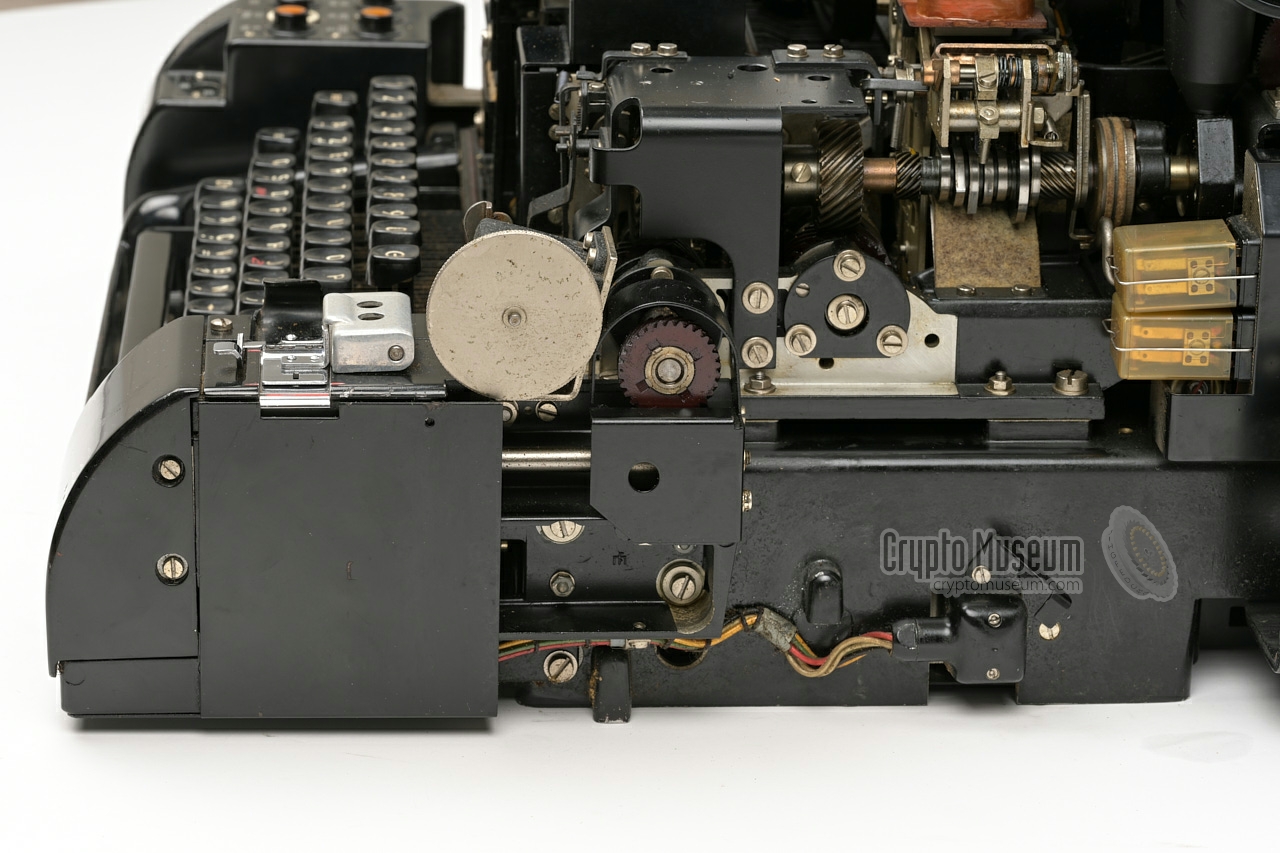
At the left side is a tape puncher, also known as a perforator, which is not
always present on a standard T-37i teleprinter.
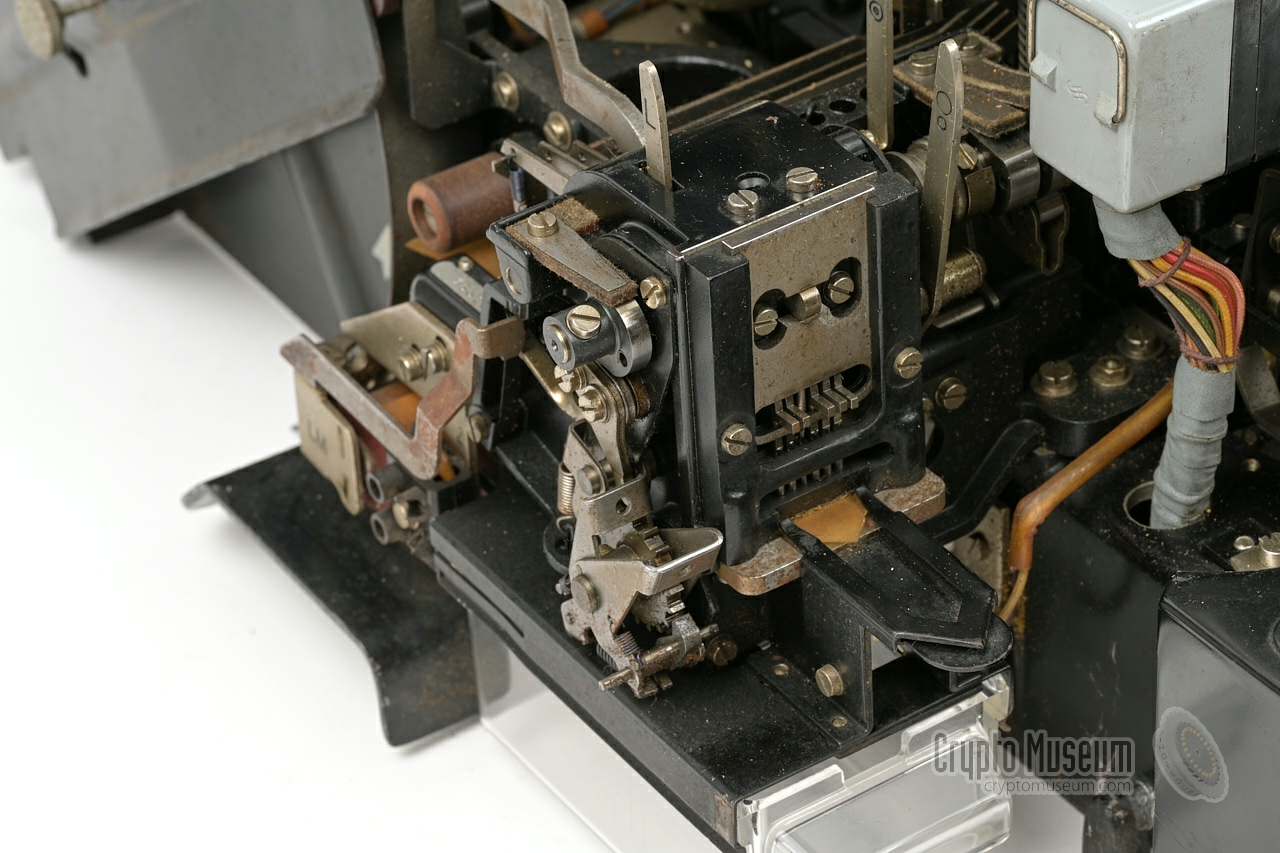
To the right of the keyboard is a tape reader that can be used for entering
plaintext, as an alternative to the keyboard. The ciphertext tape reader
— an essential part of an OTT machine — comes in the form of an external
T.send.61 that must be connected to the fixed wiring of the T-37i CA.
It is controlled from the control panel at the front left.
|
|
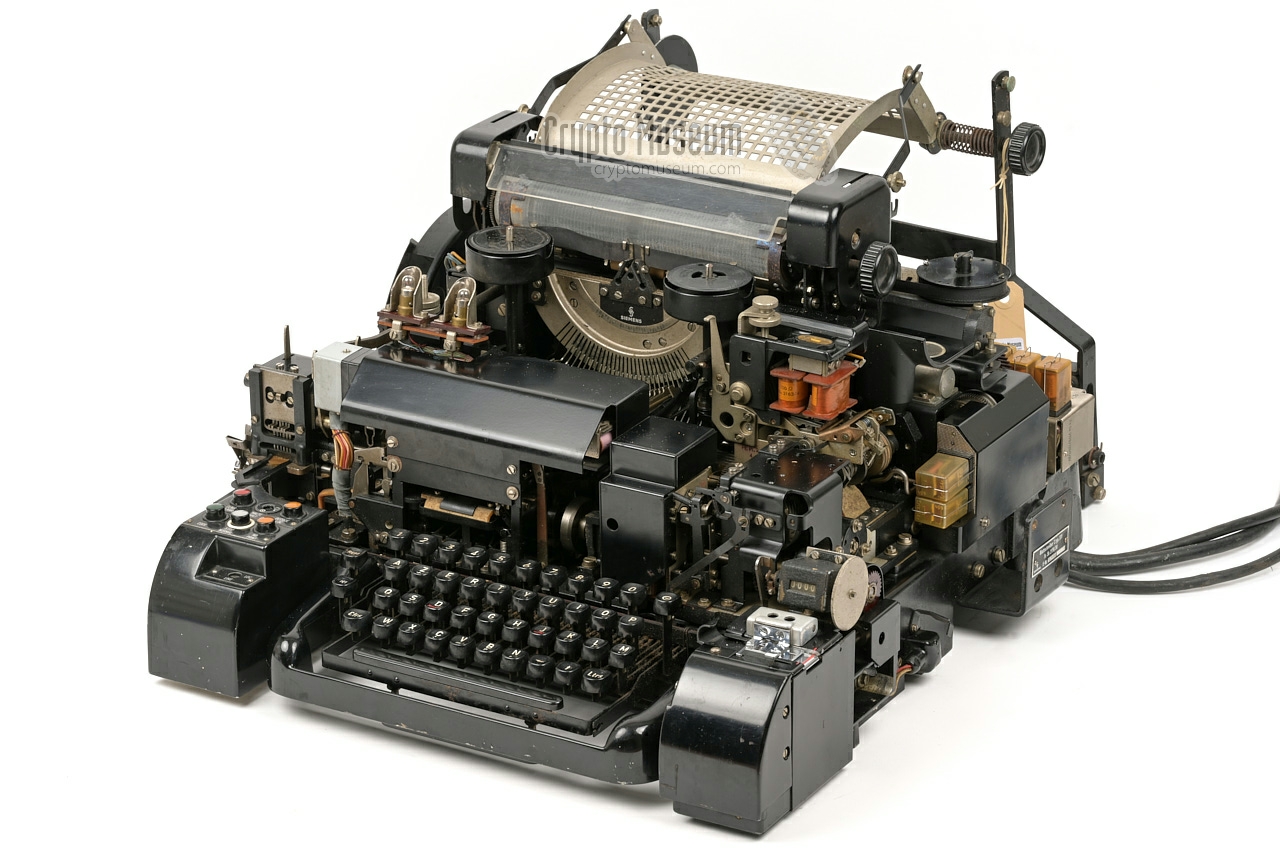
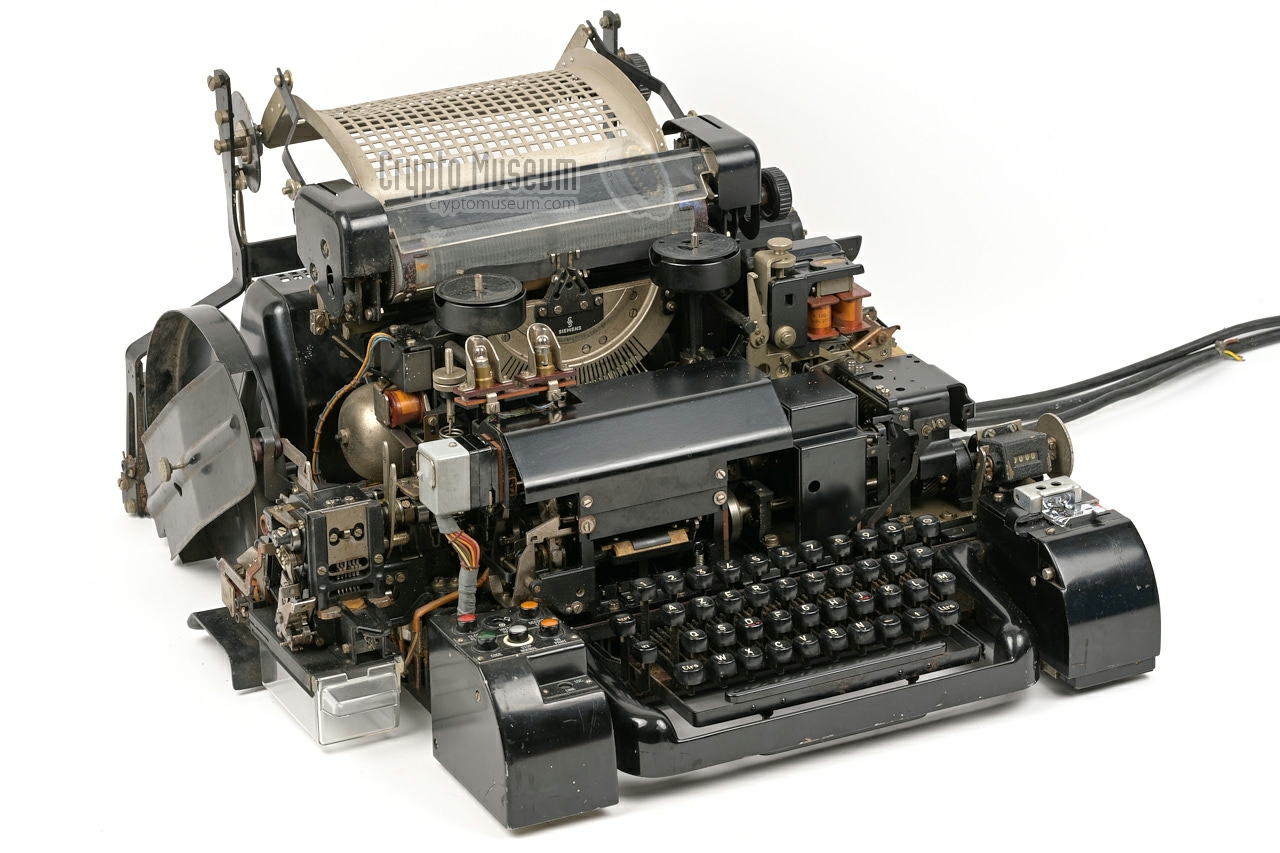
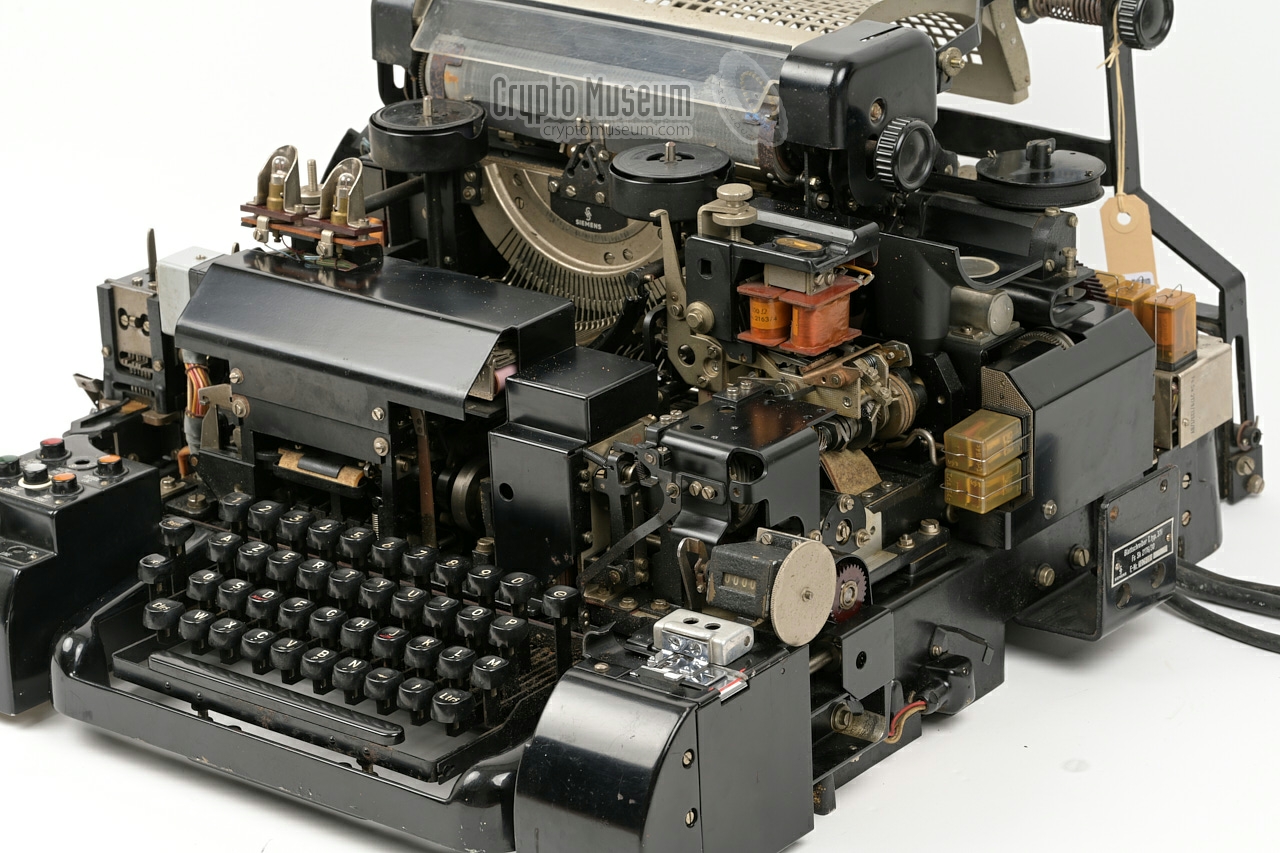
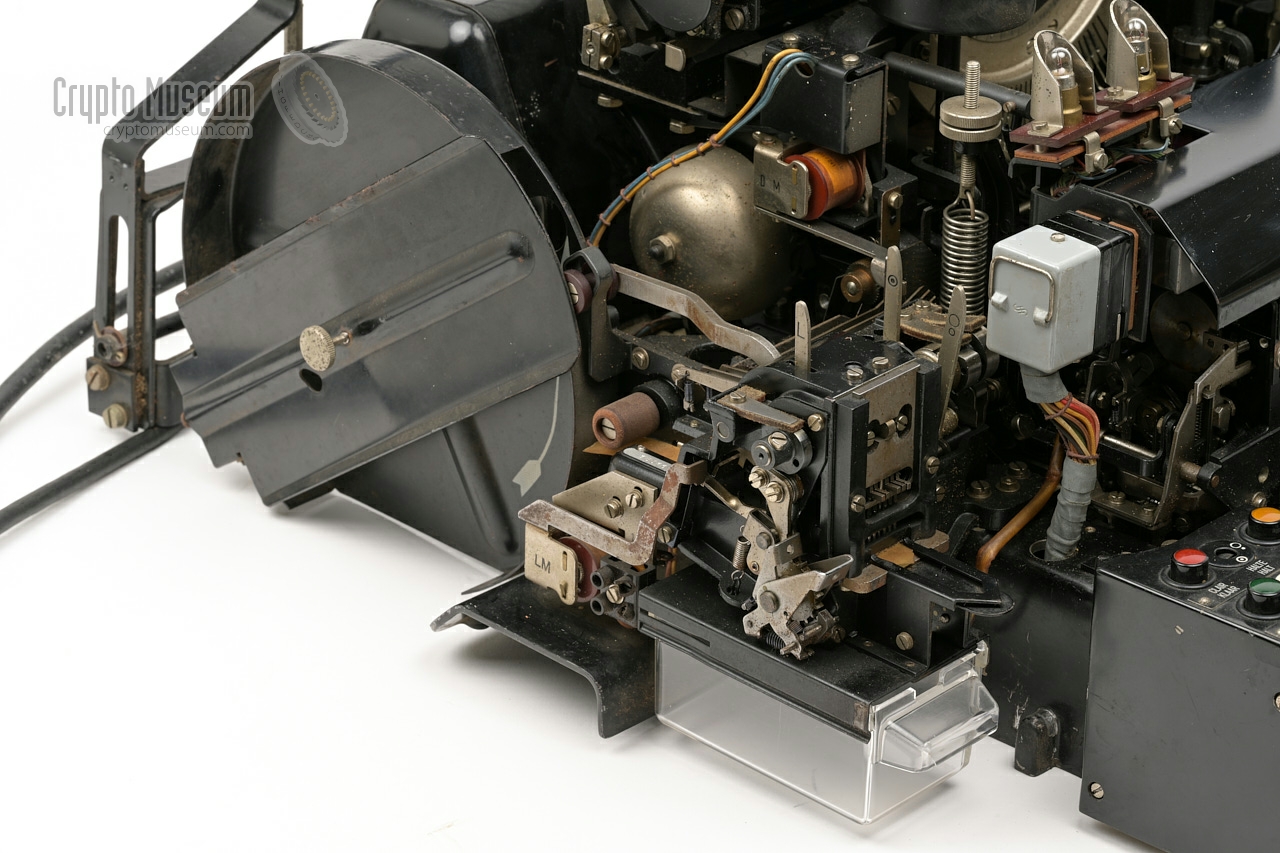
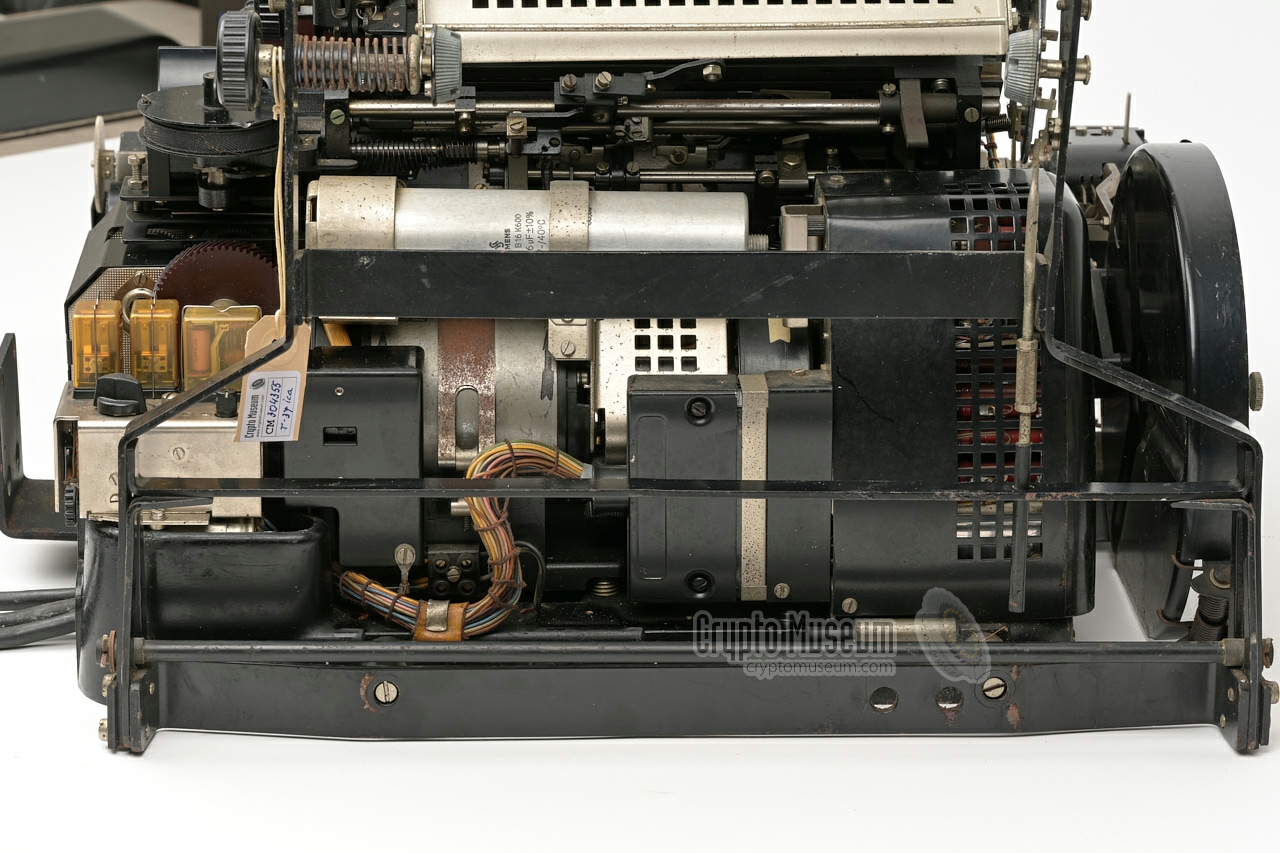
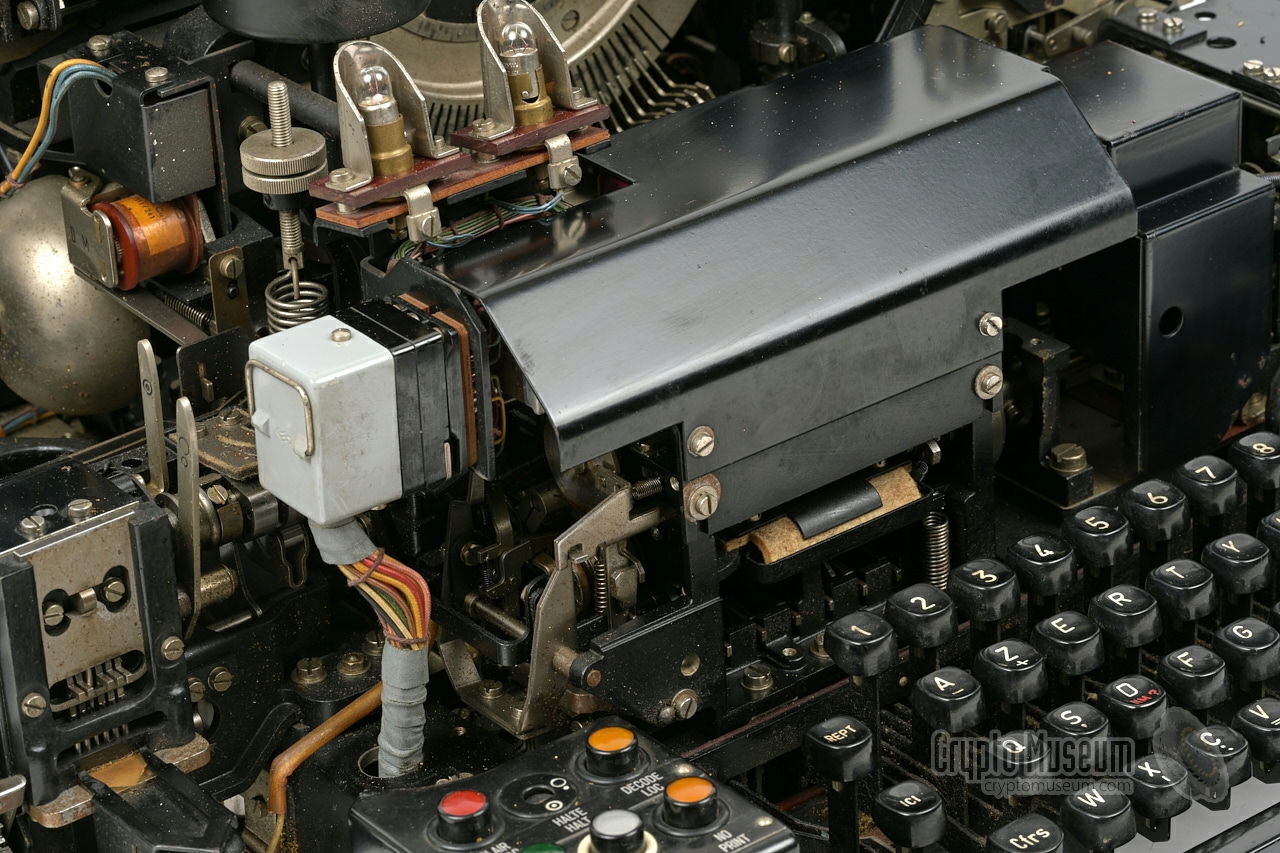
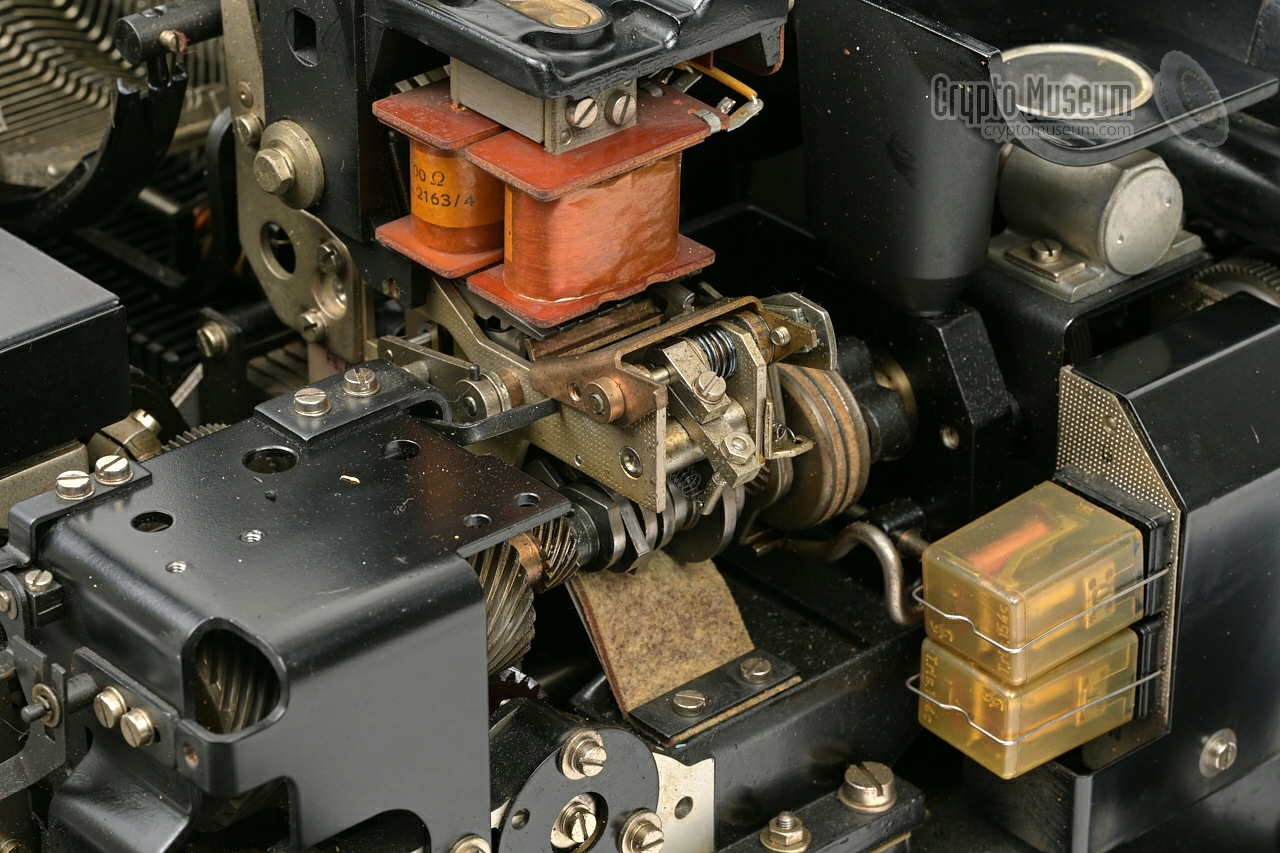
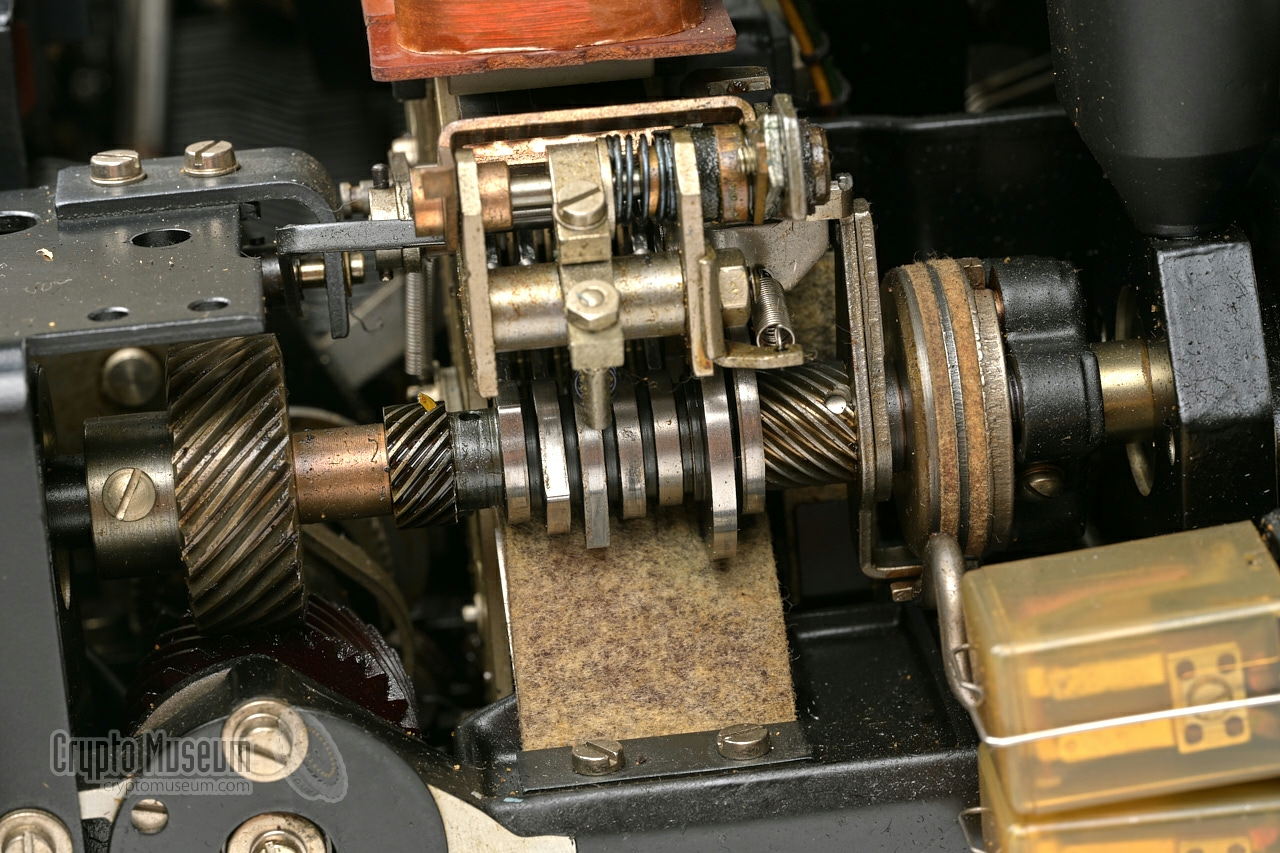
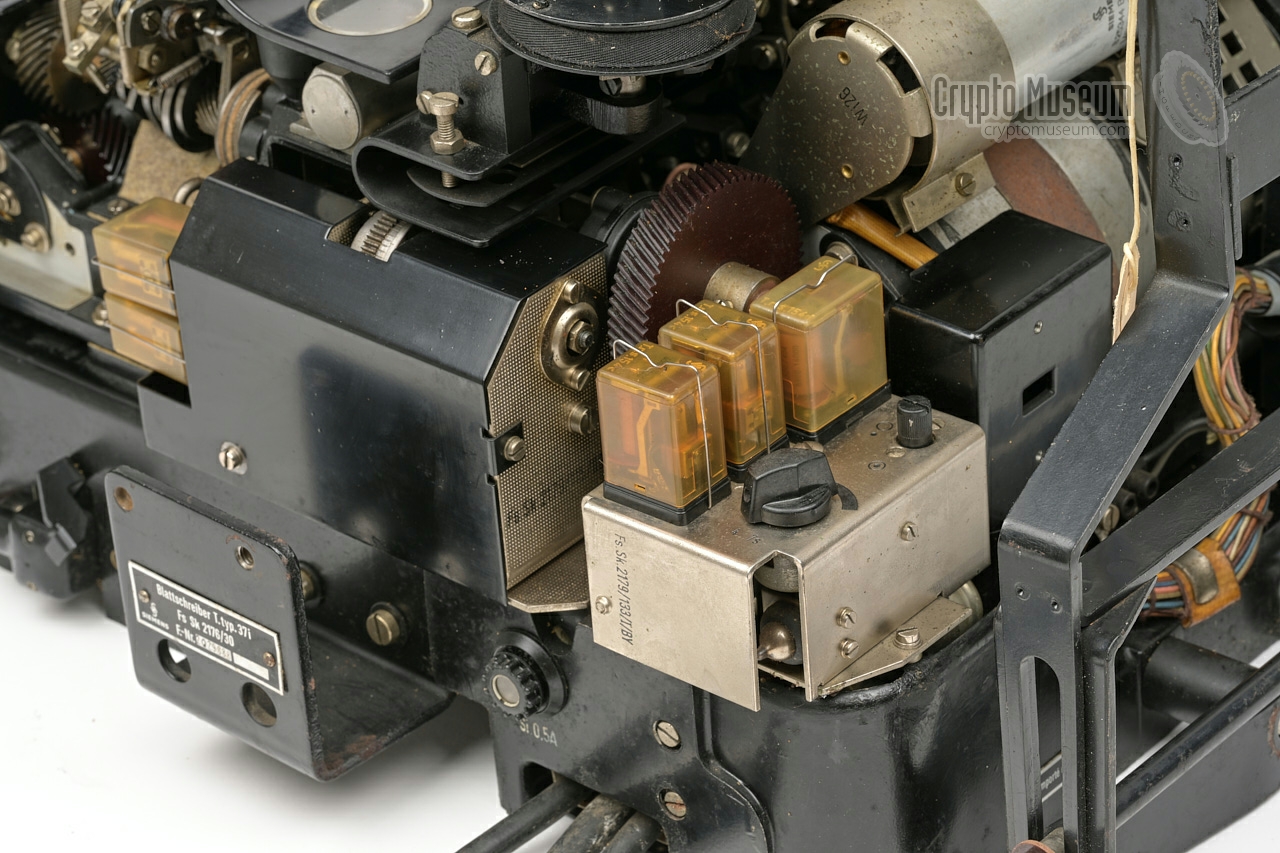
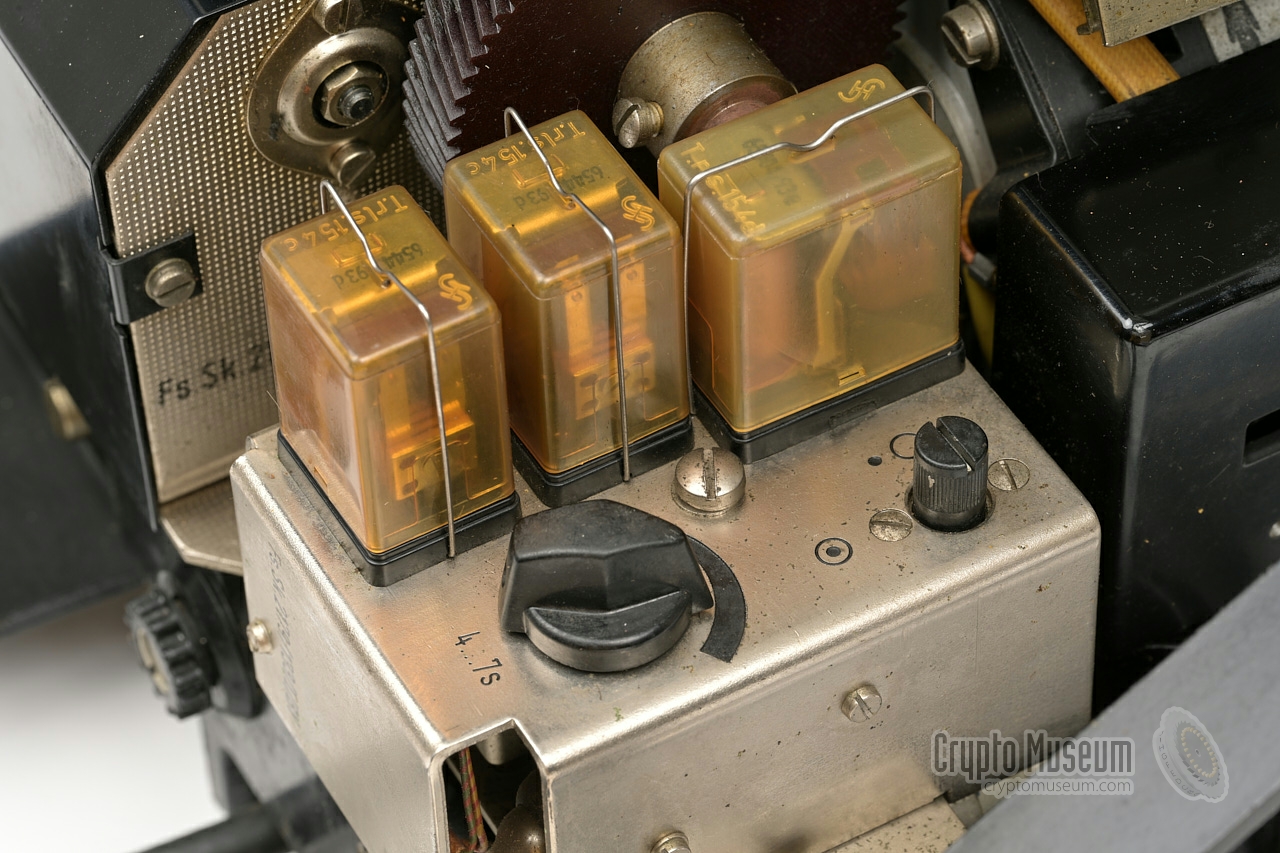
The interior of the machine can be accessed by raising the paper support
guide above the carriage and opening the tape supply port of the tape puncher
at the left, after which the black hood can be lifted from the device.
This reveals the interior as shown in the image above.
|
|
The device has not yet been restored. It came with the original T.send. 61
tape reader. Both devices are in excellent cosmetic condition,
although there certainly will be hurdles on the way, before this magnificent
piece of mechanical enginering will run again.
The following is noted:
|
- Mains and data cables old and brittle. Must be replaced.
- Telex data socket for external T.send.61 tape reader missing from cable.
- Mechanics very dry and binding (must be cleaned and oiled).
- Keyboard mechanics dry and rusty.
- Tape tension control of the reader is damaged.
|
|
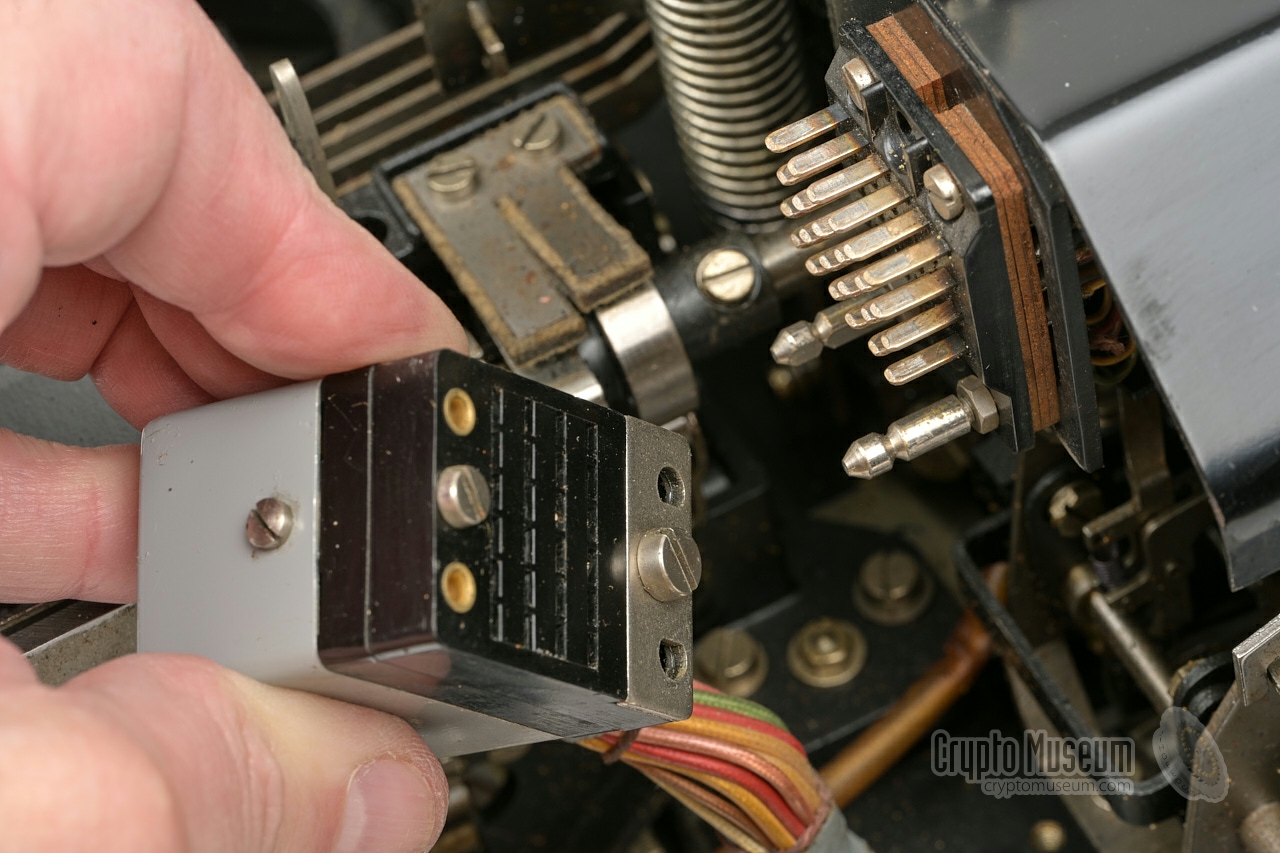
The T-37i CA has three fixed cables that are used for connection to the
outside world:
|
- Power cable for connection to the 220 V/AC mains
- Data cable for connection to ta telex subscriber line
- Data cable for connection to a T.send.61 tape reader
|
The wiring of the above cables will be specified here in due course.
|
- Afbeeldingen Verreschrijvers Type 37 en Type 34 en Ponsontvangers
Detailed pictures and drawings of T-37 and T-34 (Dutch).
PTT, 1951. 3rd print.
- Tgf 1011a, montage-, instel- en onderhoudsvoorschrift T typ 37 g t/m i
Installation, alignment and maintenance manual (Dutch).
PTT, November 1956, Issue 1.
- Tfg 1011b, Afbeeldingen
Pictures, belonging to Tgf 1011a (Dutch).
PTT, November 1956, Issue 1. 1
- Tgf 1024a, Beschrijving bladschrijver T typ 37 a t/m i
Description of T-37a thru i teleprinters (Dutch).
PTT, August 1959. Issue 2. CM303981.
- Tgf 1024b, Afbeeldingen
Pictures, belonging to Tgf 1024a. (Dutch).
PTT, August 1959. Issue 2. CM303981.
- De Verreschrijvers T-37/LP, T-68/LP
Description and operating instructions for the Siemens T-37 and T-68 (Dutch).
Belgian Army. March 1967.
- Afregelvoorschrift voor den Verreschrijver en den Reperforator Fabr. S. & H.
TLX 23. Alignment procedure for the Siemens T-37 (Dutch). A5 size.
CM303970. To be used with item (F) CM303971.
- Afbeeldingen van den Verreschrijver en den Reperforator Fabr. S. & H.
TLX 70. Images of the Siemens T-37 (Dutch). A4 size.
CM303971. To be used with item (F) CM303970.
- Blattschreiber T typ 37 h mit Schlüsselzusatz - Manual (German)
Fs Bs 2179/80. Siemens & Halske, 23 May 1956. 2
|
 |
-
Document kindly provioded by Gert Stam [4].
-
Document from MfS
Abt XI 385 archive, obtained from BStU [3]
and kindly provided by Jörg Drobick [2].
|
- Jerry Proc and contributors, T-37 ICA Fjernskriver (Teletypewriter)
Accessed 24 january 2026.
- Jörg Drobick, Website Der SAS- und Chiffrierdienst (SCD)
Retrieved March 2016.
- Bundesbeauftragte für die Stasi-Unterlagen (BStU) 1
Federal Commissioner for the Stasi-Records.
- Gert Stam, restored Siemens T-37 with documentation — THANKS !
November 2017.
- NATO, Siemens T-37i CA (approval)
SGM-138-60. NATO, 9 March 1960.
➤ French version
- NATO, Siemens T-37i CA (power line filter)
SGM-111-65. NATO, 23 March 1965.
- NATO, Siemens T37i CA (re-approval)
SGLP 231/65, NATO, 30 March 1965.
|
-
Full name: Bundesbeauftragte für die Unterlagen des Staatssicherheitsdienstes
der ehemaligen Deutschen Demokratischen Republik
(DDR) —
Federal Commissioner for the Records of the
State Security Service
of the former German Democratic Republic (GDR) —
officially abbreviated BStU.
|
|
|
|
Any links shown in red are currently unavailable.
If you like the information on this website, why not make a donation?
© Crypto Museum. Created: Saturday 24 January 2026. Last changed: Monday, 24 August 2026 - 07:10 CET.
|
|

|
|
|