|
|
|
|
|

|
|
OTP
One-time tape cipher machines · mixers
One-Time Tape, abbreviated OTT, is a general expression for
teleprinter cipher machines that are based on the principle of
the One-Time Pad (OTP), where the key stream is
distributed on perforated paper tape, rather than printed on paper as a pad.
The system can be regarded as a digital implementation of the OTP.
When correctly applied, a message encrypted with an OTT is unbreakable,
although in practice some OTT cipher machines exhibited
TEMPEST problems.
|
Most (but not all) OTT cipher machines use a 5-bit digital code such
as the ITA-2 standard (Baudot) or MTK-2.
Random characters (e.g. from a noise generator) are recorded onto perforated
tape, which is then used as the KEY. Only one duplicate of this
KEY is made, so that both sides of a communication line have an
identical KEY.
The KEY tape is then combined, character-by-character, with the
plaintext by means of a XOR-operations (modulo-2 addition).
The combining XOR function was patented by
Gilbert Vernam in 1918,
and is known as the Vernam Cipher.
|
|
|
The advantage of adding the KEY to the plaintext by means of an
XOR-operation in order to obtain the ciphertext,
is that the same KEY can be be XOR-ed with the ciphertext
in order to obtain the original plaintext. This makes the cipher
symmetrical. Bell Labs engineer Claude Shannon
proved during WWII that, when correctly implemented,
the Vernam-based OTT is unbreakable.
The above process is also known as mixing, which is why OTT
cipher machines are also known as mixers. A good example of a mixer
is the Norwegian ETCRRM, which was used
from 1963 onward on the
Washington-Moscow teleprinter hotline.
It was replaced in 1980 by the Siemens M-190.
It should be noted that an unkeyed OTT cipher machine
is usually an unclassified device.
As soon as it is loaded with a KEY tape — i.e. it is keyed —
it is classified to the level of the KEY tape.
The use of an OTT cipher system is 100% secure when all
of the following conditions are met:
|
Please note that not all items above are selectable.
This is the case if no further information is currently available.
|
UNCLASSIFIED —
It is a common misunderstanding that mixers, like most other cipher machines, are
classified items. This is not the case. The operating principle of a mixer
– a bitwise XOR-operation – is not secret at all.
It is a common mathematical modulo-2 addition.
Consequently, most mixer machines were unclassified, although
their circuit diagrams and user manuals may have been restricted at the time.
With machines of this class, it is the keytape that protects the
secret. A machine loaded with a keytape, is classified to the level of the
keytape.
OTT uses properties of digital telegraphy, also known as Telex,
Teletype, 1 Teleprinter or Teletypewriter.
Messages can be stored on perforated tape,
where the holes of each column represent a character. A column was usually 5 holes
high, but other data formats were also used. The most common formats,
like ITA-2 and MTK-2, use 5 holes or channels.
In modern terminology, these holes would be called bits (0 or 1).
A '1' represents a hole and a '0' is the absence of a hole.
The channels or units of a perforated tape are usually numbered 1-5,
from top to bottom, as shown in the diagram above. In modern terminology these
channels would be numbered as digital bits in the order 0-4. In the example
above, the perforated tape moves through a reader from right to left,
whilst the holes are sampled vertically, one character at a time. This means
that the tape is read from left to right. The smaller holes in the third row
are the sprocket holes. They are used for transport of the tape.
Sometimes they also provided the clock signal for the reader.
In the diagrams below, the principle of the Vernam Cipher
is explained by using a message stored on a perforated paper tape.
Suppose we want to transmit the word HELLO which is stored on the
plaintext tape at the left.
We also have a pre-recorded key tape, with a series of random
characters; in this case the sequence AXHJB .
The contents of the plaintext tape are now XOR-ed with the
contents of the key tape.
The result (KMIVE ) is shown here as the ciphertext tape:
|
| |
Mixing the plaintext with the key
|
Now let us see what happens if we repeat this operation on the
resulting ciphertext tape with the letters 'KMIVE '.
In the illustration below,
the ciphertext tape is on the left. It is XOR-ed with a copy of the
original key tape (AXHJB ), which results in the original
plaintext: 'HELLO '.
|
| |
Mixing the ciphertext with the key
|
This process of applying the XOR-operation to text and key
is often called mixing, and the cipher machines that use the
Vernam principle, are therefore known as mixers.
In the days when teleprinters were in widespread use,
technicians were often so experienced that they could read a text directly from
a paper tape, simply by looking at the holes and reading the bit patterns.
|
| |
Visually mixing of the ciphertext with the key
|
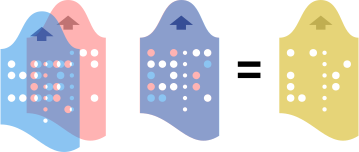
Maintenance engineers were able to do the same with the tapes of OTT cipher machines.
By taking a ciphertext tape, overlaying it with a keytape and holding it
against a bright light source, they were often able to 'read' the plaintext
directly. This is illustrated in the drawing above, in which each half-transparent
hole (either red or bue) should be interpreted as as a binary '1'. The same can
be done when combining the ciphertext tape with the keytape, as shown below.
|
| |
Visially mixing the plaintext with the key
|
|
 |
-
Although 'Teletype' is actually a brand name of the
Teletype Corporation,
it has become a generic expression for
digital 5-bit telegraphy.
Even in modern computer operating systems, a terminal connected to
the serial port is known as a 'TTY', which is short for TeleTYpe.
|
Many companies and countries claim the invention of the
one-time tape cipher machine. The accounts differ per country.
Although the Philips Ecolex was definitely not the
first machine in this class, its inventor
was payed for his patents for many years.
STK (now: Thales)
claims that it was a Norwegian invention, but their patent of 1952 1
is predated by a Siemens patent of 1921 [3].
Furthermore, the Siemens T-43,
the British 5-UCO
and the British-Canadian Rockex,
were all developed and built during WWII, in 1943, well before the machines
mentioned above. So, who is the actual inventor and who built the first
OTT machine? To answer this question, we must first look
at the definition of a one-time tape cipher machine.
It basically consists of two parts:
|
The mixer was invented in 1918 by Gilbert Vernam in the US, whilst working at
Bell Telephone Laboratories (BTL). In US Patent 1,310,719
he describes a cipher system in which a plaintext
character is mixed with a character from a keytape, although he does not
claim that the keytape has (at least) the same length as the plaintext
message and that it contains fully random characters.
According the NSA, Vernam's invention is perhaps the most important one
in the history of cryptography [5].
His principle of the mixer (XOR, modulo-2) became known as
the Vernam Cipher.
➤ More about the Vernam Cipher
The One-Time Pad (OTP), on which the OTT is based, was first
described in 1882 by US banker Frank Miller [6][7].
It was reportedly re-invented in 1917 by Joseph Mauborgne [1],
but we are unable to put an exact
date on it. The closest timeframe can be found in David Kahn's book
The Codebreakers [8 p.6], in which he dates the
re-invention to 'during World War I' (1914-1918), when Mauborgne was
Chief Signal Officer of the Signal Corps Engineering and Research Division
of the US Army.
So, it is entirely possible that this happened in 1917.
➤ More about the one-time pad
Shortly after Vernam's invention of the mixer,
Joseph Mauborgne recognised that if the keytape would contain fully
random characters, the cipher would be unbreakable [8 p.397-388].
We may therefore assume that the OTT was
invented by Vernam and Mauborgne in late 1918.
Nevertheless, the first cipher machine that used the
Vernam Cipher — the Telekrypton of 1926 —
did not use a one-time random keytape. Instead it used two looped tapes
of a different (finite) length [8 p.397].
This means that Telekrypton was not the first
OTT cipher machine, and that therefore, based on the currently available
information, the Russian M-100 from 1938,
should be recognised as the first OTT cipher machine that was produced in
quantity.
|
|
-
Although this patent is frequenty mentioned in literature, for example
in [2], we have not been able to find it. If anyone has access to this
patent, please contact us.
|
When creating keytapes, it is of the utmost importance that the tape
contains uniformly distributed random characters, with no bias or repetition.
This means that they keytape may not contain a random text in a particular
language, as that would make the cipher solvable. The best random tapes were
created with a white noise source, such as radioactive decay or
thermal noise generated by a diode. In all cases, test equipment had
to be present to continuously check the randomness of the generated data,
and raise an alarm if was no longer within reasonable boundaries.
In practice however, several manufacturers of keytape generators used
mechanical methods for creating a pseudo-random key sequence.
Manufacturer Hell, for example, used five looped
perforated tape strings of different length, in order to generate a key with
a long cipher period. Although the tape strings themselves contained data with
a uniform distribution, the repetitive nature of the keystream made it
deterministic and therefore solvable.
Even when a real noise source was used, the situation was often not ideal.
During the latter part of World War II (WWII) and the beginning
of the Cold War, keytapes for the British OTT
machines — 5-UCO, Rockex and WIM —
were generated in a central facility. At some point, engineers noticed that the
random keystream had a slight bias. This was thought to be acceptable for
Rockex, but was totally unacceptable for the top-level
5-UCO that was used by the high-command [9].
|
Various machines were developed for the production of OTT key tapes.
Some machines used mechanical methods to create a pseudo-random key
stream, whilst others produced truly random characters generated
by a white noise source.
In most cases, the devices had purpose-built tape punchers that
were able to punch two key tapes simultaneously, to ensure that
they were identical. Most generators also had devices that could
check the randomness of the key stream.
➤ List of keytape generators
|
|
|
A major problem with the use of OTT systems, is the distribution of the
key tapes. As each tape can only be used once, and must be at least as long
as the message itself, an enourmous stock of fresh tapes is required,
especially on busy military circuits far away from the homeland.
For diplomatic use (embassies, etc.), large quantities of tapes had to be
shipped by diplomatic bag. Although such shipments are protected under
international law, there is always a risk of interception and tampering,
especially in high-risk or hostile countries.
|
|
|
One of the conditions for proper use of an OTT system,
is that the keytapes are destroyed immediately after use. This is done
to prevent reconstruction of the plaintext by a malicious party
from (partly) recovered keytapes.
To ensure that the keytape could not be used again,
some OTT cipher machines had a built-in knife that
cut the keytape in half upon leaving the tape reader.
For proper security however,
the tapes had to be destroyed completely, e.g. with a special device,
such as the KD-100 shown in the image on the right.
It produces paper powder.
➤ More information
|
|
|
|
From 1946, the Dutch state-owned PTT 1 developed its own range of
mixers, based on the principle described above. As PTT didn't have
sufficient production capacity, the machines were manufactured by
Philips Usfa in Eindhoven (Netherlands).
The first machine to be released in 1946 was the relay-based
Colex, followed by the valve-based
Ecolex I in 1950.
In 1955, the Ecolex I was succeeded by the transistorised
Ecolex II, which was also adopted by NATO.
After that, Philips Usfa took over
the development of cipher machines, resulting in 1963 in the
Ecolex IV that featured full synchronisation.
According to a former company director, Philips payed royalties
to Professor Dr. Ir. Oberman, the initial
developer at the Dutch PTT Research Labs,
for the use of his patents [10].
The Ecolex IV was the last mixer
developed in the Netherlands.
|
|
In 1952, a similar patent was filed 2 by Bjørn Røhrholdt – a Colonel,
engineer, veteran and liason of the Norwegian Army – and Kåre Meisingset
of STK in Norway [2].
The collaboration of the two engineers resulted in the
development of the ETCRRM,
a mixer machine that used valves (tubes) rather than electric relays.
The machine was soon adopted by the Americans
for communication at the highest level and later also by the newly
established NATO.
At height of the Cold War,
the ETCRRM was used at
the heart of the Hot line between Washington and Moscow.
|
-
PTT = Staatsbedrijf der Posterijen Telegrafie en Telefonie.
(state company for post, telegraphy and telephony). Privatized in 1989
and currently known as KPN.
-
So far, we've been unable to find this patent.
|
Even when the regular conditions for use of a one-time pad (OTP)
are met, there is still a risk of losing intelligence when the equipment
emanates compromising signals. In modern terminology this is known as
side channel leakage. Within NATO the phenomenon is known as
TEMPEST. There are various types of compromising emanations, such as
acoustic, optical, electrical and via RF energy (radio). The effect was
first discovered at Bell Labs during WWII in 1943. It was
discovered that teleprinters could cause glitches (spikes) that could be
picked up at a considerable distance.
The first problems with OTT cipher machines (mixers) were discovered
in the late 1950s and early 1960s. It prompted the manufacturers to add
shielding and filtering to the design. In some cases, multiple measures
had to be taken to avoid potentional leakage of intelligence-bearing signals.
➤ More about TEMPEST
|
The main problem with OTT machines, is the
key distribution.
Outstations had to have a large stock of fresh keytapes,
which often led to serious supply problems, especially on busy circuits.
Although for diplomatic and high-grade military traffic, secrecy is
of the utmost importance, the distribution issue became a major burden.
It was the main reason for prompting the development of a new generation
of cipher machines that didn't need the bulky and costly one-time tapes.
The solution came in the late 1950s and early 1960s, in the form of
electronic cipher machines that were based on shift-registers.
The first machines, like KW-26 and BID-610,
were made with valves, but the invention of the transistor
soon made the machines smaller and more energy-efficient; for example
the KW-7. Although the key generators of these
so-called TROL machines did not produce a truly random key stream, the use of
non-linear feedback shift-registers (NLFSR) enabled the
generation of high-quality pseudo-random key streams with a
long cipher period, that could not easily be broken by an adversary,
even when the algorithm was known. 1
Consequently, most military OTT-machines were replaced from the
mid-1960s onward, by shift-register-based alternatives.
For diplomatic traffic, governments relied on the security of
OTT machines for several more decades,
until newer and more advanced solutions became available.
➤ More about TROL cipher machines
|
|
-
In the early days, this was not always the case, especially when
linear feedback shift-registers were used (LFSR).
The first generation of TROL machines from several
countries, could be broken when the algorithm was known.
This changed when the developers started using increasingly
complex non-linear solutions.
|
- US Patent 1,310,719 — Secret Signalling System
Gilbert S. Vernam on behalf of Bell Telephone Laboratories, 13 September 1918.
This patent, filed by Gilbert S. Vernam on 13 September 1918,
describes the basic exclusive-OR (XOR) operation that forms
the basis of all modern cipher machines and algorithms, although
he did not use the term XOR at the time.
In Boolean Algebra, XOR is also known as modulo-2 addition.
Note that Vernam described the use of his invention for 5-bit
teleprinter traffic. The drawing above shows two distributors
that are used for the serialising and de-serialysing the 5-bit
data words (the circular objects).
In the patent, Vernam does not claim the use of one-time tape
to make the cipher unbreakable.
- German Patent 371,087 — Verfahren, Vorrichtung und
Schaltungsanordnung zur Nachrichtenübermittlung in Geheimschrift
Karl Ammon on behalf of Siemens & Halske, Berlin, filed 10 July 1921.
This patent, filed in 1921 by Karl Ammon on behalf of
Siemens & Halske in Berlin (Germany), presents a
system that is very similar to the orignal patent of Vernam (1918).
It describes a system in which two perforated tapes are read simultaneously.
|
|
Below is a non-exhaustive list of known one-time tape cipher machines.
Unusual specifications are highlighted.
If you come across an OTT machine that is not listed here, please
let us know.
|
|
-
The Atheneum Stiftung
had its statutory seat in tax-paradise Liechtenstein,
although its directors and employees were all based in Germany.
Most of them also worked for the
German cipher authority ZfCh.
|
- Wikipedia, One-time pad
Accessed January 2013.
- Norwegian National Security Authority (NSM), Årsmelding 2008
NSM Annual Report 2008 (Norwegian).
Noen kryptosuksesser. p. 15.
- US Patent 1,310,719, Secret Signalling System
Filed 13 September 1918.
- German Patent DE371087
Patent describing the principle of a mixer machines.
Filed: 10 July 1921.
- Melville Klein, Securing Record Communications. The TSEC/KW-26
NSA, CCH, 2003. Updated 19 March 2004.
- Telegraphic Code to Insure Privacy and Secrecy in the Transmission of Telegrams
Frank Miller, 1982. Via WikiSource.
- Steven M. Bellovin, Frank Miller: Inventor of the One-Time Pad
CUCS-009-11. Columbia University, Department of Computer Science.
Cryptologia 35(3), 12 July 2011.
p. 203-222.
- David Kahn, The Codebreakers
Macmillian, New York (USA). First printing, 1967.
- John Bowen (G8DET), Remembering the BID/30 (5-UCO)
Personal correspondence, 7 July 2019.
- Anonymous former company director of Philips Usfa
Interview at Crypto Museum. April 2013.
|
|
|
|
Any links shown in red are currently unavailable.
If you like the information on this website, why not make a donation?
© Crypto Museum. Created: Saturday 08 September 2012. Last changed: Thursday, 27 August 2026 - 08:45 CET.
|
|

|
|
|
|
| | |