|
|
|
|
|

|
Linguist and cryptographer
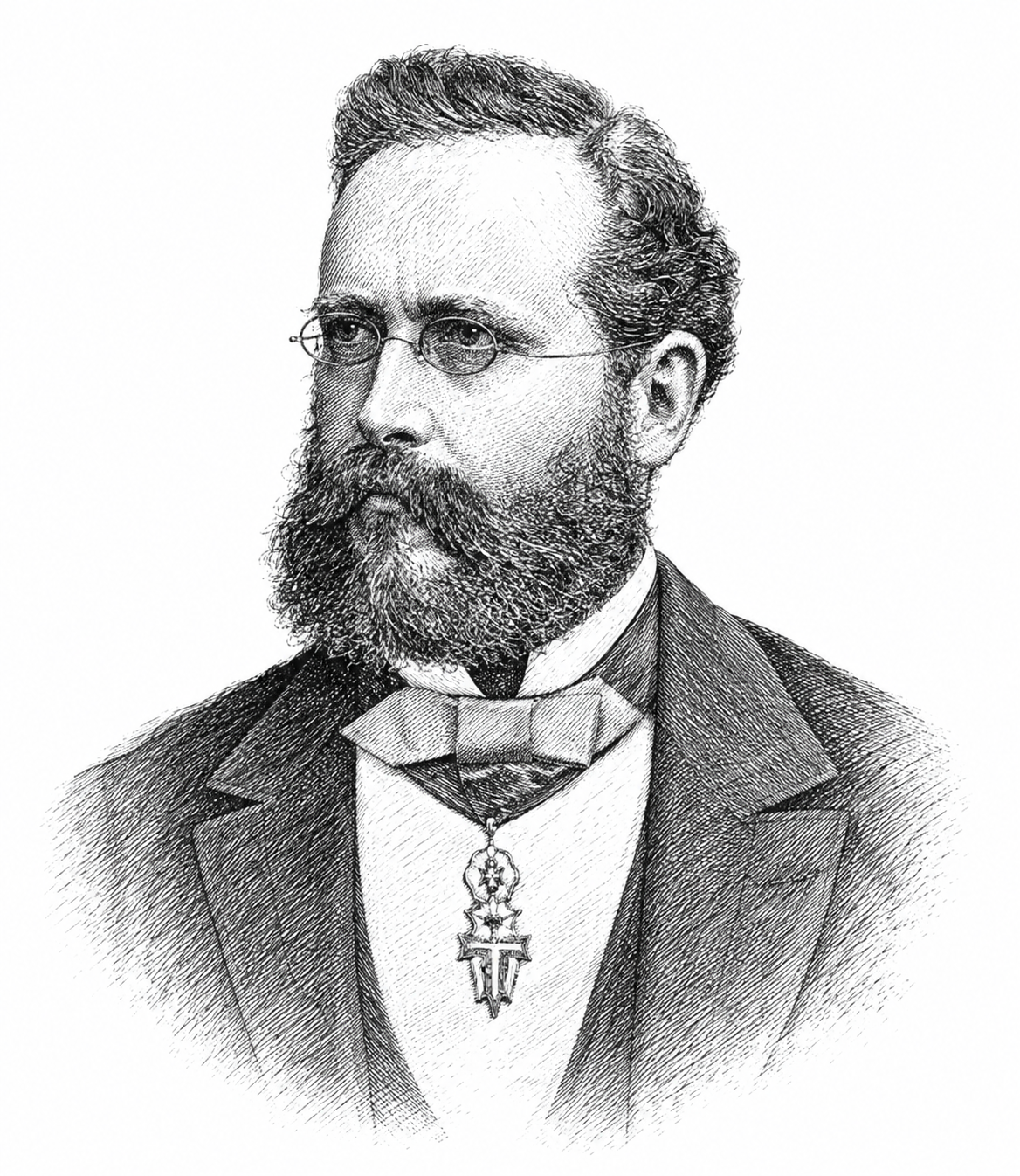
Auguste Kerckhoffs (19 January 1835 - 9 August 1903) was a Dutch linguist
and cryptographer, best known for his propositions for practical cipher
design. In particular his second proposition is foundational for modern,
transparent crypto systems. It became known as Kerckhoffs Principle.
|
Kerckhoffs was born in Nuth (Neherlands) as
Jean Guillaume Auguste Victor François Hubert Kerckhoffs,
son of Jean Guillaume Kerckhoffs – mayor of Nuth – and Jeanette Elisabeth Lintjens. He studied at the Rolduc boarding school in Kerkrade
(Netherlands) from October 1847 to August 1852, after which he lived in England
for a year and a half to improve his English [1][2].
Subsequently, he studied philosophy and natural sciences at the Universities
of Liège and Leuven (Belgium). After graduating, Kerckhoffs became a school
teacher and tought German in Eindhoven (Netherlands).
In 1860 he moved to France, where he initially worked as a private tutor.
From 1863 onwards, he tought modern languages in Meaux and Melun
(near Paris, France). A year later, in 1864, he married Marie Émile Thévenin,
with whom he got a daughter, Pauline, in 1865.
In 1870 Kerckhoffs joined the French National Guard, and became a French
citizen in 1873 [2].
|
|
|
That same year he took leave to study Phylology (the study of language in oral
and written historical sources) at the universities of Bonn and Tübingen
(Germany), where he received his doctorate in 1876. During his time in Germany,
as well as after his return to Prais (France), he earned his living as a private tutor. From 1881 to 1891 he tought German at the
École des hautes études commerciales de Paris (HEC).
During this time, he wrote his magnum opus, La Cryptographie
Militaire, which was published in early 1883 in two parts in
Le Journal des Sciences Militaires [I][II].
|
|
Kerhoffs's 64-page essay from 1883 — La Cryptographie Militaire —
became foundational in the field of cryptography.
It contains six propositions for modern transparent cryptographic systems,
which are formulated as follows:
|
- The system should be, if not theoretically unbreakable, unbreakable in practice.
- The design of a system should not require secrecy, and compromise of the system should not inconvenience the correspondents.
- The key should be memorable without notes and should be easily changeable.
- The cryptograms should be transmittable by telegraph.
- The apparatus or documents should be portable and operable by a single person.
- The system should be easy, neither requiring knowledge of a long list of rules nor involving mental strain.
|
|
Some of these are no longer relevant since computers are able to
perform complex encryption. The second one however, is still critically
important and is known as Kerckhoffs's Principle. Over the years,
it has been rephrased many times, for example in 1949 by Claude Shannon, as:
|
"the enemy knows the system"
|
or, more formally, as Shannon's Maxim:
|
"one ought to design systems under the assumption that the enemy will
immediately gain full familiarity with them"
|
A more popular form which is commonly used today, is:
|
The security of a cipher system should not depend on the secrecy of the
system, but only on the secrecy of the key.
- Kerckhoffs's principle
- Kerckhoffs's desideratum
- Kerckhoffs's assumption
- Kerckhoffs's axiom
- Kerckhoffs's doctrine
- Kerckhoffs's law
|
Since 1 October 2026, Crypto Museum will be awarding an annual stimulus grant
to a student, scholar or researcher in the field of (the history of) cryptography
in the Netherlands. To emphasize the necessity of open research and freely-accessible
publications, the grant is named after Kerckhoffs. In Dutch it is known as
Kerckhoffs Stimulatiebeurs or KSB.
➤ More information
|
|
|
|
Any links shown in red are currently unavailable.
If you like the information on this website, why not make a donation?
© Crypto Museum. Created: Tuesday 03 November 2026. Last changed: Tuesday, 03 November 2026 - 21:07 CET.
|
 |

|
|
|