|
|
|
|
|

|
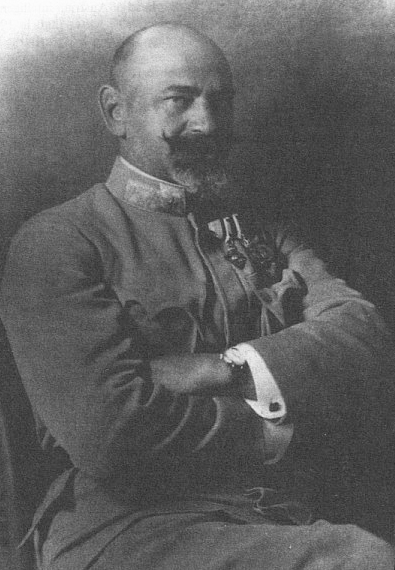
Army Colonel and Cryptologist
Andreas Figl (22 June 1873 - 11 November 1967) was an Austrian army
officer 1 and autodidact cryptologist. He was the founder of both the
Austrian cipher bureau and the country's codebreaking
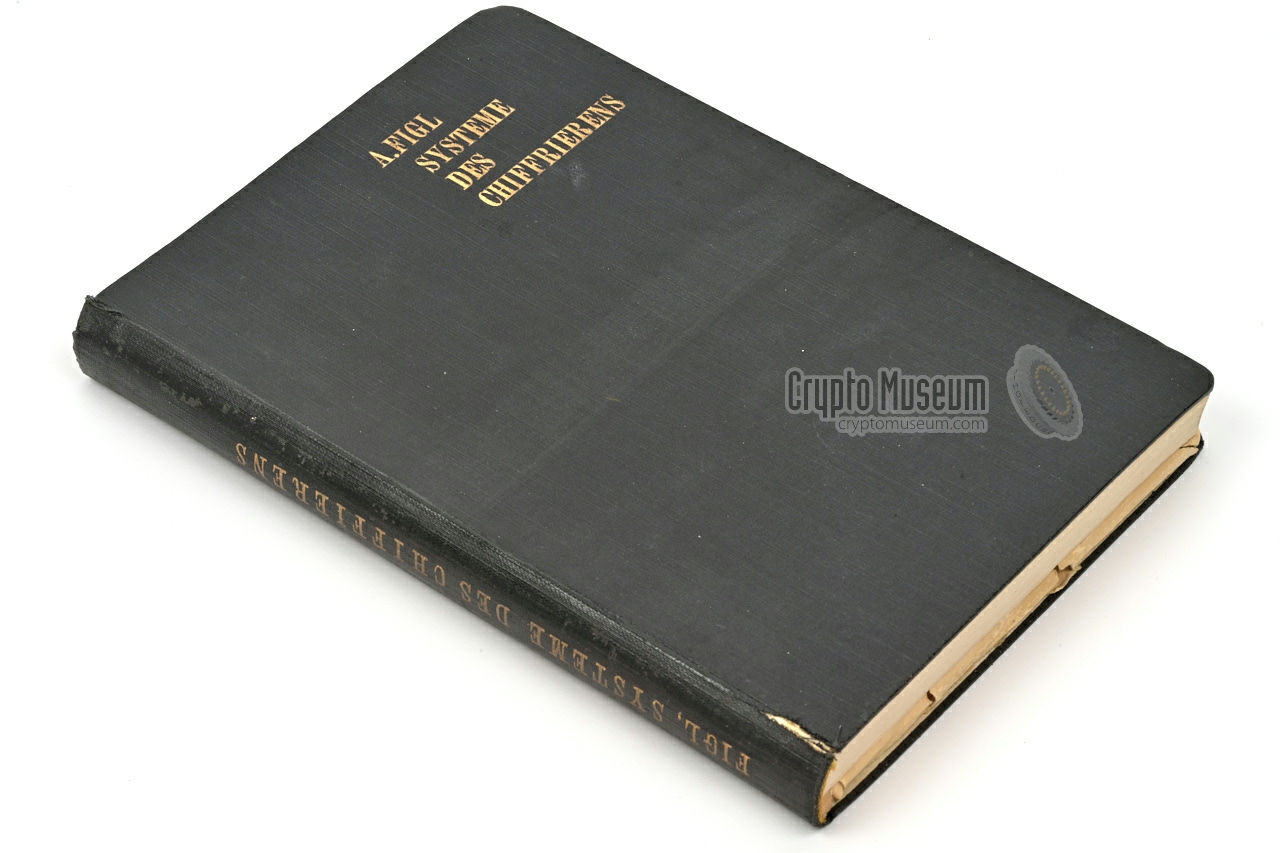
organisation. In 1926, whilst working for the Foreign Office, he
wrote his book Systeme des Chiffrierens (cipher systems) [I].
His second book Systeme des Dechiffrierens
(systems for deciphering)
– a codebreaking guide [II] was probited by the authorities
and was never published.
|
Born on 22 June 1873 in Vienna (Austria), Figl grew up in
Vienna and Sarajevo (Yugoslavia). 2
He started an education as Army Cadet at the age of 14 and was promoted
Lieutenant in 1891.
After a work-related accident in 1910, he retired as
Army Captain (Hauptmann), but was recalled a year later to build new the cipher
organisation of the Austrian Army. 3
Over the course of the next two decades he gained international recognition
as a cryptographic expert. From 1920 until his official retirement in 1937,
he worked for the Austrian Foreign Office (Außenministerium) [1].
|
|
|
|
In 1926, he published Systeme des Chiffrierens (cipher
systems), as a scientific publication of the criminalistic laboratory of
the Vienna Police [I]. It contains 243 pages and 45 attachments,
and is internationally recognised as one of the leading
publications on classic cipher systems of the era.
|
It was his intention to produce another book a year later (1927)
on the subject of cryptanalysis and codebreaking:
Systeme des Dechiffrierens (systems for deciphering).
It comprised three parts [II], but the manuscript was
confiscated by the authorities and was never published.
The Austrian authorities also ruled that from then on, Figl had to seek
advance permission for any further cryptology-related publications.
Apparently the Austrian authorities wanted to keep any knowlege about
codebreaking away from the public. It would be Figl's last work.
|
|
|
Figl remained bitter about the decision of the superiors, and kept
secretly improving his manuscript Systeme des Dechiffrierens
in the following years.
Even after his retirement on 1 July 1937, he kept updating and
improving his manuscript.
The last known addition was as late as 1953 [4].
On 21 March 1949, Figl offered the denied manuscript
(Systeme des Dechiffrierens) to the
General Staff of the US Army (GSUSA), together with a manuscipt
of his cryptographic memoirs. The offer was handled by Mr. Arthur Schutz
in Baltimore (MD, USA), who acted as Figl's agent.
The General Staff passed the offer on to Lt. Colonel H. Haiser of the
Army Security Agency (ASA), who rejected both manuscripts
as they were of insufficient interest to the US.
Haiser also believed that the books
contained nothing of a compromising nature [6],
and kindly returned both books.
On 24 September 1953, Figl tried again. This time he offered the sole
copy of the forbidden manuscript directly to
William Friedman, cryptologist of the ASA
and avid collector. He had hoped that Friedman – or another collector –
would want to acquire the book [7].
After a long delay, 4 Friedman replied on 14 May 1954.
He wanted a friend to visit Figl in Salzburg (Austria) to review
the books [8]. On 25 May, Figl approved the visit, but demanded absolute
confidentiality, as he didn't want the German and Austrian intelligence
services to become aware of his offer [9].
On 29 October 1954, Friedman advised Figl that his friend was no longer
available in the Salzburg area, as a result of which he was no longer able to
be of assistence in the sale of the manuscripts [10].
In 1960, Figl became advisor to the newly established Austrian
Bundesheer (Federal Army), but it was not until his 90th birthday
in 1963, that he was officially honoured for his work.
Figl, the Altmeister of Austrian cryptography,
died on 11 November 1967 in Salzburg (Austria), aged 94.
|
 |
-
His higest rank was Oberstleutnant (Lieutenant Colonel), not General
as claimed in some publications.
-
Now: Bosnia and Herzegovia.
-
Known as kaiserliche und königliche Armee (imperial and royal army),
abbreviated k.u.k. Armee [2].
-
Around this time, Friedman was secretly working on the
Hagelin problem, for which
he had to travel to Sweden and Switzerland, and write extensive reports.
His efforts led to the creation of a
Gentleman's Agreement
between the NSA and Hagelin's company
Crypto AG – a large manufacturer of cipher machines.
|
- Systeme des Chiffrierens 1
Wissenschafliche Veröffentlichungen des Kriminalistischen Laboratoriums der Polizeidirektion Wien.
Andreas Figl. Graz, April 1926 (in German language).
➤ Beilagen (attachments)
- Systeme des Dechiffrierens - Band I
Systems for Deciphering (cryptanalysis, codebreaking), part 1.
Andreas Figl. Graz, 1927. Unpublished manuscript. 2
- Systeme des Dechiffrierens - Band II
Systems for Deciphering (cryptanalysis, codebreaking), part 2.
Andreas Figl. Graz, 1927. Unpublished manuscript. 2
- Systeme des Dechiffrierens - Band III
Systems for Deciphering (cryptanalysis, codebreaking), part 3.
Andreas Figl. Graz, 1927. Unpublished manuscript. 2
|
|
-
Scanned by Arthur Bauer and available from his website.
➤ More (off-site)
-
According to the Austrian copyright rules, the copyright of an unpublished
work expires 70 years after its creation. Since the manuscript was written
in 1927, its copyright expired in 1997. Even if the date of the last
update is taken into account (1953), its copyright expired in 2023.
Although the Austrian authorities confiscated the book in 1927,
the grounds for this confiscation can no longer hold, since in 1953
the General Staff of the US Army confirmed – after reading it – that it
"contained nothing of a compromising nature" [6].
|
- Andreas Figl, Hofrat i.R. und Oberst a.D., Leben und Werk, 1873-1967
Altmeister der österreichischen Enträtselung und kryptographischen
Wissenschaft
Otto J. Horak. Linz, 2005. ISBN 978-3-85487-779-X.
- Was übrich blieb
Kommentare zu Andreas Figl, Leben und Werk, 1873-1967.
Otto J. Horak. Linz, 2005. ISBN 978-3-85487-790-0.
- Oberst a.D. Andreas Figl under der k.u.k. Radiohorch- und Dechiffrierdienst
Otto J. Horak. Linz, 2011. ISBN 978-3-902475-90-9.
|
- Wikipedia (Germany), Andreas Figl
Retrieved August 2020.
- Wikipedia, Common Army
Retrieved August 2020. ➤ German version
- Walter Blasi, Datensicherheit und Enträtselungskunst
Über das Verbergen und Entschlüsseln von Informationsinhalten.
SIAK Journal - Zeitschrift für Polizeiwissenschaft und polizeiliche Praxis (1), 62-73. 2014
- Otto J. Horak, Andreas Figl, Leben und Werk (biography)
Linz, 2005. ISBN 978-3-85487-779-X. pp. 229-254. [a]
- Herbert Paulis, The Scheubele Apparatus
Cryptologia 31, 2007, pp. 194-178.
- Charles H. Hiser (ASA) to Director of Intelligence (GSUSA)
ASA, 18 April 1949
- Figl to Friedman, Offer to acquire manuscripts
25 September 1953.
- Friedman to Figl, Cannot afford but might be able to help
14 May 1954.
- Figl to Friedman, Confidentiality required
25 May 1954.
- Friedman to Figl, No longer able to be of assistence
29 October 1954.
|
|
|
|
Any links shown in red are currently unavailable.
If you like the information on this website, why not make a donation?
© Crypto Museum. Created: Monday 24 August 2020. Last changed: Sunday, 19 July 2026 - 08:25 CET.
|
|

|
|
|