|
|
|
|
|

|
|
Voice Telsey ← TDS-2004 ← TS-500
Mobile voice encryptor
TDS-2004M is a voice scrambler for mobile (military) use, introduced
around 1978 by Telsy in Turin (Italy),
as part of the TDS-2000 series.
It is the mobile version of the TDS-2004.
It is the successor to the earlier and much less secure
TS-500 scrambler,
and is compatible with other members of the TDS-2000 family, such as
the briefcase TDS-2003
(and with Gretacoder 104).
|
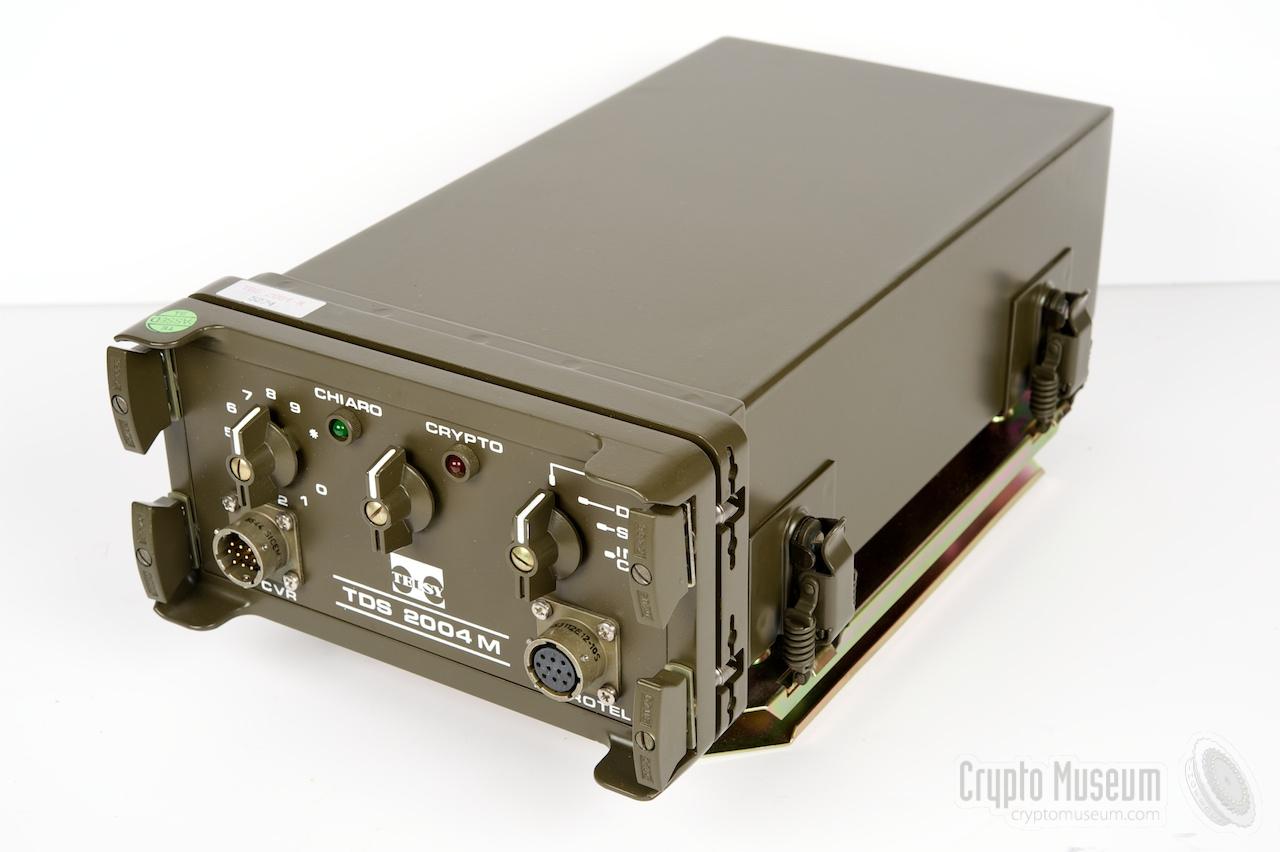
The TDS-2004M was the mobile version of the TDS-2004
desktop encryption device and was housed in a military-grade case, complete with shockmount base-plate. The image on the right shows a typical TDS-2004M,
mounted on its base-plate with two snap locks at either side.
The TDS-2004M has two modes of encryption: time domain or
2-dimensional coding (time and frequency domain) and the cryptographic key
determines which mode is used.
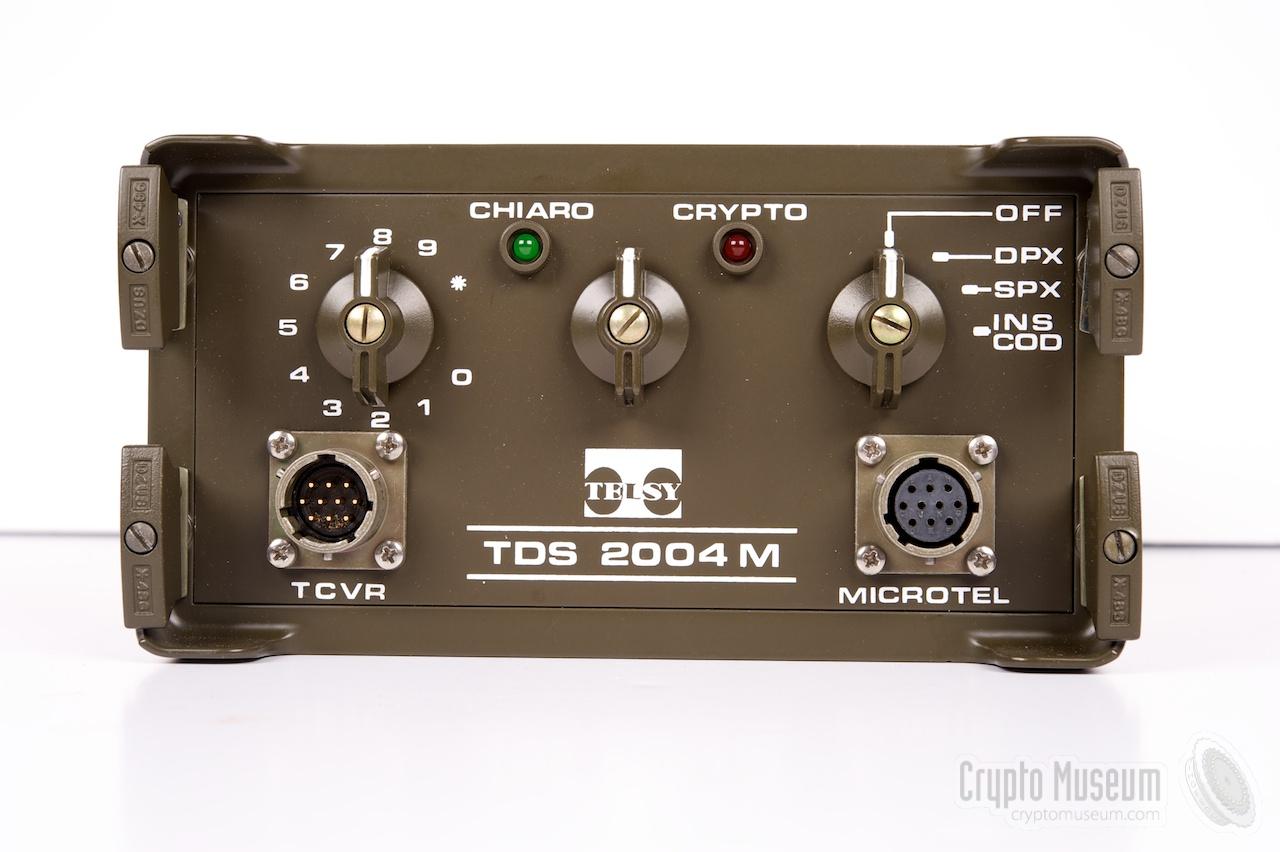
A total of 9 keys can be preset and the key selector at the front is used to
select the key compartment.
|
|
|
Setting the key can be done on the front panel.
When setting the key, the mode selector (right) has to be set to SET KEY
(INS COD). Then set the key selector (left) to the number of the required
key compartment and toggle the middle knob to CLEAR (CHIARO) in order to
purge the current key. Next, enter between 1 and 8 digits, by rotating the
key selector to the required number and toggling the middle knob to
CRYPTO in order to enter the digit.
When doing this, you need to remember which digits you have already entered.
Unlike the TDS-2003,
the TDS-2004M does not have the visual aid of a display.
Finally, set the mode selector to SPX (simplex) or DPX (duplex).
The TDS-2000 range was very successful and thousands of units were
sold to the Army and the Police, and even to the corporate sector.
The TDS-2004M was also sold as an OEM product by competitor Gretag,
where it was known as the Gretacoder 104.
The TDS-2004M was introduced in 1978 and remained in production well into
the 1990s.
The image above shows a typical TDS-2004M unit that was manufactured in 1991,
close to the end of its life-cycle.
|
|
The TDS-2004M is housed in a robust green military-grade enclosure.
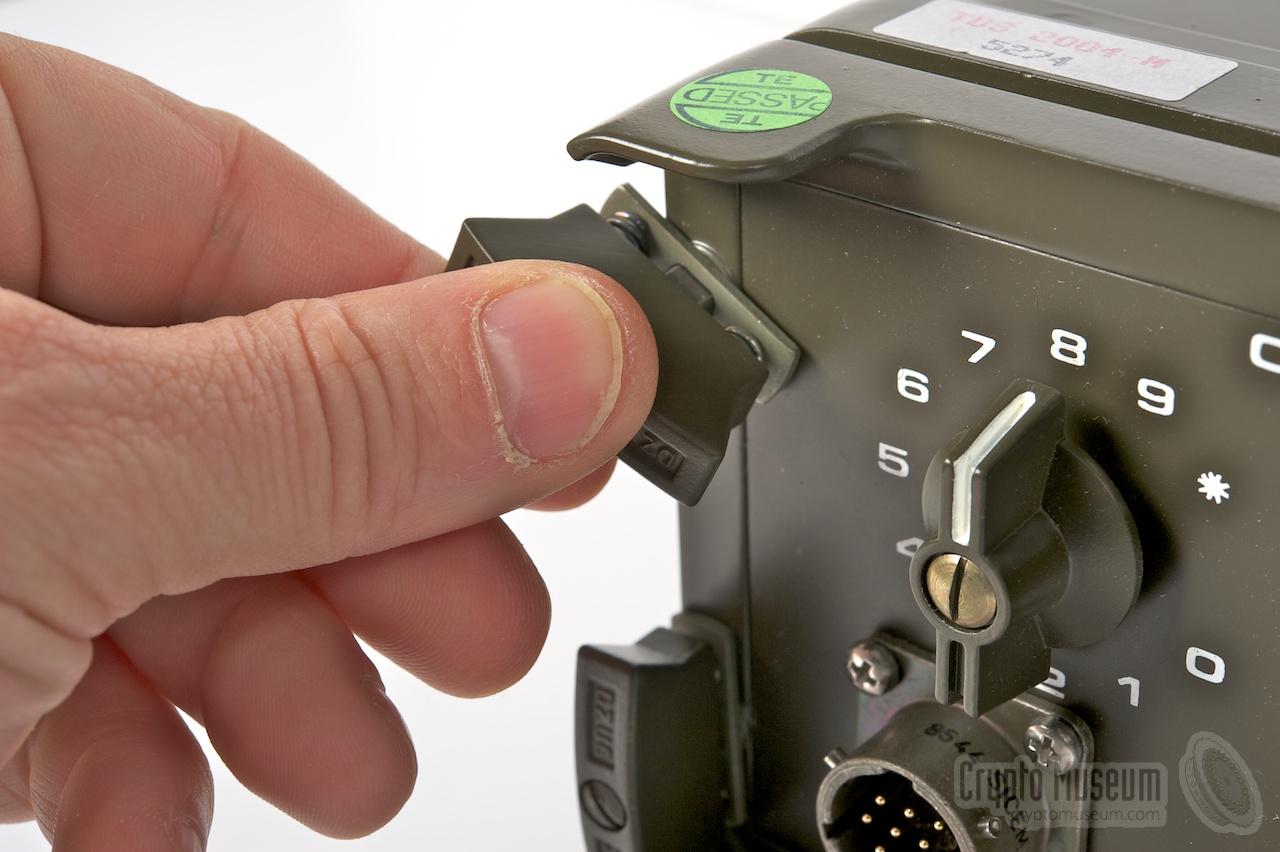
The electronics are easily extracted from the case, by
releasing the 4 locking-knobs at the
corners of the front panel. Rotating them counter-clockwise, releases the unit.
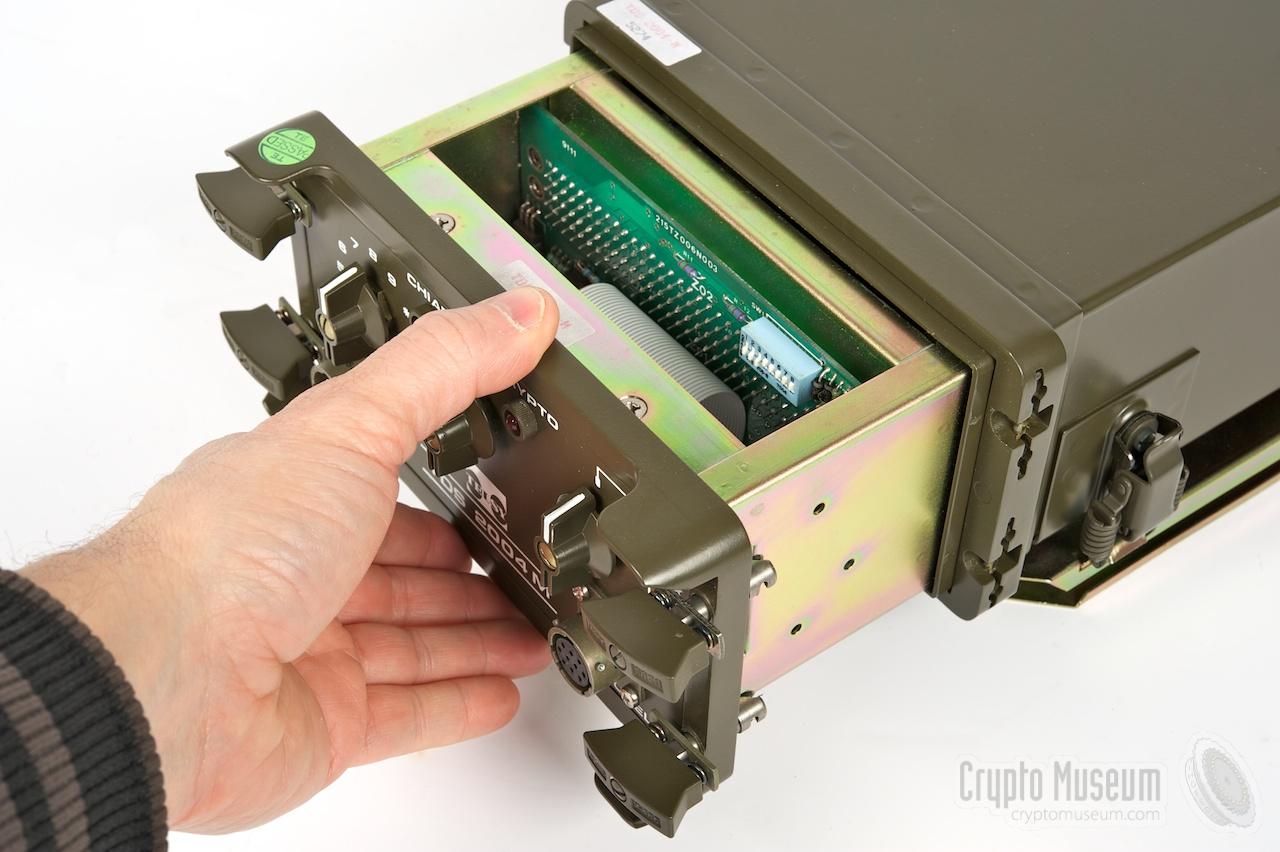
Once all 4 locks are released, the front panel can be
separated from the case.
All electronics are mounted in a frame behind the front panel.
|
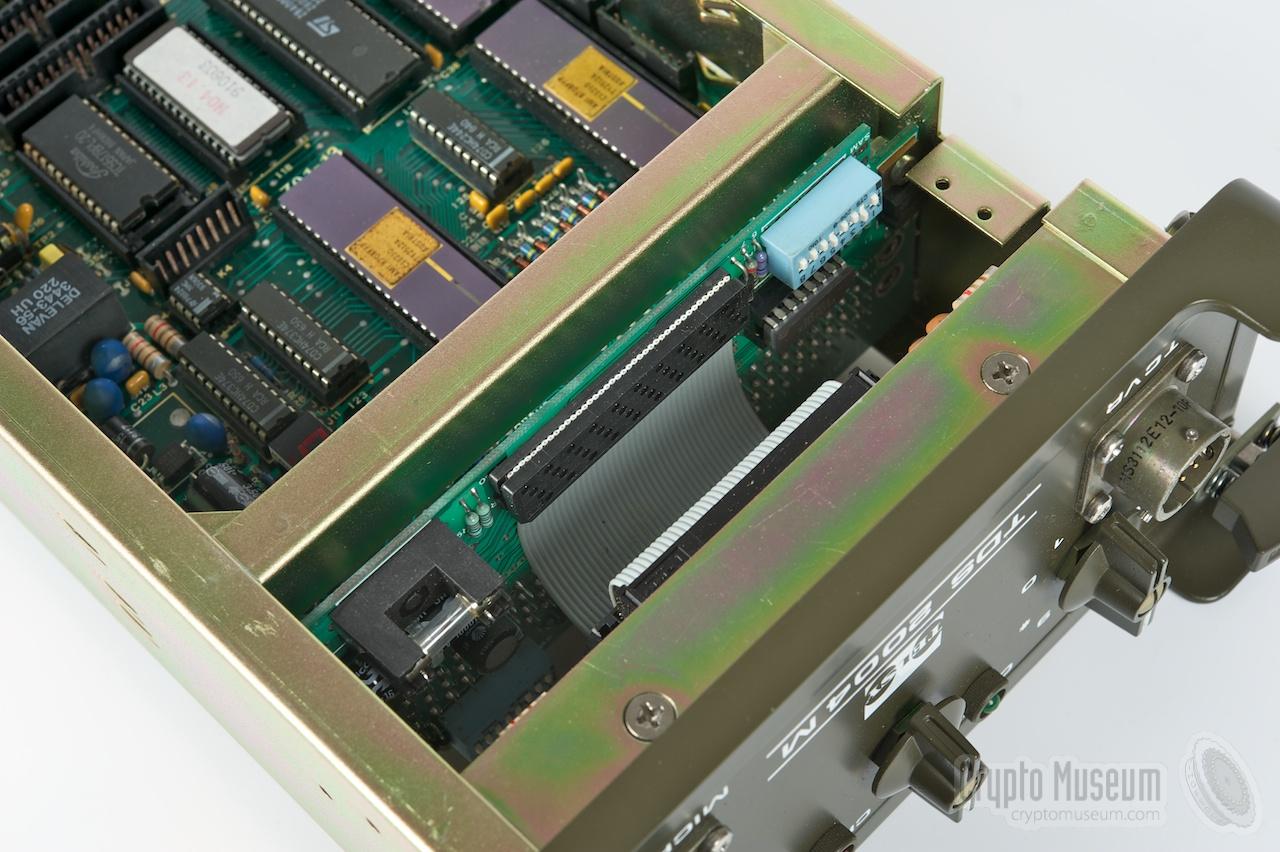
The TDS-2004M contains two main PCBs:
(1) an analogue board at the top,
and (2) a digital PCB at the bottom.
They are both inserted from the back
and are slotted into a card-edge connector.
A sturdy metal frame keeps the PCBs in place.
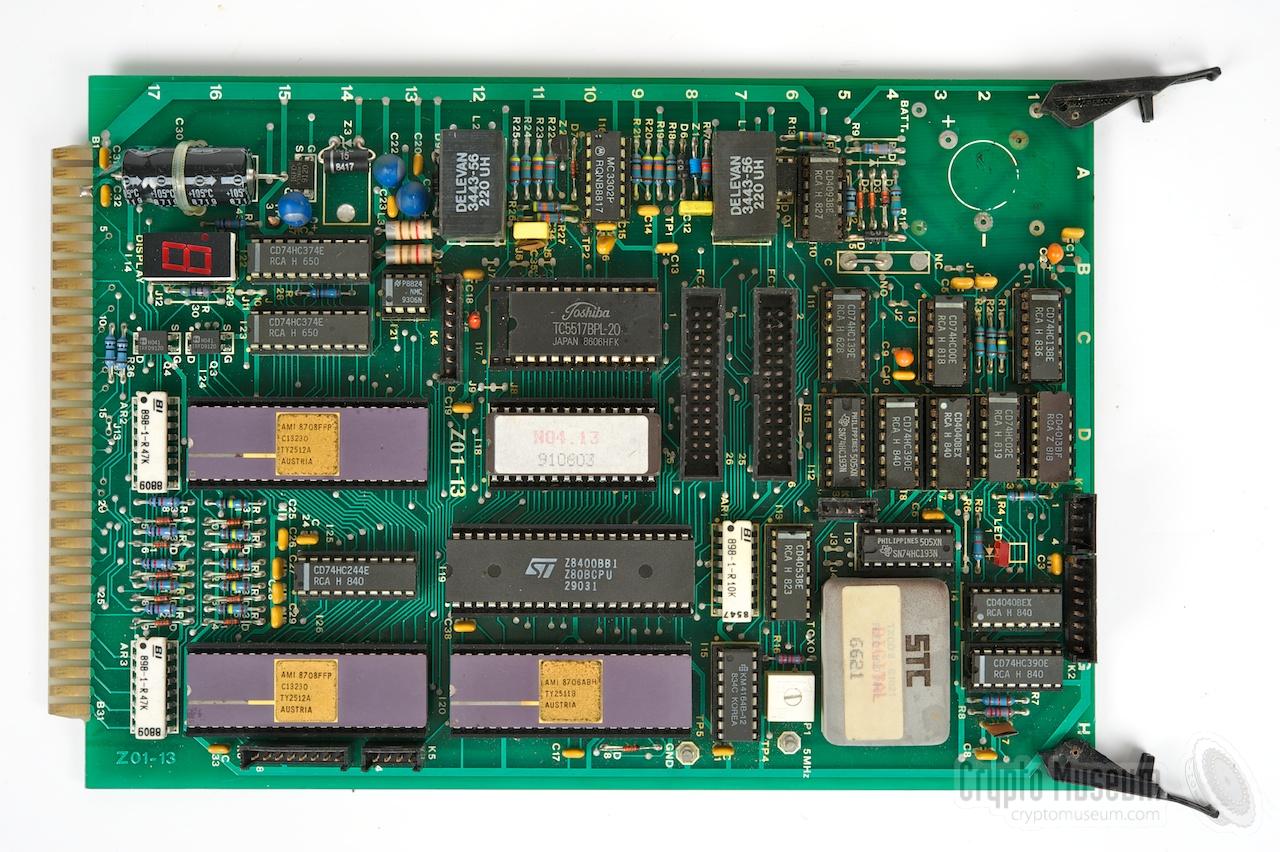
The image on the right shows the digital board with a Z80
processor at its heart. Note that the TDS-2004M was designed
in 1978, just two years after the introduction of the Z80,
which is a remarkable achievement.
It was probably one of the first encryption devices that used a Z80.
The unit shown here was built in June 1991.
|
|
|
The digital board
also contains a number of custom chips that can be recognized
by their golden caps. They were manufactured by American Microsystems Inc. (AMI)
in their production facility in Austria. The custom chips all carry ID-numbers
starting with TY to show that they were built exclusively for Telsy.
Three such custom chips are used on the digital board.
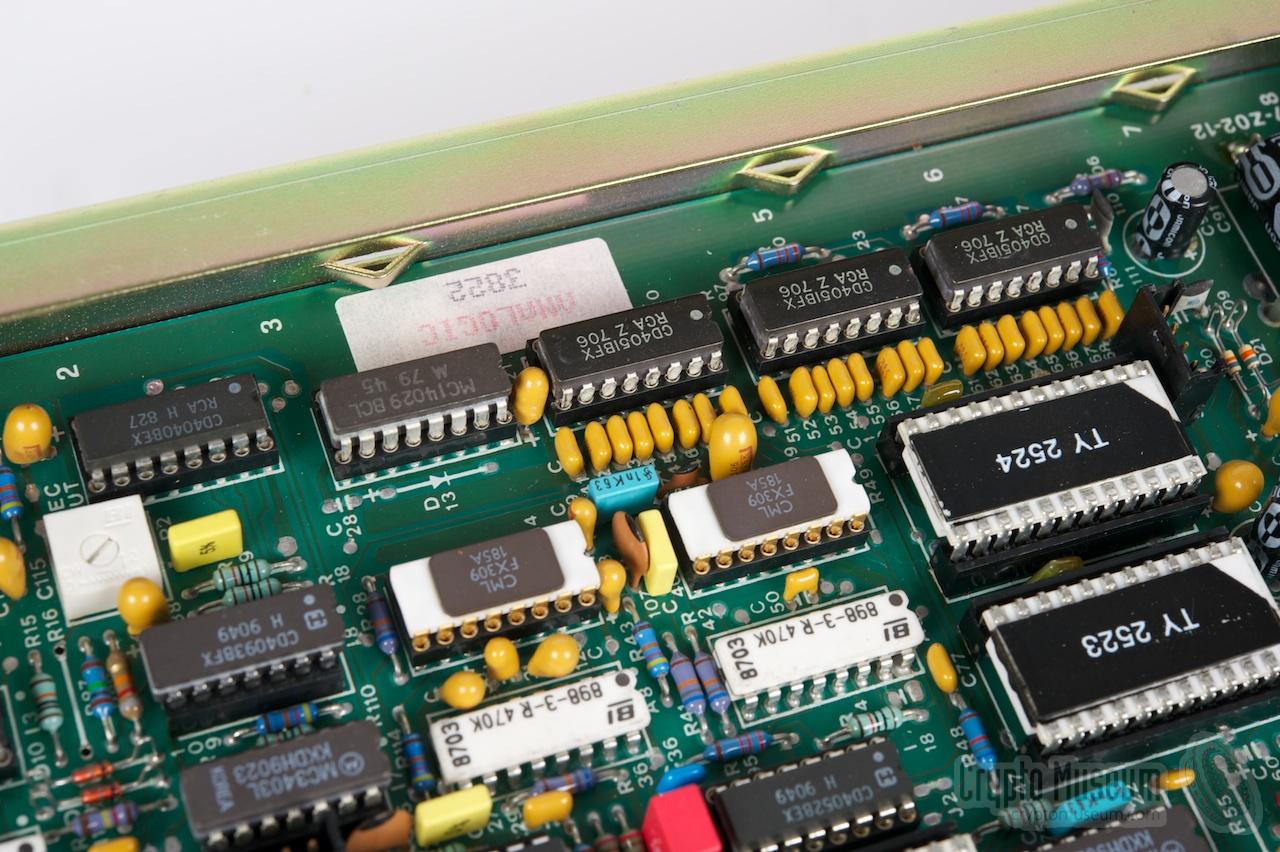
The other PCB contains the analogue circuitry.
At the heart of this board are two FX-309 Delta Modulators by CML (UK)
[a].
This was a later generation of the FX-209 that was used in the earlier
TS-500 voice encryptor.
The large white/black chips,
marked TY2521-2524, are thick film circuits
with OpAmp-based active low-pass filters.
They were also custom-made for Telsy.
The same analogue and digital boards are also used in the
TDS-2003
and in the TDS-2004.
|
|
When we received the TDS-2004M featured on this page [1],
we immediately opened the unit in order to check it for leaking batteries.
Although the device looks brand new, it was manufactured in the early 1980s
and any battery that was installed at that time, might be leaking by now.
|
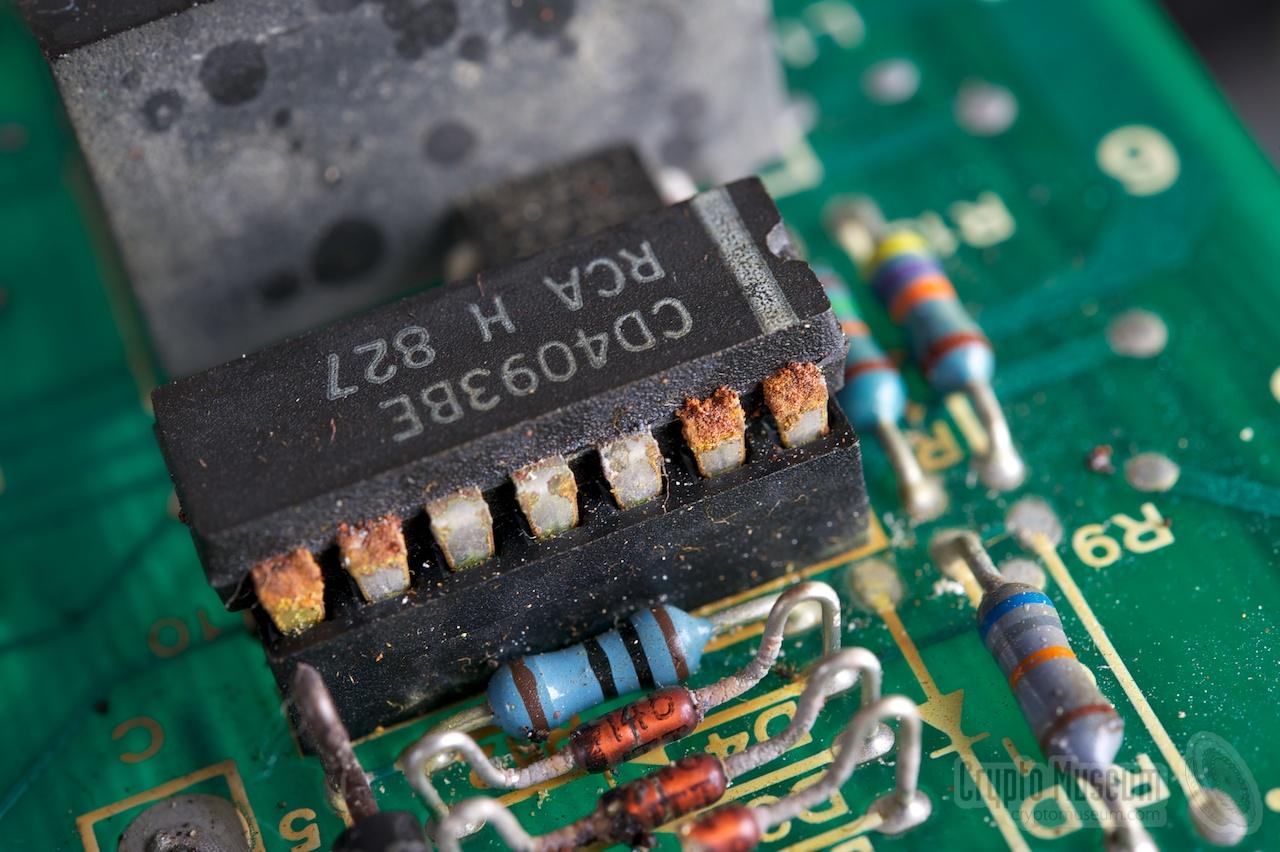
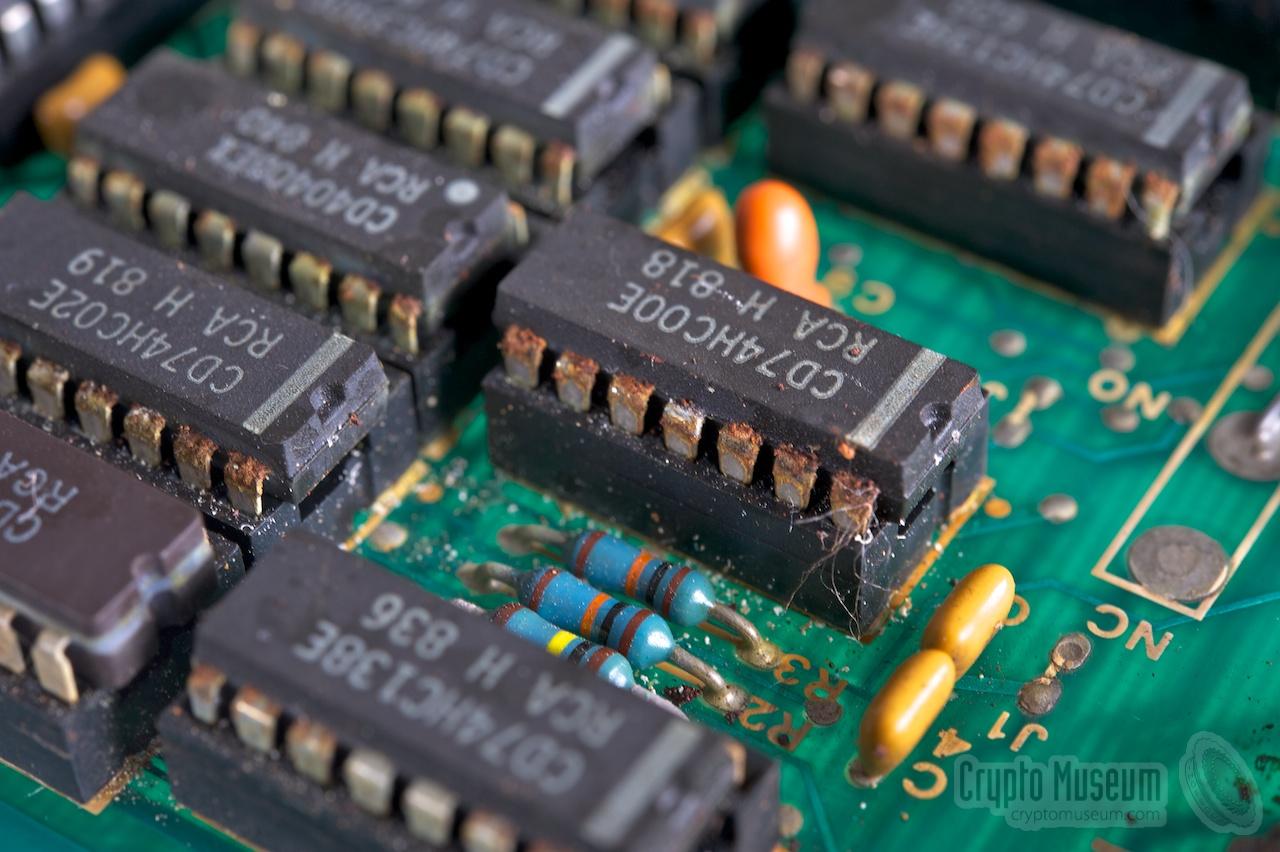
Leaking batteries can cause serious damage to the interior. When released,
the liquids from the battery can 'eat' away copper tracks from the PCB
and even complete components. The toxic gasses that are released when the
battery comes apart, can even damage components at the other end of the unit,
by causing oxidation.
The image on the right shows the interior of the TDS-2004M featured on this
page, when we first opened it. Many years of storage have exhausted the
battery as a result of which it started leaking.
The damage is illustrated in the images below.
|
|
|
Although the unit in the above image may appear beyond repair, this was not
the case. Careful removal of the damaged parts and cleaning of the PCB
has brought the unit back to working condition. The rightmost image below
shows the affected corner of the PCB after cleaning.
With older equipment it is always important to check for leaking batteries.
In most cases, it is advised to remove them as a preventive measure.
It may then be replaced by a modern alternative, but that will require
maintenance in due course as well. Another possibility is to replace it with
a so-called super-cap (a very large capacitor) or leave it out altogether
as the device will probably work without the battery (settings will be lost
when the unit is switched off).
|
|
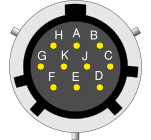
The leftmost connector at the front panel – marked TCVR (transceiver) –
is for the connection to a simplex or duplex
radio set. The 12V DC power source for the unit is also supplied here.
It is a standard military 10-way male receptacle. Below is the pinout when
looking onto the receptacle.
|
PWR in +12V/DC in SPK out Speaker out REM in Remote key sel. (for 2 keys) AOUT out Audio (to radio) GND - Ground MIC in Microphone RXI in Audio from radio REL out Relay (bypass) PTT in Reverse signalling or PTT EAR out Earphone
|
|
|
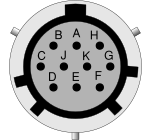
The rightmost connector at the front panel is marked MICROTEL.
It can be used for connection of a remote control unit and other accessories.
It is a standard military 10-way female receptacle. Below is the pinout
when looking into the receptacle.
|
PWR out +12V/DC 400mA (for accessories) PRI in Private (remote control) CLR in Clear (remote control) SEC in Crypto (remote control) GND - Ground MIC in Microphone LEDC out LED clear PTT in Reverse signalling or PTT LEDS out LED secure (crypto) EAR out Earphone
|
|
Device Frequency and time domain voice scrambler Purpose Secure 2-way radio and cellular phone conversations Model TDS-2004M Manufacturer Telsy Year 1978 Country Italy Principle 8 fragment time / 16 fragment frequency division Algorithm Proprietary non-linear Period 500,000 hrs Keys see below Waveform Delta modulation (CVSD) 64 kbps Delay 1 s (in secure mode) Processor Z80 ROM 8KB RAM 2KB Power 11-15V DC (24V optional) Current 300 mA Temperature -10°C to +60°C Storage -20°C to +80°C Humidity ≤ 95% Dimensions 100 × 190 × 330 mm (HWD) Weight 4 kg
|
Compartments 9 Digits 1 to 8 per compartment External 108 via front panel (100 million) Custom 107 in firmware Storage Battery backed CMOS RAM Battery Rechargeable NiCd
|
- Built-in test equipment (BITE)
- Pseudo digital security
- Long cryptographic period
- Supervisor for suppression of unsuitable fragment combinations
- Microprocessor master control with 8KB program
- Works over standard narrowband voice grade channels
- One- or two-dimensional scrambling
- Wrong polarity and overvoltage protection
- Battery backed key memory
- Dust and splash proof enclosure
- Snap-on mounting
- Shock absorbing mounting plate
|
-
Applicable to serial numbers above 5000.
Document kindly provided by Miguel Bravo, May 2020.
|
|
|
|
Any links shown in red are currently unavailable.
If you like the information on this website, why not make a donation?
© Crypto Museum. Created: Wednesday 02 May 2012. Last changed: Tuesday, 06 January 2026 - 16:03 CET.
|
 |

|
|
|