|
|
|
|
|

|
|
Hagelin Pin-wheel Mixer OTT C-52 → ← C-443
Pin-and-lug cipher machine
The C-446 was a mechanical cipher machine
developed by Boris Hagelin of A.B. Cryptoteknik
in Stockholm (Sweden) in 1946.
The machine is nearly identical to the earlier
C-443 and is based on the design of the
C-38
(M-209).
It features two printers at the left: one for the plain text and one for
the cipher text.
The C-446 was used by many armies world-wide, including
Norway and The Netherlands.
It is compatible with the C-38,
M-209,
C-48,
C-443,
BC-38
and with the BC-543.
|
The case is similar to that of the M-209, with the tools
and the two paper reels stored inside the top lid.
The image on the right shows a typical C-446 with its top lid
open, ready for use.
Unlike the M-209, that features a rather simple lock,
the C-446 is locked with two different keys (see below);
one for the user and one for the officer.
Three versions of the C-446 are known:
|
|
|
The differences between the C-446 and the C-446-A are currently unknown,
but it is likely that the 'A' just refers to some simple manufacturing changes.
It is believed that the machines are otherwise identical.
The RT-version is quite different however. Rather than pin-and-lug
cipher wheels, it features a 5-level paper tape reader, allowing the
machine to be used as a One-Time Pad (OTP).
Such machines are also
known as One-Time Tape (OTT)
machines or Mixers.
|
The C-446 came in commercial (grey) and military (green) variants.
Apart from the outer colour, these variants are functionally identical.
The machines shown on this page are all of the military type and were
used by the Dutch Navy, the Dutch Airforce and the Norwegian Army.
The image on the right shows both versions side by side.
The one on the right is the standard C-446-A that has six cipher wheels.
The leftmost one has a 5-level tape reader instead of the six wheels.
When used with a truely random One Time Tape (OTT),
it is theoretically unbreakable.
|
|
|
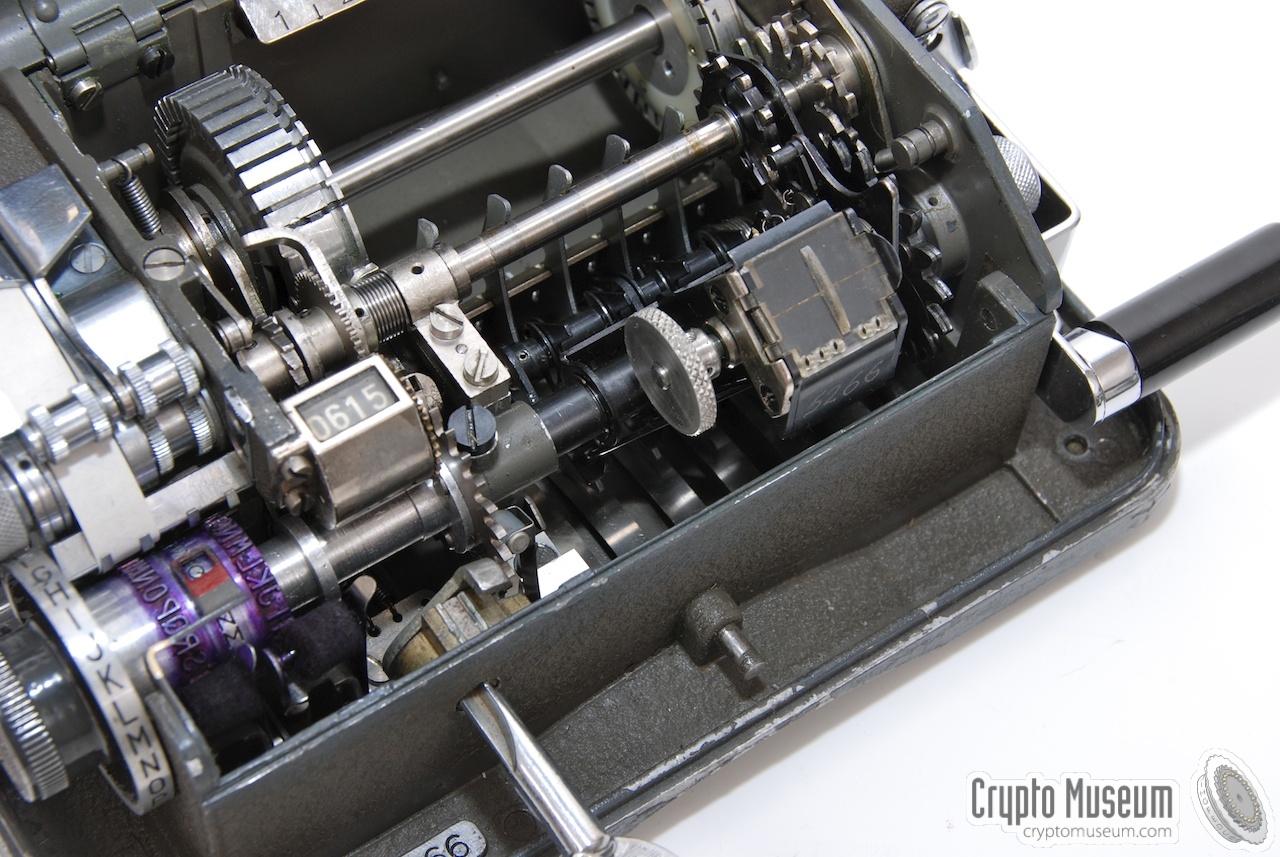
Many C-446 machines that have been found in recent years, appear to be
incomplete due to de-militarisation procedures that were followed
when they were finally decommissioned.
As a result, some of the bars and lugs may be missing from the cage inside
the machine. In some cases, even the serial number plates have been removed
and the keys are nearly always missing.
The C-446 was used throughout the 1950s, when they were gradually replaced
by the more powerful CX-52.
The C-446 machines were often kept in storage for backup purposes
during 1960s and 1970s.
|
|
The machine shown below is a standard C-446-A. At first sight it is very
similar to the war-time M-209, which in turn was based
on the civil C-38.
The machine has six non-removable cipher wheels that protrude the top lid
at the front of the machine.
At the left is a double printer with two paper strips: one for the plain
text and one for the cipher text, plus a small letter counter.
|
Unlike the M-209, the C-446 can be locked properly. It has a lock on the
top cover and one on the machine itself. Both locks are different
and suitable keys were supplied for both locks, with one key acting
as the master key.
One key could only open
the cover, whilst the master key (a.k.a. the officer's key) could
open both locks (see below), allowing the base key to be set.
The machine is operated by a lever at the right. In the image, the lever
is shown upright, in the operational position. The mechanism is operated
by pulling-down and releasing the lever.
|
|
|
Different versions of the C-446-A are known. The two rightmost images
below show two variants.
The one on the right has some additional mechanical features just behind
the printer at the left.
These components were added to support an external keyboard
attachment. Strangely, there is no way to discriminate
these differences from the model number of the machine.
|
|
This variant of the C-446 uses a paper tape reader instead of the six cipher
wheels. Using a tape reader with a random cipher tape (RT) produces a much
stronger cipher. In fact, when the tape is truely random, and the machine is
used correctly, the cipher is unbreakable. Such systems are generally known
as One-Time Pad (OTP),
One-Time Tape (OTT) or
Mixer machines.
|
Although most mixer machine are operated electronically or electro-mechanically,
the C-446-RT is a fully hand-operated mechanical device. The image on the
right show a typical C-446-RT that was used for many years by the Dutch Navy.
A 5-level punched paper-tape is fed through the tape reader at the front.
Each time the lever is operated, it advances one step.
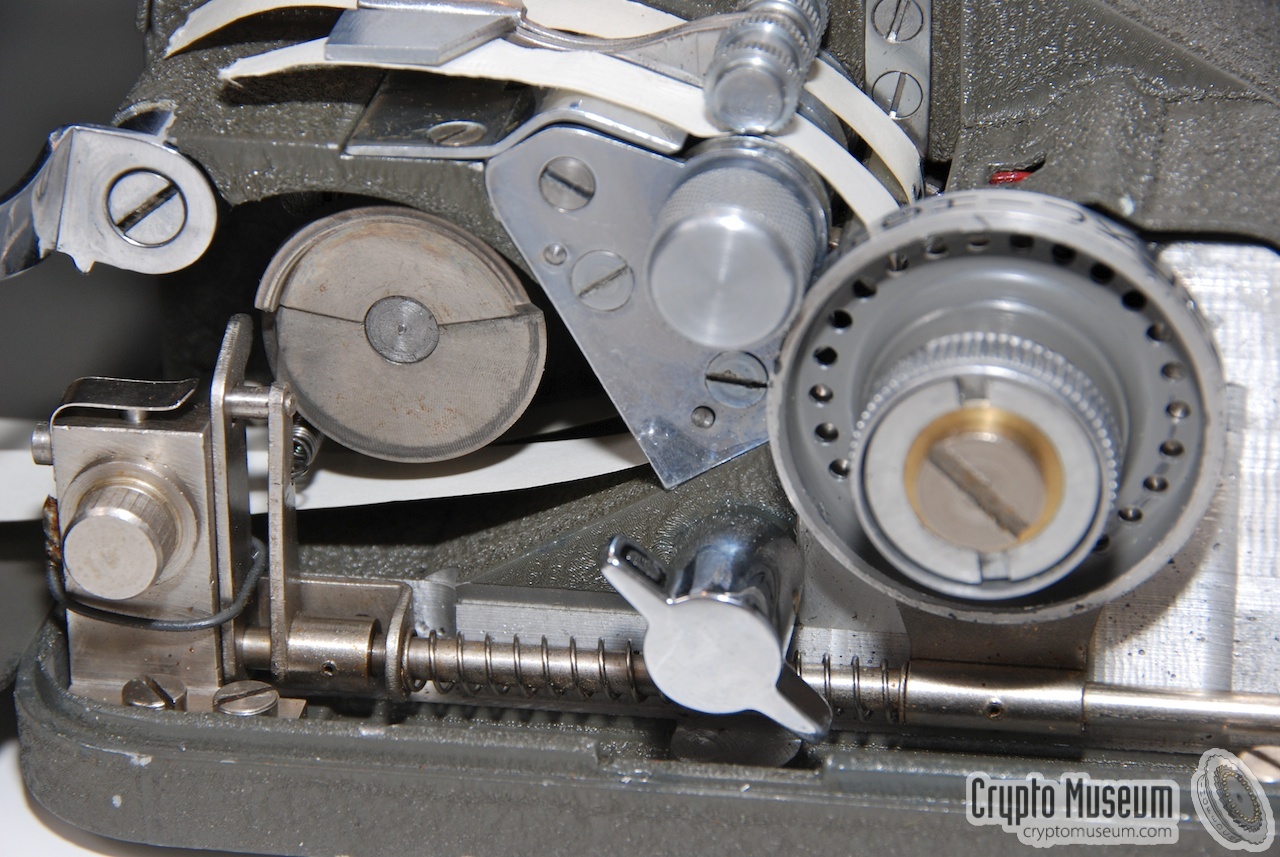
Unfortunately, most of the bars and lugs are missing
from the machine shown here. They were removed as part of the
de-militarisation procedure, as can be seen here
and here.
|
|
|
The same principle was later used in the OTP-version of the
Hagelin CX-52.
It was called the CX/RT.
Both machines could be expanded with
a motor-operated keyboard, in order to allow faster processing of
crypto text. Apart from purely mechanical OTP-machines, Hagelin
produced several electro-mechanical OTP/OTT-machines, such as
the TC-52,
the TC-55
and the ULES-64.
|
|
The C-446 comes with a set of tools that are usually stored
inside the top cover.
At the right are the screwdriver and the tweezers. At the left
are two metal containers, which are held in place by metal clamps.
One or of these more tools are often missing from machines found today.
|
The tweezers
are needed to feed the paper through the printer and to remove
any clotted paper from the mechanism.
The screwdriver is needed to disassemble certain parts and to make adjustments
to the mechanism. Please note the
special cut-out in the tip of the screwdriver.
Also stored in the top cover are two small metal containers.
One contains oil
that can be applied with a needle
that is attached to the cap.
The other one contains a set of replacement ink rolls.
Please check the images below.
|
|
|
|
The C-446 was usually supplied with a set of four keys: two operator's keys
and two officer's keys. They can be identified by the number of gaps in the
grip. The operator's key has one gap, whilst the officer's key
has two of them. The gaps are clearly visible in the images below.
|
The operator's key can only be used to open the top cover, but the officer's
key can be used to open both the top cover and the machine itself.
The latter is needed in order to set the position of the pins and lugs
as part of the daily key.
The operator could only change the starting position of each of the
wheels (message key).
The keys of all C-446 machines are different and the chance that a key fits
another machine is very small. Furthermore, different versions of the cross-lock
have been used: long, small, simple, complex and (unpickable) safety versions.
|
|
|
|
From most ex-Navy versions of the C-446 that ended up on the Dutch surplus
market, the keys are missing. And even worse: in most cases the machines are
locked. Over the years, we've seen many machines that were severely
damaged by a new owner, in an attempt to open the locks.
|
Our C-446-RT, for example, was locked and came without the keys.
In this case, we were lucky. We tried the keys of another C-446 unit and,
with a little wiggeling, we managed to open both locks.
Apparently, the locks of the two machines were nearly identical.
Since then, we've tried the keys numerous times on many other machines,
but never had the same luck again.
If you ever find a C-446 with the locks closed and without any keys present,
please don't attempt to open it yourself as you are likely to cause
permanent damage to the machine. The lock is simply too strong and too well
built.
|
|
|
Instead try to find a good lock-picker.
Although cross-locks are rather complex, they can usually be opened
relatively quickly, without damage to the lock or to the machine.
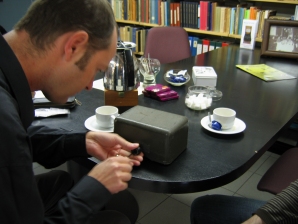
The image above shows lock-picker Walter Belgers
(Netherlands) opening the C-446 of a friend at
the Dutch Radio Ham Museum in December 2008.
It took him about two minutes to open two machines.
|
|
All cipher machines that were used by the Dutch Navy, were issued
a maintenance book (LIVRET), in which the complete history of the machine was
recorded. It contained a checklist, instructions for storing the machine
and written records of maintenance, repairs and overseas shipments.
|
It is called LIVRET voor Chiffreermachines
(Pocket book for Cipher Machines).
It was issued by the Codedienst (Code Department) of the
Verbindingsdienst (Signals Department) of the Koninklijke Marine (Royal Dutch
Navy).
The image on the right shows an ex-Dutch Navy C-446-A with serial number 5224.
In front of the machine is the maintenance book
which also carries serial
number 5224. The book measures 12 x 16 cm and has 20 pages. It starts with a
hand-written checklist
followed instructions for storing the machine without
revealing the key.
|
|
|
Maintanance books like these are extremely rare. In this case, it enables us
to trace the full history of the machine. Page 4 tells us that the machine
was received brand new from the factory on 9-6-1949. It was tested and
approved a day later by the chief of the technical department of the
MCD (Marine Code Department) mr. M. Vonk.
The machine was then stored for several months, until it was released to
S.O.C. Ned. on 13 April 1950, following a request of 6 April.
On 7 April 1954 the machine was returned to the MCD where it was subsequently
refurbished and re-issued. After that, the machine was returned several times
for maintenance or repairs. The last major maintenance recorded in the LIVRET
is of 9 November 1966. The last entry
in the book is of 14 August 1988, which
is probably the last check before the machine was released to a museum.
|
The image on the right proves that the Hagelin C-446 was also used by the
Dutch Airforce. The LIVRET was issued for a C-446A with serial number 5659,
which was received brand new from the factory on 1 January 1950.
Five days later it was tested and released for active duty.
According to the booklet, the machine saw heavy use and was repaired
and reworked a number of times. The last repair is dated 19 April 1964.
After that, the machine was anually oiled and tested.
The last entry before the machine was put in storage,
is dated 18 March 1966.
|
|
|
The two written records above, prove that the C-446 was in use with the
Dutch Army from the late 1940s to the mid-1960s. After that, the machines
received a last checkup and were put in permanent storage for many years,
probably as backups for the electronic machines that had entered service.
Mechanical machines were considered useful after a nuclear (EMP) blast.
|
|
The C-446 normally has an ID plate that is mounted over the lock in the top
cover, at the front of the machine. This ID plate is shown in the
second image below.
Quite often it is missing, as it was sometimes removed as part
of the de-militarisation process before the machines ended on the surplus
market.
The serial number can also be found at the front of the machine,
where it is engraved in the bottom plate.
The image below shows the position of the engraved number.
|
Many, if not all, of the C-446 machines that were used by the
Dutch Navy, were delivered by a company called
Koopman & Co.
These machines have an additional manufacturer's plate attached to
the side of their outer cover.
The Koopman & Co name tag is shown
here,
here and
here.
Koopman & Co
was a trading company with offices in Amsterdam,
Bandoeng and Djakarta (in the former Dutch East-Indies). It is unclear
whether, apart from the name tag, they made any modifications to
the machine, prior to delivery to the Navy, but this seems unlikely.
|
|
|
The C-446 machines used by the Norwegian Armed Forces had a manufacturer
tag that was painted to the back of the machine.
It shows that the machine was manufactured in Sweden by A.-B Cryptoteknik;
Boris Hagelin's company in Sweden before he made the move to Switzerland.
|
|
The machine is usually opened with one of the keys (the operator's key or
the officier's key). The top cover is hinged at the rear and can not be
removed. After opening, the top cover should be locked into position with a
special spring-loaded bracket at the left (see picture
#1
below).
|
In the images below it is shown how the top cover should be locked into
position. At the left of the machine - to the rear of the printer - is a shiny
spring-loaded metal bracket.
Rotate this bracket clockwise (i.e. towards the rear).
A gap in the bracket should mate
with a pin inside the top cover (at the left
side). You may have to open the cover a bit further to allow the bracket to
pass the pin first. Release the bracket and ensure that the pin has engaged
the gap.
Do not forget to release the bracket before closing the case again.
|
|
|
|
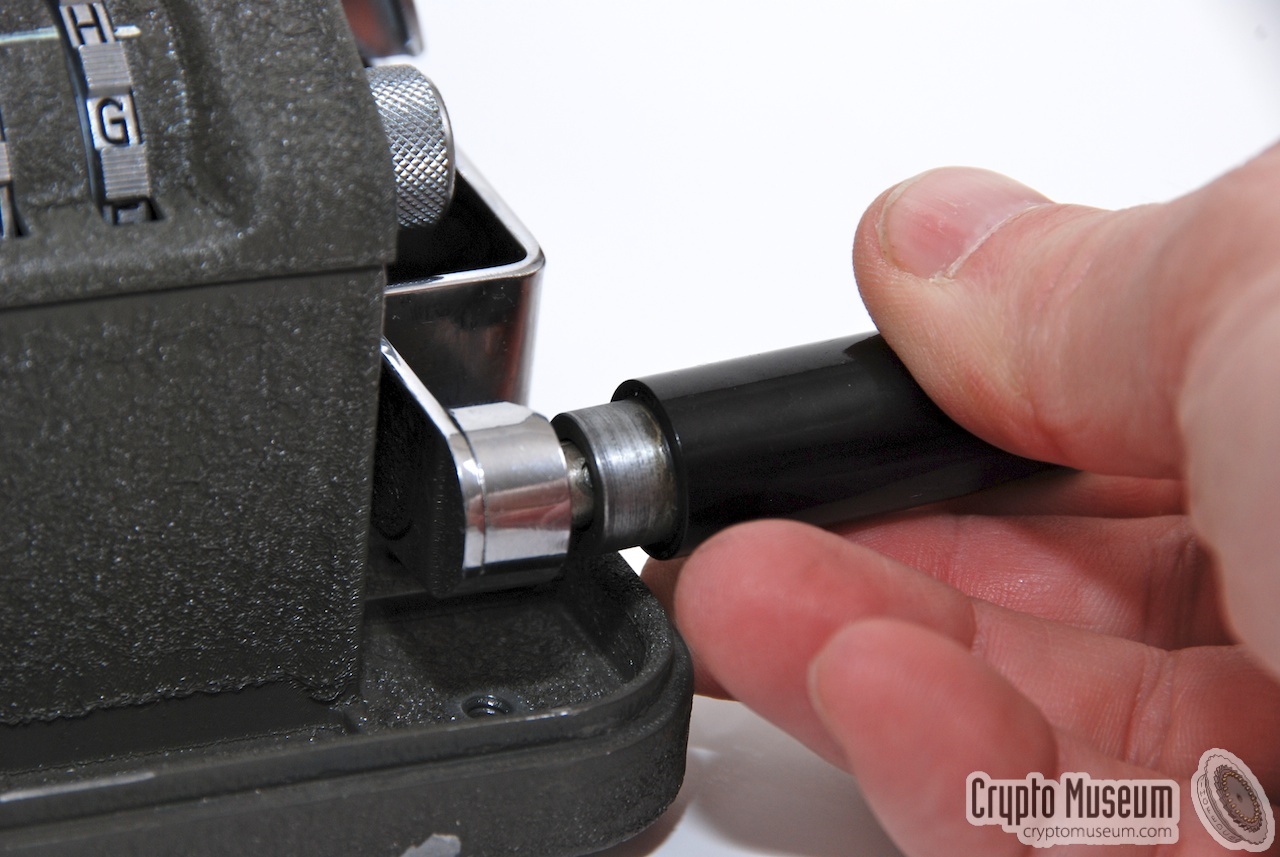
Before the case of a Hagelin machine can be closed again,
the handle at the right first has to be pushed down completely.
If you are not familiar with Hagelin machines, you may have trouble
pushing down the lever to its home position,
which sometimes leads to broken handles.
|
Whatever you do, never use excessive force!
Although Hagelin machines are very robust and tough, axles can be broken
easily when enough force is applied. Once broken, these machines are
extremely difficult to repair.
If the lever won't come down, it's probably because the mechanism is blocked.
The most common reason for this is the fact that it always blocks
after (de)coding a letter. All you should do at this stage is selected another
input letter by rotating the letter knob at the left.
Now you should be able to bring the handle down.
|
|
|
|
Depending on the model, a Hagelin machine takes one or two paper reels.
In the example below, we are showing how to load paper into a Hagelin C-446
machine. Please note that there are two different types of paper:
standard paper tape, and pre-gummed paper tape.
The paper is 9.65 mm wide and the hole at the centre of a reel is
±11 mm. A full roll is about 10 cm wide.
|
Please be careful with pre-gummed paper. Over the years, this paper is
likely to have become brittle and will easily break. Furthermore,
gummed paper has the tendency to attract moist, making it sticky and
potentially block the machine. Removing sticking tape is difficult.
Place the rolls in the lid of the machine and load them one at a time.
Lock the roll with the metal bracket that 'snaps' into position.
Then feed the paper over the first guide,
through the second guide,
into the printer.
Feeding it into the printer may be a bit tricky
(use the tweezers for this).
|
|
|
Make sure the paper tape curls up
a little before it is entered
through one of two slots at the rear of the printer mechanism,
so that it can be fed through the printer easily.
This is best done with the tweezers that are usually stored inside
the top lid of the machine (see above under tools.
|
The paper used in the C-446 is the same as used in the
M-209. It is very difficult to find suitable paper
reels these days, and in many cases the pre-gummed tape has either become
'pudding' or brittle.
If you have any surplus rolls left, please contact us.
|
The document below describes the Hagelin M-209 and the C-446A in great
detail. Not only is the working principle of the machines explained,
it also discusses the machine's cryptanalysis and methods for its attack.
The document is in Dutch and was released for publication
by the Dutch School for Military Intelligence (DIVI) in 2011 [D].
➤ Download cryptanalysis of C-446A and M-209 (Dutch)
|
|
Apart from manufacturing improvements, the following machines
are functionally identical:
|
-
Reproduced here by kind permission of DIVI, May 2010.
-
Document kindly provided by Bart Wessel.
|
|
|
|
Any links shown in red are currently unavailable.
If you like the information on this website, why not make a donation?
© Crypto Museum. Created: Thursday 06 August 2009. Last changed: Tuesday, 18 August 2026 - 08:55 CET.
|
 |

|
|
|